



IRAK-1 Antibody (YA335)
(Synonyms: IRAK, IRAK1, Interleukin-1 receptor-associated kinase 1, IRAK-1)
Based on 1 Customer Validation
IRAK-1 Antibody (YA335) is a Rabbit-derived and non-conjugated IgG monoclonal antibody, targeting to IRAK-1.
-
Host:
Rabbit
-
Isotype:
IgG
-
Application:
WB, IHC-P
-
Reactivity :
Human, Mouse
-
Formulation:
Supplied in 1*TBS (pH7.4), 0.05% BSA and 40% Glycerol. Preservative: 0.05% Sodium Azide.
-
Conjugation:
Non-conjugated


To place orders, for customer services and technical support, please contact: MedChemExpress USA
Tel: 609-228-6898 E-mail: [email protected] [email protected]





Applications
| Application |
WB

WB: Western Blot
|
IHC-P
IHC-P: Immunohistochemistry-Paraffin
|
|---|---|---|
| Dilution Ratio | 1:500-1:2000 | 1:100-1:200 |


Product Details
IRAK-1 Antibody (YA335) is a Rabbit-derived and non-conjugated IgG monoclonal antibody, targeting to IRAK-1.
-
Host Rabbit

-
Clonality Recombinant,Monoclonal

-
Species ReactivityHuman, Mouse
-
Observed Molecular WeightObserved band size: 75/77 kDa
Note: Due to possible protein modifications or aggregation, the molecular weight should be confirmed by actual measurement, and the predicted value is for reference only.

-
Calculated Molecular Weight Predicted band size: 77 kDa

Synthetic peptide corresponding to Human IRAK-1.AA range:201-500.
Endogenous
Protein A affinity purified.
Non-conjugated
Unmodified
IgG


Product Properties
-
Appearance
Solution
-
Formulation
Supplied in 1*TBS (pH7.4), 0.05% BSA and 40% Glycerol. Preservative: 0.05% Sodium Azide.
-
Concentration
Batch-dependent, Please check the COA for the concentration of each lot. Check Lot Concentration
-
Storage & Stability
Stored at -20°C for 1 year. Avoid repeated freeze / thaw cycles.
-
Shipping
Shipping with blue ice.


Verification Images
-
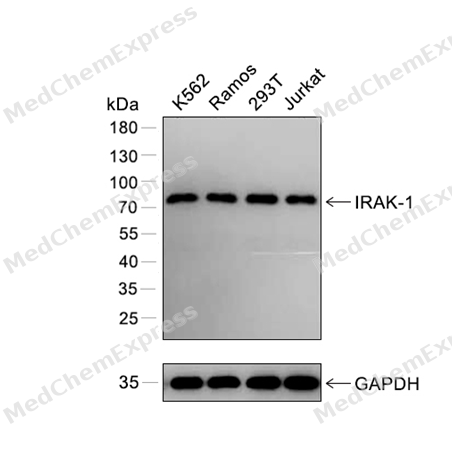 Western blot analysis of extracts from K562 (lane 1) and Ramos (lane 2) and 293T (lane 3) and Jurkat (lane 4) using IRAK-1 antibody. Proteins were transferred to a PVDF membrane and blocked with 5% nonfat powdered milk in PBST for 2 hour at room temperature. The primary antibody (1/1000) and loading control antibody (GAPDH, 1/3000) was diluted with 5% nonfat powdered milk in PBST at 4°C overnight. Goat Anti-Rabbit IgG-HRP Secondary Antibody (1/8,000) was incubated for 45min at room temperature.


Background
-
Function
Interleukin-1 receptor-associated kinase 1 (IRAK1) is a serine-threonine kinase that mediates signaling downstream of Toll-like receptors (TLRs) and interleukin-1 receptor (IL-1R) complexes, promoting innate immune and inflammatory responses[1][2]. Mechanistically, IRAK1 interacts with the adaptor protein MyD88 and is recruited to the myddosome, where it undergoes phosphorylation and contributes to the activation of NF-κB and MAPK pathways[2][3]. Compared with its paralog IRAK4, IRAK1 exhibits distinct roles in hematologic malignancies, being preferentially expressed and required for maintaining viability and progenitor function in myelodysplastic syndrome (MDS) and acute myeloid leukemia (AML) [4][5]. IRAK1 also regulates cancer stemness and chemoresistance in hepatocellular carcinoma through the IRAK1/IRAK4/AP-1/AKR1B10 signaling cascade, influencing self-renewal and tumorigenicity[6]. Alternative splicing generates the IRAK1b isoform, which is kinase-inactive but stable, adding regulatory complexity to IL-1 signaling[7]. Pharmacologically, selective IRAK1 inhibitors, including dual IRAK1/4 compounds and covalent degraders, effectively suppress inflammatory responses, enhance chemotherapy sensitivity, and reduce leukemic or tumor-initiating cell function in preclinical models[8][9][10][5][11][12]. These findings underscore the importance of IRAK1 in innate immunity, oncogenesis, and as a target for therapeutic intervention, while differentiating its function and regulation from other IRAK family members[13][4][5].
-
Subcellular Localization
Cytoplasm; Nucleus; Lipid droplet
-
Expression
Tissue_specificity:In all tissues tested, both isomer 1 and isomer 2 were widely expressed, with isomer 1 being expressed at a higher intensity than isomer 2. -
Subunit
Forms a complex with TRAF6, PELI1, IRAK4 and MYD88 (PubMed:16951688). Direct binding of SMAD6 to PELI1 prevents complex formation and hence negatively regulates IL1R-TLR signaling and eventually NF-kappa-B-mediated gene expression (PubMed:16951688).
-
SwissProt ID
-
Synonyms
IRAK, IRAK1, Interleukin-1 receptor-associated kinase 1, IRAK-1
-
Research Field
Immunology


Documentation
-
Data Sheet (264 KB)
-
SDS (251 KB)
- English - EN (251 KB)
- Français - FR (251 KB)
- Deutsch - DE (251 KB)
- Norwegian - NO (251 KB)
- Español - ES (251 KB)
- Swedish - SV (251 KB)
- Italian - IT (251 KB)
- Korean - KR (251 KB)
- Portuguese - PT (251 KB)
-
User Guide for Antibodies (1077 KB)
References
[1]. Singer JW, et al. Inhibition of interleukin-1 receptor-associated kinase 1 (IRAK1) as a therapeutic strategy. Oncotarget. 2018 Sep 7;9(70):33416-33439. [Content Brief]
[2]. Ordureau A, et al. The IRAK-catalysed activation of the E3 ligase function of Pellino isoforms induces the Lys63-linked polyubiquitination of IRAK1. Biochem J. 2008 Jan 1;409(1):43-52. [Content Brief]
[3]. Hou Y, et al. IRAK Inhibitor Protects the Intestinal Tract of Necrotizing Enterocolitis by Inhibiting the Toll-Like Receptor (TLR) Inflammatory Signaling Pathway in Rats. Med Sci Monit. 2018 May 22;24:3366-3373. [Content Brief]
[4]. Hermans A, et al. A 3D-Printed and Freely Available Device to Measure the Zebrafish Optokinetic Response Before and After Injury. Zebrafish. 2024 Apr;21(2):144-148. [Content Brief]
[5]. Gosu V, et al. Molecular evolution and structural features of IRAK family members. PLoS One. 2012;7(11):e49771. [Content Brief]
[6]. Rhyasen GW, et al. Differential IRAK signaling in hematologic malignancies. Exp Hematol. 2013 Dec;41(12):1005-7. [Content Brief]
[7]. Cheng BY, et al. IRAK1 Augments Cancer Stemness and Drug Resistance via the AP-1/AKR1B10 Signaling Cascade in Hepatocellular Carcinoma. Cancer Res. 2018 May 1;78(9):2332-2342. [Content Brief]
[8]. Jensen LE, et al. IRAK1b, a novel alternative splice variant of interleukin-1 receptor-associated kinase (IRAK), mediates interleukin-1 signaling and has prolonged stability. J Biol Chem. 2001 Aug 3;276(31):29037-44. [Content Brief]
[9]. Kim KM, et al. Recent Advances in IRAK1: Pharmacological and Therapeutic Aspects. Molecules. 2024 May 9;29(10):2226. [Content Brief]
[10]. Sutter PJ, et al. Optimization of IRAK1/4/pan-FLT3 kinase inhibitors as treatments for acute myeloid leukemia. Bioorg Med Chem Lett. 2025 Dec 15;129:130355. [Content Brief]
[11]. Bennett J, et al. Paralog-specific signaling by IRAK1/4 maintains MyD88-independent functions in MDS/AML. Blood. 2023 Sep 14;142(11):989-1007. [Content Brief]
[12]. Yan B, et al. Inhibition of IRAK 1/4 alleviates colitis by inhibiting TLR4/ NF-κB pathway and protecting the intestinal barrier. Bosn J Basic Med Sci. 2022 Oct 23;22(6):872-881. [Content Brief]

 Powered by Bioz
