



Midkine Antibody (YA1582)
(Synonyms: MDK; FLJ27379; MK1; NEGF2; Midkine; NEGF2; ARAP)
Based on 1 Customer Validation
Midkine Antibody (YA1582) is a Rabbit-derived and non-conjugated IgG monoclonal antibody, targeting to Midkine.
-
Host:
Rabbit
-
Isotype:
IgG
-
Application:
WB, IP
-
Reactivity :
Human
-
Formulation:
Supplied in 50mM Tris-Glycine(pH 7.4), 0.15M NaCl, 40% Glycerol, 0.01% Sodium azide and 0.05% BSA
-
Conjugation:
Non-conjugated


To place orders, for customer services and technical support, please contact: MedChemExpress USA
Tel: 609-228-6898 E-mail: [email protected] [email protected]





Applications
| Application |
WB

WB: Western Blot
|
IP
IP: Immunoprecipitation
|
|---|---|---|
| Dilution Ratio | 1:500-1:1000 | 1:20 |


Product Details
Midkine Antibody (YA1582) is a Rabbit-derived and non-conjugated IgG monoclonal antibody, targeting to Midkine.
-
Host Rabbit

-
Clonality Recombinant,Monoclonal

-
Species ReactivityHuman
-
Observed Molecular WeightObserved band size: 16 kDa
Note: Due to possible protein modifications or aggregation, the molecular weight should be confirmed by actual measurement, and the predicted value is for reference only.

-
Calculated Molecular Weight Predicted band size: 16 kDa

A synthetic peptide of human Midkine
Endogenous
Affinity Purified
Non-conjugated
Unmodified
IgG


Product Properties
-
Appearance
Liquid
-
Formulation
Supplied in 50mM Tris-Glycine(pH 7.4), 0.15M NaCl, 40% Glycerol, 0.01% Sodium azide and 0.05% BSA
-
Concentration
Batch-dependent, Please check the COA for the concentration of each lot. Check Lot Concentration
-
Storage & Stability
Stored at -20°C for 1 year. Avoid repeated freeze / thaw cycles.
-
Shipping
Shipping with blue ice.


Verification Images
-
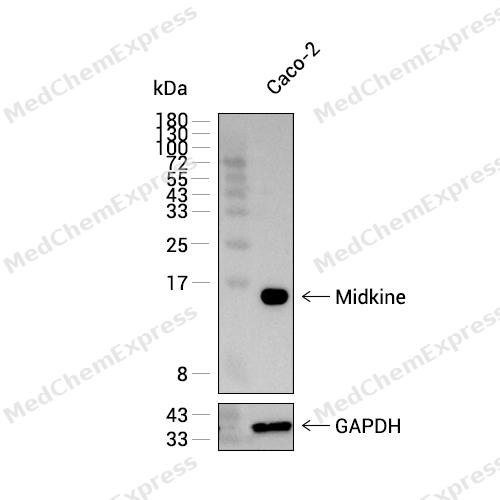 Western blot analysis was performed on extracts from Caco-2 (lane 1, 20 μg) using Midkine Rabbit mAb.Proteins were transferred to a PVDF membrane and blocked with 5% non - fat milk in TBST at 4°C overnight.The primary antibody (1:1000 dilution) and the loading control antibody (GAPDH, HY-P2804, 1:5000 dilution) were incubated in 5% non-fat milk in TBST for 1 hour at 37°C.Goat Anti - Rabbit IgG - HRP Secondary Antibody (1:20000 dilution) was then applied for 40 minutes at 37°C.


Background
-
Function
Midkine secreted protein that functions as a cytokine and growth factor and mediates its signal through cell-surface proteoglycan and non-proteoglycan receptors. Binds cell-surface proteoglycan receptors via their chondroitin sulfate (CS) groups. Thereby regulates many processes like inflammatory response, cell proliferation, cell adhesion, cell growth, cell survival, tissue regeneration, cell differentiation and cell migration. Participates in inflammatory processes by exerting two different activities. Firstly, mediates neutrophils and macrophages recruitment to the sites of inflammation both by direct action by cooperating namely with ITGB2 via LRP1 and by inducing chemokine expression. This inflammation can be accompanied by epithelial cell survival and smooth muscle cell migration after renal and vessel damage, respectively. Secondly, suppresses the development of tolerogenic dendric cells thereby inhibiting the differentiation of regulatory T cells and also promote T cell expansion through NFAT signaling and Th1 cell differentiation. Promotes tissue regeneration after injury or trauma. After heart damage negatively regulates the recruitment of inflammatory cells and mediates cell survival through activation of anti-apoptotic signaling pathways via MAPKs and AKT pathways through the activation of angiogenesis. Also facilitates liver regeneration as well as bone repair by recruiting macrophage at trauma site and by promoting cartilage development by facilitating chondrocyte differentiation. Plays a role in brain by promoting neural precursor cells survival and growth through interaction with heparan sulfate proteoglycans. Binds PTPRZ1 and promotes neuronal migration and embryonic neurons survival. Binds SDC3 or GPC2 and mediates neurite outgrowth and cell adhesion. Binds chondroitin sulfate E and heparin leading to inhibition of neuronal cell adhesion induced by binding with GPC2. Binds CSPG5 and promotes elongation of oligodendroglial precursor-like cells. Also binds ITGA6:ITGB1 complex; this interaction mediates MDK-induced neurite outgrowth. Binds LRP1; promotes neuronal survival. Binds ITGA4:ITGB1 complex; this interaction mediates MDK-induced osteoblast cells migration through PXN phosphorylation. Binds anaplastic lymphoma kinase (ALK) which induces ALK activation and subsequent phosphorylation of the insulin receptor substrate (IRS1), followed by the activation of mitogen-activated protein kinase (MAPK) and PI3-kinase, and the induction of cell proliferation. Promotes epithelial to mesenchymal transition through interaction with NOTCH2. During arteriogenesis, plays a role in vascular endothelial cell proliferation by inducing VEGFA expression and release which in turn induces nitric oxide synthase expression. Moreover activates vasodilation through nitric oxide synthase activation. Negatively regulates bone formation in response to mechanical load by inhibiting Wnt/beta-catenin signaling in osteoblasts. In addition plays a role in hippocampal development, working memory, auditory response, early fetal adrenal gland development and the female reproductive system[1][2][3][4][5][6][7][8][9][10][11].
-
Subcellular Localization
Secreted
-
Expression
Tissue_specificity:Expressed in various tumor cell lines. In insulinoma tissue predominantly expressed in precancerous lesions
Induction:By heparin and retinoic acid -
Isoforms & Post-Translational Modification
P21741 has 2 isomers: P21741-1: 15585 Da (predicted); P21741-2: 9512 Da (predicted).
-
Subunit
Homodimer. Interacts with ALK (PubMed:12122009). Interacts with LRP1; promotes neuronal survival (PubMed:10772929). Interacts with LRP2 (PubMed:10772929). Interacts with NCAM1 (PubMed:10772929). Interacts (via C-terminal) with PTPRZ1 (via chondroitin sulfate chains); this interaction is inhibited by PTN; this interaction promotes neuronal migration (PubMed:10212223). Interacts with NCL; this interaction promotes NCL clustering and lateral movements of this complex into lipid rafts leading to MDK internalization (PubMed:12147681). Interacts with LRP6 and LRP8: this interaction is calcium dependent (PubMed:12573468). Interacts with ITGA4 (PubMed:15466886). Interacts with ITGA6 (PubMed:15466886). Interacts with ITGB1 (PubMed:15466886). Interacts with ITGA4:ITGB1 complex; this interaction mediates MDK-induced osteoblast cells migration through PXN phosphorylation (PubMed:15466886). Interacts with ITGA6:ITGB1 complex; this interaction mediates MDK-induced neurite outgrowth (PubMed:15466886). Interacts with NOTCH2; this interaction mediates a nuclear accumulation of NOTCH2 and therefore activation of NOTCH2 signaling leading to interaction between HES1 and STAT3 (PubMed:18469519). Interacts with GPC2 (via heparan sulfate chain); this interaction is inhibited by heparin followed by chondroitin sulfate E; this interaction induces GPC2 clustering through heparan sulfate chain; this interaction induces neuronal cell adhesion and neurite outgrowth (PubMed:12084985). Interacts with SDC3; this interaction induces SDC3 clustering; this interaction induces neuronal cell adhesion and neurite outgrowth (PubMed:12084985). Interacts with SDC1 (By similarity). Interacts with CSPG5; this interaction promotes elongation of oligodendroglial precursor-like cells (By similarity)
-
SwissProt ID
-
Synonyms
MDK; FLJ27379; MK1; NEGF2; Midkine; NEGF2; ARAP
-
Research Field
Neuroscience


Documentation
-
Data Sheet (232 KB)
-
SDS (251 KB)
- English - EN (251 KB)
- Français - FR (251 KB)
- Deutsch - DE (251 KB)
- Norwegian - NO (251 KB)
- Español - ES (251 KB)
- Swedish - SV (251 KB)
- Italian - IT (251 KB)
- Korean - KR (251 KB)
- Portuguese - PT (251 KB)
-
User Guide for Antibodies (1077 KB)

 Powered by Bioz
