



NDRG2 Antibody (YA3295)
(Synonyms: SYLD)
Based on 1 Customer Validation
NDRG2 Antibody (YA3295) is a Rabbit-derived and non-conjugated IgG monoclonal antibody, targeting to NDRG2.
-
Host:
Rabbit
-
Isotype:
IgG
-
Application:
WB, IHC-F, IHC-P, ICC/IF, IP
-
Reactivity :
Mouse, Rat
-
Formulation:
Supplied in 50mM Tris-Glycine(pH 7.4), 0.15M NaCl, 40% Glycerol, 0.01% Sodium azide and 0.05% BSA
-
Conjugation:
Non-conjugated


To place orders, for customer services and technical support, please contact: MedChemExpress USA
Tel: 609-228-6898 E-mail: [email protected] [email protected]





Applications
| Application |
WB

WB: Western Blot
|
IHC-P
IHC-P: Immunohistochemistry-Paraffin
|
IHC-F
IHC-F: Immunohistochemistry-Frozen
|
ICC/IF
ICC/IF: Immunocytochemistry/
Immunofluorescence |
IP
IP: Immunoprecipitation
|
|---|---|---|---|---|---|
| Dilution Ratio | 1:500-1:1000 | 1:50-1:100 | 1:50-1:100 | 1:50-1:200 | 1:20 |


Product Details
NDRG2 Antibody (YA3295) is a Rabbit-derived and non-conjugated IgG monoclonal antibody, targeting to NDRG2.
-
Host Rabbit

-
Clonality Recombinant, Monoclonal

-
Species ReactivityMouse, Rat
-
Observed Molecular WeightObserved band size: 41 kDa
Note: Due to possible protein modifications or aggregation, the molecular weight should be confirmed by actual measurement, and the predicted value is for reference only.

-
Calculated Molecular Weight Predicted band size: 41 kDa

Entrez Gene: 57447 Human ; 29811 Mouse ; 171114 Rat
SwissProt: Q9UN36 Human ; Q9QYG0 Mouse ; Q8VBU2 Rat
OMIM: 605272 Human
A synthetic peptide of human NDRG2
Endogenous
Affinity Purified
Non-conjugated
Unmodified
IgG


Product Properties
-
Appearance
Liquid
-
Formulation
Supplied in 50mM Tris-Glycine(pH 7.4), 0.15M NaCl, 40% Glycerol, 0.01% Sodium azide and 0.05% BSA
-
Concentration
Batch-dependent, Please check the COA for the concentration of each lot. Check Lot Concentration
-
Storage & Stability
Stored at -20°C for 1 year. Avoid repeated freeze / thaw cycles.
-
Shipping
Shipping with blue ice.


Verification Images
-
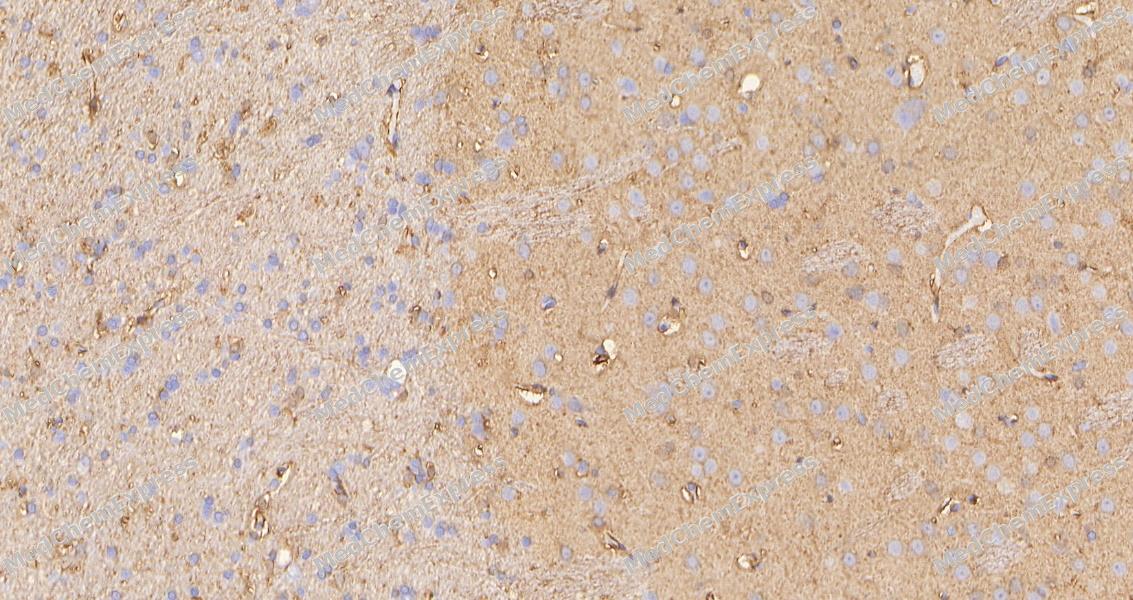 Immunohistochemical analysis of paraffin-embedded rat brain tissue using NDRG2 Antibody. The section was pre-treated using heat mediated antigen retrieval with sodium citrate buffer (pH 6.0) for 8 minutes. The tissues were blocked in QuickBlock for 20 minutes at room temperature, washed with ddH2O and PBS, and then probed with the primary antibody at 1/100 dilution in 4℃ overnight. The detection was performed using an HRP conjugated compact polymer system. DAB was used as the chromogen. Tissues were counterstained with hematoxylin and mounted with DPX.
 -
Immunohistochemical analysis of paraffin-embedded rat brain tissue using NDRG2 Antibody. The section was pre-treated using heat mediated antigen retrieval with sodium citrate buffer (pH 6.0) for 8 minutes. The tissues were blocked in QuickBlock for 20 minutes at room temperature, washed with ddH2O and PBS, and then probed with the primary antibody at 1/100 dilution in 4℃ overnight. The detection was performed using an HRP conjugated compact polymer system. DAB was used as the chromogen. Tissues were counterstained with hematoxylin and mounted with DPX.


Background
-
Function
NDRG2 contributes to the regulation of the Wnt signaling pathway. Down-regulates CTNNB1-mediated transcriptional activation of target genes, such as CCND1, and may thereby act as tumor suppressor. May be involved in dendritic cell and neuron differentiation
-
Subcellular Localization
Cytoplasm; Cytoplasm, perinuclear region; Cell projection, growth cone
-
Expression
Tissue_specificity:Highly expressed in brain, heart, skeletal muscle and salivary gland, and moderately in kidney and liver. Expressed in dendritic cells, but not in other blood cells. Expression levels are low in pancreatic and liver cancer tissues; absent in meningioma. Expressed in low-grade gliomas but present at low levels in glioblastoma. Isoform 1 and isoform 2 are present in brain neurons and up-regulated in Alzheimer disease (at protein level) -
Isoforms & Post-Translational Modification
Q9UN36 has 6 isomers: Q9UN36-1: 40798 Da (predicted); Q9UN36-2: 39289 Da (predicted); Q9UN36-3: 39679 Da (predicted); Q9UN36-4: 36052 Da (predicted); Q9UN36-5: 37497 Da (predicted); Q9UN36-6: 40297 Da (predicted).
-
Subunit
Interacts with CTNNB1
-
SwissProt ID
-
Synonyms
SYLD
-
Research Field
Neuroscience


Documentation
-
Data Sheet (258 KB)
-
SDS (251 KB)
- English - EN (251 KB)
- Français - FR (251 KB)
- Deutsch - DE (251 KB)
- Norwegian - NO (251 KB)
- Español - ES (251 KB)
- Swedish - SV (251 KB)
- Italian - IT (251 KB)
- Korean - KR (251 KB)
- Portuguese - PT (251 KB)
-
User Guide for Antibodies (1077 KB)

 Powered by Bioz
