



NF-KB p105/p50 Antibody (YA700)
(Synonyms: NFKB1; Nuclear factor NF-kappa-B p105 subunit; DNA-binding factor KBF1; EBP-1; Nuclear factor of kappa light polypeptide gene enhancer in B-cells 1)
Based on 1 Customer Validation
NF-KB p105/p50 Antibody (YA700) is a Mouse-derived and non-conjugated IgG1 monoclonal antibody, targeting to NF-KB p105/p50.
-
Host:
Mouse
-
Isotype:
IgG
-
Application:
WB
-
Reactivity :
Human, Mouse, Rat
-
Formulation:
Supplied in 1*PBS (pH 7.3), 50% glycerol and 0.5% BSA. Preservative: 0.02% sodium azide.
-
Conjugation:
Non-conjugated


To place orders, for customer services and technical support, please contact: MedChemExpress USA
Tel: 609-228-6898 E-mail: [email protected] [email protected]





Applications
| Application |
WB

WB: Western Blot
|
|---|---|
| Dilution Ratio | 1:500-1:1000 |


Product Details
NF-KB p105/p50 Antibody (YA700) is a Mouse-derived and non-conjugated IgG1 monoclonal antibody, targeting to NF-KB p105/p50.
-
Host Mouse

-
Clonality Monoclonal

-
Species ReactivityHuman, Mouse, Rat
-
Observed Molecular WeightObserved band size: 50/120 kDa
Note: Due to possible protein modifications or aggregation, the molecular weight should be confirmed by actual measurement, and the predicted value is for reference only.

-
Calculated Molecular Weight Predicted band size: 105 kDa

Entrez Gene: 4790 Human ; 18033 Mouse ; 81736 Rat
SwissProt: P19838 Human ; P25799 Mouse ; Q63369 Rat
OMIM: 616576 Human
Synthetic peptide corresponding to Human NF-κB1 p105/p50.The exact sequence is proprietary to MCE.
Endogenous
affinity purified
Non-conjugated
Unmodified
IgG


Product Properties
-
Appearance
Solution
-
Formulation
Supplied in 1*PBS (pH 7.3), 50% glycerol and 0.5% BSA. Preservative: 0.02% sodium azide.
-
Concentration
Batch-dependent, Please check the COA for the concentration of each lot. Check Lot Concentration
-
Storage & Stability
Stored at -20°C for 1 year. Avoid repeated freeze / thaw cycles.
-
Shipping
Shipping with blue ice.


Verification Images
-
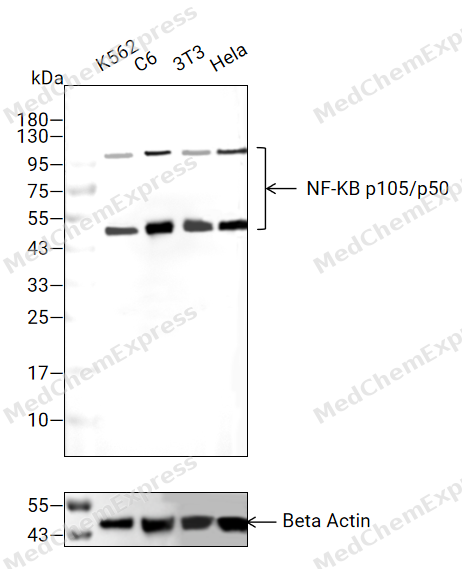 Western blot analysis of extracts from K562 (lane 2(20μg), C6 (lane 3(20μg), 3T3 (lane 4(20μg), Hela (lane 5(20μg), using NF-KB p105/p50 Antibody. Proteins were transferred to a PVDF membrane and blocked with 5% BSA in TBST for 2 hour at room temperature. The primary antibody and Loading control antibody (Beta Actin, HY-P80438, 1/3000) was used in 5% BSA in TBST at 4°C overnight. Goat Anti-Mouse/Rabbit IgG-HRP Secondary Antibody (HY-P8004/HY-P8001, 1/10,000) was used for 1 hour at room temperature.
 -
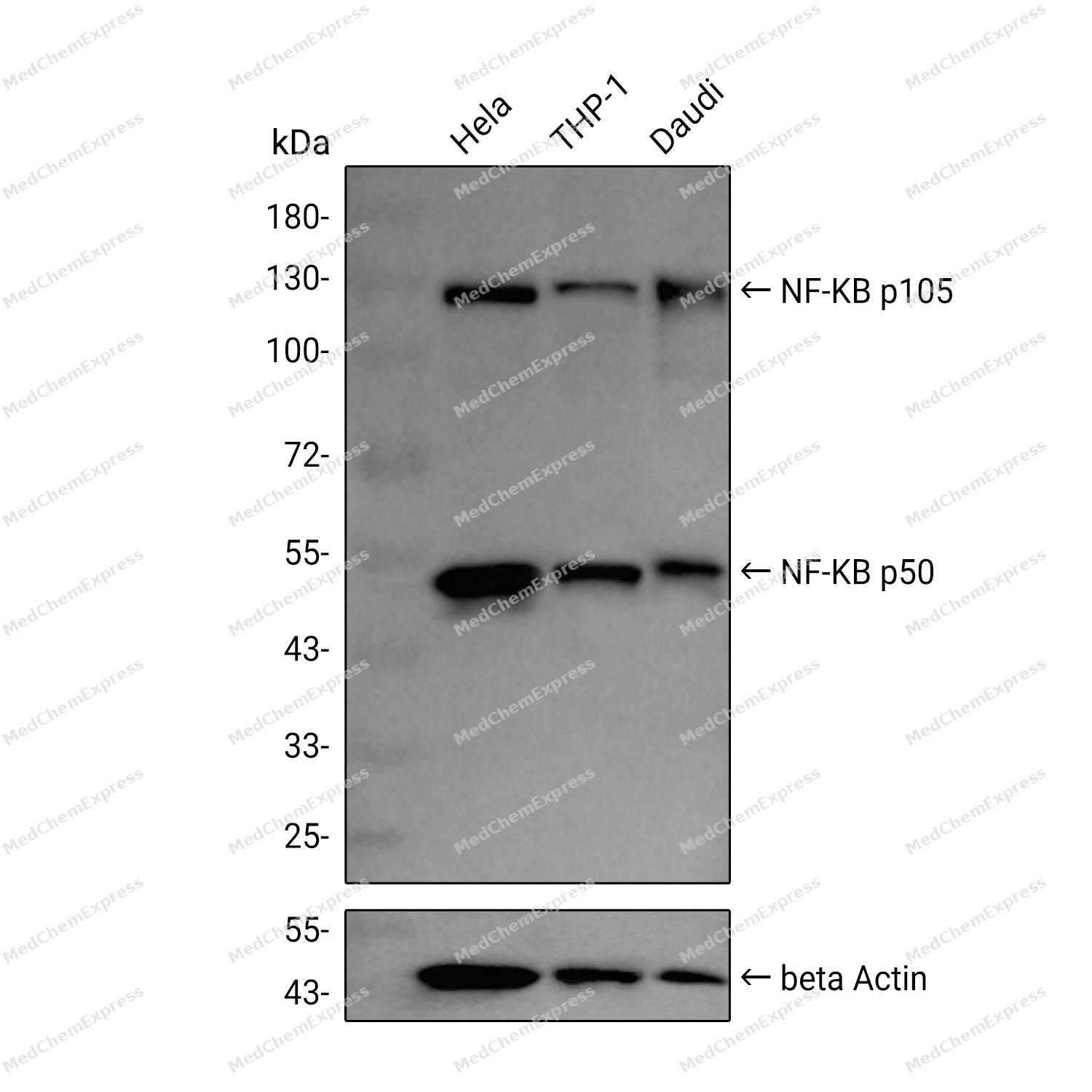 Western blot analysis was performed on extracts from Hela (lane 1, 15 μg), THP-1 (lane 2, 15 μg), and Daudi (lane 3, 15 μg) using NF-KB p105 Mouse mAb. Proteins were transferred to a PVDF membrane and blocked with 5% non - fat milk in TBST at 4°C overnight. The primary antibody (1:1000 dilution) and the loading control antibody (beta-Actin(HRP), HY-P80993, 1:5000 dilution) was incubated in 5% non-fat milk in TBST for 1 hour at 37°C. Goat Anti - Mouse IgG - HRP Secondary Antibody (1:20000 dilution) was then applied for 40 minutes at 37°C.


Background
-
Function
NF-KB p105/p50 is a NF-kappa-B is a pleiotropic transcription factor present in almost all cell types and is the endpoint of a series of signal transduction events that are initiated by a vast array of stimuli related to many biological processes such as inflammation, immunity, differentiation, cell growth, tumorigenesis and apoptosis. NF-kappa-B is a homo- or heterodimeric complex formed by the Rel-like domain-containing proteins RELA/p65, RELB, NFKB1/p105, NFKB1/p50, REL and NFKB2/p52 and the heterodimeric p65-p50 complex appears to be most abundant one. The dimers bind at kappa-B sites in the DNA of their target genes and the individual dimers have distinct preferences for different kappa-B sites that they can bind with distinguishable affinity and specificity. Different dimer combinations act as transcriptional activators or repressors, respectively. NF-kappa-B is controlled by various mechanisms of post-translational modification and subcellular compartmentalization as well as by interactions with other cofactors or corepressors. NF-kappa-B complexes are held in the cytoplasm in an inactive state complexed with members of the NF-kappa-B inhibitor (I-kappa-B) family. In a conventional activation pathway, I-kappa-B is phosphorylated by I-kappa-B kinases (IKKs) in response to different activators, subsequently degraded thus liberating the active NF-kappa-B complex which translocates to the nucleus. NF-kappa-B heterodimeric p65-p50 and RelB-p50 complexes are transcriptional activators. The NF-kappa-B p50-p50 homodimer is a transcriptional repressor, but can act as a transcriptional activator when associated with BCL3. NFKB1 appears to have dual functions such as cytoplasmic retention of attached NF-kappa-B proteins by p105 and generation of p50 by a cotranslational processing. The proteasome-mediated process ensures the production of both p50 and p105 and preserves their independent function, although processing of NFKB1/p105 also appears to occur post-translationally. p50 binds to the kappa-B consensus sequence 5'-GGRNNYYCC-3', located in the enhancer region of genes involved in immune response and acute phase reactions. In a complex with MAP3K8, NFKB1/p105 represses MAP3K8-induced MAPK signaling; active MAP3K8 is released by proteasome-dependent degradation of NFKB1/p105; P105 is the precursor of the active p50 subunit (Nuclear factor NF-kappa-B p50 subunit) of the nuclear factor NF-kappa-B. Acts as a cytoplasmic retention of attached NF-kappa-B proteins by p105; Constitutes the active form, which associates with RELA/p65 to form the NF-kappa-B p65-p50 complex to form a transcription factor. Together with RELA/p65, binds to the kappa-B consensus sequence 5'-GGRNNYYCC-3', located in the enhancer region of genes involved in immune response and acute phase reactions[1][2][3].
-
Subcellular Localization
Cytoplasm; Nucleus; Cytoplasm
-
Expression
Induction:By phorbol ester and TNF -
Isoforms & Post-Translational Modification
P19838 has 3 isomers: P19838-1: 105356 Da (predicted); P19838-2: 105427 Da (predicted); P19838-3: 85520 Da (predicted).
Generation of the NF-kappa-B p50 (Nuclear factor NF-kappa-B p50 subunit) transcription factor takes place both cotranslationally and post-translationally via non-mutually exclusive mechanisms (PubMed:10970863, PubMed:25860612, PubMed:8628291, PubMed:9529257). A cotranslational processing allows the production of both p50 and p105 (Nuclear factor NF-kappa-B p105 subunit) from a single NFKB1 mRNA (PubMed:10970863, PubMed:8628291, PubMed:9529257). While translation occurs, the particular unfolded structure after the GRR repeat region acts as a substrate for the proteasome, promoting degradation of the C-terminus (PubMed:10970863, PubMed:9529257). The GRR acts as a proteasomal 'stop signal', protecting the region upstream of the GRR from degradation and promoting generation of p50 (PubMed:10970863, PubMed:9529257). It is unclear if limited proteasome degradation during cotranslational processing depends on ubiquitination (PubMed:10970863, PubMed:9529257). NF-kappa-B p50 is also generated post-translationally following ubiquitination by the KPC complex, leading to limited processing by the proteasome downstream of the GRR region, thereby generating p50 (PubMed:25860612);Phosphorylation at the C-terminus by IKBKB/IKKB acts as a signal for ubiquitination and promotes either complete degradation or processing to generate the NF-kappa-B p50 (Nuclear factor NF-kappa-B p50 subunit) (PubMed:10835356, PubMed:11158290, PubMed:11297557, PubMed:12482991, PubMed:14673179, PubMed:25860612, PubMed:8626394). Phosphorylation at Ser-903 and Ser-907 primes p105 for proteolytic processing in response to TNF-alpha stimulation (PubMed:12871932). Phosphorylation at Ser-923, Ser-927 and Ser-932 are required for BTRC/BTRCP-mediated ubiquitination and proteolysis (PubMed:10835356, PubMed:11158290, PubMed:11297557, PubMed:12482991, PubMed:14673179). Phosphorylation at Ser-927 is also required for ubiquitination by the KPC complex and limited processing to generate NF-kappa-B p50 (Nuclear factor NF-kappa-B p50 subunit) (PubMed:25860612);Polyubiquitinated at multiple Lys residues in the C-terminus (PubMed:11158290, PubMed:14673179, PubMed:25860612). Polyubiquitinated by the SCF(FBXW11) and SCF(BTRC) complexes following phosphorylation at Ser-923, Ser-927 and Ser-932, leading to its complete degradation (PubMed:11158290). In contrast, polyubiquitination by the KPC complex following phosphorylation at Ser-927 leads to limited proteosomal processing and generation of the active NF-kappa-B p50 (Nuclear factor NF-kappa-B p50 subunit) (PubMed:25860612);S-nitrosylation of Cys-61 affects DNA binding;The covalent modification of cysteine by 15-deoxy-Delta12,14-prostaglandin-J2 is autocatalytic and reversible. It may occur as an alternative to other cysteine modifications, such as S-nitrosylation and S-palmitoylation -
Subunit
Component of the NF-kappa-B p65-p50 complex (PubMed:1740106, PubMed:7830764). Homodimer; component of the NF-kappa-B p50-p50 complex.
-
SwissProt ID
-
Synonyms
NFKB1; Nuclear factor NF-kappa-B p105 subunit; DNA-binding factor KBF1; EBP-1; Nuclear factor of kappa light polypeptide gene enhancer in B-cells 1
-
Research Field
Cell Biology


Documentation
-
Data Sheet (235 KB)
-
SDS (252 KB)
- English - EN (252 KB)
- Français - FR (252 KB)
- Deutsch - DE (252 KB)
- Norwegian - NO (252 KB)
- Español - ES (252 KB)
- Swedish - SV (252 KB)
- Italian - IT (252 KB)
- Korean - KR (252 KB)
- Portuguese - PT (252 KB)
-
User Guide for Antibodies (1077 KB)

 Powered by Bioz
