



NQO1 Antibody (YA697)
(Synonyms: DIA4, NMOR1, NQO1, NAD(P)H dehydrogenase [quinone] 1, Azoreductase, DT-diaphorase, Menadione reductase, NAD(P)H:quinone oxidoreductase 1, Phylloquinone reductase, Quinone reductase 1, DTD, QR1)
Based on 1 Customer Validation
NQO1 Antibody (YA697) is a Mouse-derived and non-conjugated IgG2b monoclonal antibody, targeting to NQO1.
-
Host:
Mouse
-
Isotype:
IgG
-
Application:
WB
-
Reactivity :
Human, Rat
-
Formulation:
Supplied in 1*PBS (pH7.4), 0.2% BSA and 50% Glycerol. Preservative: 0.05% Sodium Azide.
-
Conjugation:
Non-conjugated


To place orders, for customer services and technical support, please contact: MedChemExpress USA
Tel: 609-228-6898 E-mail: [email protected] [email protected]





Applications
| Application |
WB

WB: Western Blot
|
|---|---|
| Dilution Ratio | 1:1000-1:5000 |


Product Details
NQO1 Antibody (YA697) is a Mouse-derived and non-conjugated IgG2b monoclonal antibody, targeting to NQO1.
-
Host Mouse

-
Clonality Monoclonal

-
Species ReactivityHuman, Rat
-
Observed Molecular WeightObserved band size: 31 kDa
Note: Due to possible protein modifications or aggregation, the molecular weight should be confirmed by actual measurement, and the predicted value is for reference only.

-
Calculated Molecular Weight Predicted band size: 31 kDa

Synthetic peptide corresponding to Human NQO1.AA range:1-285.
Endogenous
Immunogen affinity purified.
Non-conjugated
Unmodified
IgG


Product Properties
-
Appearance
Solution
-
Formulation
Supplied in 1*PBS (pH7.4), 0.2% BSA and 50% Glycerol. Preservative: 0.05% Sodium Azide.
-
Concentration
Batch-dependent, Please check the COA for the concentration of each lot. Check Lot Concentration
-
Storage & Stability
Stored at -20°C for 1 year. Avoid repeated freeze / thaw cycles.
-
Shipping
Shipping with blue ice.


Verification Images
-
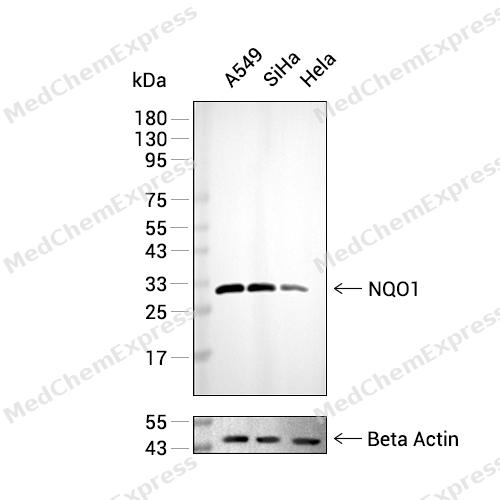 Western blot analysis of extracts from A549 (lane 2(20μg), SiHa (lane 3(20μg), Hela (lane 4(20μg) using NQO1 Antibody (HY-P80250) Mouse mAb. Proteins were transferred to a PVDF membrane and blocked with 5% BSA in TBST for 2 hour at room temperature. The primary antibody (HY-P80250, 1/1000) and Loading control antibody (Beta Actin, HY-P80438, 1/3000) was used in 5% BSA in TBST at 4°C overnight. Goat Anti-Mouse/Rabbit IgG-HRP Secondary Antibody (HY-P8004/HY-P8001, 1/10,000) was used for 1 hour at room temperature.


Background
-
Function
NQO1 (NAD (P) H:quinone oxidoreductase 1) is a cytosolic flavoprotein that catalyzes the obligate two-electron reduction of endogenous and exogenous quinones to hydroquinones, thereby limiting semiquinone formation, redox cycling, and reactive oxygen species generation[1][2]. Through this catalytic activity, NQO1 functions as a major cellular defense enzyme that supports redox homeostasis and protects cells from oxidative and electrophilic stress[1][3]. Mechanistically, NQO1 is a prominent downstream target of the Keap1-Nrf2-ARE signaling pathway, and its transcription is strongly induced during oxidative stress and xenobiotic exposure, linking environmental stress responses to cytoprotective gene expression programs[3][4]. In disease contexts, NQO1 is frequently overexpressed in multiple solid tumors, including lung, breast, liver, colon, and pancreatic cancers, where elevated expression is associated with adaptation to oxidative stress and altered responses to therapeutic agents[3][5][6]. Compared with the related isoform NQO2, NQO1 is the predominant stress-inducible quinone reductase and utilizes NADH or NADPH as reducing cofactors, whereas NQO2 exhibits distinct cofactor preferences and biological regulation, supporting nonredundant cellular functions[7][6]. For experimental applications, NQO1 is widely used as a model enzyme for investigating redox regulation, quinone metabolism, and cytoprotective signaling pathways, while the inhibitor dicoumarol remains a commonly employed pharmacological tool for probing NQO1-dependent biological mechanisms[2][6].
-
Subcellular Localization
Cytoplasm, cytosol
-
Expression
Induction:By dioxin (PubMed:1657151) . By oxidative stress (PubMed:21636573) -
Subunit
Homodimer (PubMed:10543876, PubMed:10706635, PubMed:11587640, PubMed:11735396, PubMed:16700548, PubMed:28291250). Interacts with PDLIM4 isoform 2; this interaction stabilizes PDLIM4 isoform 2 in response to oxidative stress and protects it from ubiquitin-independent degradation by the core 20S proteasome (PubMed:21636573). Interacts with TP73 (via SAM domain); this interaction is NADH-dependent, stabilizes TP73 in response to oxidative stress and protects it from ubiquitin-independent degradation by the 20S proteasome (PubMed:15687255, PubMed:28291250). Interacts with TP53; this interaction is NADH-dependent, stabilizes TP53 in response to oxidative stress and protects it from ubiquitin-independent degradation by the 20S proteasome (PubMed:15687255)
-
SwissProt ID
-
Synonyms
DIA4, NMOR1, NQO1, NAD(P)H dehydrogenase [quinone] 1, Azoreductase, DT-diaphorase, Menadione reductase, NAD(P)H:quinone oxidoreductase 1, Phylloquinone reductase, Quinone reductase 1, DTD, QR1
-
Research Field
Signal Transduction


Documentation
-
Data Sheet (262 KB)
-
SDS (252 KB)
- English - EN (252 KB)
- Français - FR (252 KB)
- Deutsch - DE (252 KB)
- Norwegian - NO (252 KB)
- Español - ES (252 KB)
- Swedish - SV (252 KB)
- Italian - IT (252 KB)
- Korean - KR (252 KB)
- Portuguese - PT (252 KB)
-
User Guide for Antibodies (1077 KB)
References
[1]. Dinkova-Kostova AT, et al. NAD(P)H:quinone acceptor oxidoreductase 1 (NQO1), a multifunctional antioxidant enzyme and exceptionally versatile cytoprotector. Arch Biochem Biophys. 2010 Sep 1;501(1):116-23. [Content Brief]
[2]. Bianchet MA, et al. Structure and mechanism of NAD[P]H:quinone acceptor oxidoreductases (NQO). Methods Enzymol. 2004;382:144-74. [Content Brief]
[3]. Lee WS, et al. Roles of NAD(P)H:quinone Oxidoreductase 1 in Diverse Diseases. Life (Basel). 2021 Nov 26;11(12):1301. [Content Brief]
[4]. Ross D, et al. Functions of NQO1 in Cellular Protection and CoQ10 Metabolism and its Potential Role as a Redox Sensitive Molecular Switch. Front Physiol. 2017 Aug 24;8:595. [Content Brief]
[5]. Yang Y, et al. Clinical implications of high NQO1 expression in breast cancers. J Exp Clin Cancer Res. 2014 Feb 5;33(1):14. [Content Brief]
[6]. Pey AL, et al. NAD(P)H quinone oxidoreductase (NQO1): an enzyme which needs just enough mobility, in just the right places. Biosci Rep. 2019 Jan 3;39(1):BSR20180459. [Content Brief]
[7]. Jaiswal AK, et al. Localization of human NQO1 gene to chromosome 16q22 and NQO2-6p25 and associated polymorphisms. Pharmacogenetics. 1999 Jun;9(3):413-8. [Content Brief]

 Powered by Bioz
