



P Glycoprotein Antibody (YA255)
(Synonyms: p-pg; PGP; ABCB1; MDR1; PGY1; Multidrug resistance protein 1; ATP-binding cassette sub-family B member 1; P-glycoprotein 1; CD antigen CD243)Based on 2 publication(s) in Google Scholar
P Glycoprotein Antibody (YA255) is a Rabbit-derived and non-conjugated IgG monoclonal antibody, targeting to P Glycoprotein.
-
Host:
Rabbit
-
Isotype:
IgG
-
Application:
WB, IHC-P
-
Reactivity :
Human
-
Formulation:
Supplied in 50 mM Tris-Glycine (pH 7.4), 0.15 M NaCl, 40% Glycerol and 0.05% BSA. Preservative: 0.01% Sodium azide
-
Conjugation:
Non-conjugated


To place orders, for customer services and technical support, please contact: MedChemExpress USA
Tel: 609-228-6898 E-mail: [email protected] [email protected]



Publications Citing Use of MedChemExpress (MCE) P Glycoprotein Antibody (YA255)
More

Applications
| Application |
WB

WB: Western Blot
|
IHC-P
IHC-P: Immunohistochemistry-Paraffin
|
|---|---|---|
| Dilution Ratio | 1:1000-1:50000 | 1:100-1:1200 |


Product Details
P Glycoprotein Antibody (YA255) is a Rabbit-derived and non-conjugated IgG monoclonal antibody, targeting to P Glycoprotein.
-
Host Rabbit

-
Clonality Recombinant,Monoclonal

-
Species ReactivityHuman
-
Observed Molecular WeightObserved band size: 130-180 kDa
Note: Due to possible protein modifications or aggregation, the molecular weight should be confirmed by actual measurement, and the predicted value is for reference only.

-
Calculated Molecular Weight Predicted band size: 141 kDa

Synthetic peptide corresponding to Human P Glycoprotein.The exact sequence is proprietary to MCE.
Endogenous
affinity purified
Non-conjugated
Unmodified
IgG


Product Properties
-
Appearance
Solution
-
Formulation
Supplied in 50 mM Tris-Glycine (pH 7.4), 0.15 M NaCl, 40% Glycerol and 0.05% BSA. Preservative: 0.01% Sodium azide
-
Concentration
Batch-dependent, Please check the COA for the concentration of each lot. Check Lot Concentration
-
Storage & Stability
Stored at -20°C for 1 year. Avoid repeated freeze / thaw cycles.
-
Shipping
Shipping with blue ice.


Publications (2)
-
Journal Impact Factor
-
Most Recent
-
Drug Resist Updat
CEA-induced PI3K/AKT pathway activation through the binding of CEA to KRT1 contributes to oxaliplatin resistance in gastric cancer. [Abstract]2025 Jan:78:101179. PMID: 39644827 -
Int J Mol Sci
Study on the Chemical Composition and Multidrug Resistance Reversal Activity of Euphorbia uralensis (Euphorbiaceae). [Abstract]2025 Jan 6;26(1):412. PMID: 39796265


Verification Images
-
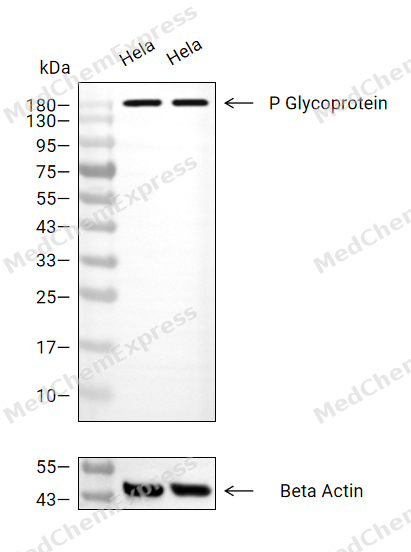 Western blot analysis of extracts from Hela (lane 2(20μg), Hela (lane 3(40μg), using P Glycoprotein Antibody. Proteins were transferred to a PVDF membrane and blocked with 5% BSA in TBST for 2 hour at room temperature. The primary antibody and Loading control antibody (Beta Actin, HY-P80438, 1/3000) was used in 5% BSA in TBST at 4°C overnight. Goat Anti-Mouse/Rabbit IgG-HRP Secondary Antibody (HY-P8004/HY-P8001, 1/10,000) was used for 1 hour at room temperature.


Background
-
Function
P-glycoprotein (P-gp) also known as multidrug resistance protein 1 (MDR1) is an important protein of the cell membrane that pumps many foreign substances out of cells. More formally, it is an ATP-dependent efflux pump with broad substrate specificity. P-gp is extensively distributed and expressed in the intestinal epithelium where it pumps xenobiotics (such as toxins or drugs) back into the intestinal lumen, in liver cells where it pumps them into bile ducts, in the cells of the proximal tubular of the kidney where it pumps them into urine-conducting ducts, and in the capillary endothelial cells comprising the blood–brain barrier and blood-testis barrier, where it pumps them back into the capillaries. Some cancer cells also express large amounts of P-gp, which renders these cancers multi-drug resistant. P-gp is an ATP-dependent drug efflux pump for xenobiotic compounds with broad substrate specificity. It is responsible for decreased drug accumulation in multidrug-resistant cells and often mediates the development of resistance to anticancer drugs. This protein also functions as a transporter in the blood–brain barrier.
-
Subcellular Localization
Cell membrane; Multi-pass membrane protein; Apical cell membrane; Cytoplasm
-
Expression
Tissue_specificity:It is expressed in the small intestine (PubMed: 28408210) . It is also expressed in the liver, kidneys, and brain. -
Isoforms & Post-Translational Modification
P08183 has 2 isomers: P08183-1: 141479 Da (predicted); P08183-2: 134032 Da (predicted).
-
Subunit
Interacts with PSMB5. Finds in a complex with ABCB1, TFPI2 and PPP2R3C; leading to the dephosphorylation of ABCB1
-
SwissProt ID
-
Synonyms
p-pg; PGP; ABCB1; MDR1; PGY1; Multidrug resistance protein 1; ATP-binding cassette sub-family B member 1; P-glycoprotein 1; CD antigen CD243
-
Research Field
Signal Transduction
Documentation
-
Data Sheet (235 KB)
-
SDS (252 KB)
- English - EN (252 KB)
- Français - FR (252 KB)
- Deutsch - DE (252 KB)
- Norwegian - NO (252 KB)
- Español - ES (252 KB)
- Swedish - SV (252 KB)
- Italian - IT (252 KB)
- Korean - KR (252 KB)
- Portuguese - PT (252 KB)
-
User Guide for Antibodies (1077 KB)

 Powered by Bioz
