



PCSK9 Antibody (YA1550)
(Synonyms: HCHOLA3; LDLCQ1; NARC1; Neural apoptosis regulated convertase 1; PC9; PCSK9; Proprotein convertase 9)Based on 1 Customer Validation
PCSK9 Antibody (YA1550) is a Rabbit-derived and non-conjugated IgG monoclonal antibody, targeting to PCSK9.
-
Host:
Rabbit
-
Isotype:
IgG
-
Application:
WB, IP
-
Reactivity :
Human
-
Formulation:
Supplied in 50mM Tris-Glycine(pH 7.4), 0.15M NaCl, 40% Glycerol, 0.01% Sodium azide and 0.05% BSA
-
Conjugation:
Non-conjugated


To place orders, for customer services and technical support, please contact: MedChemExpress USA
Tel: 609-228-6898 E-mail: [email protected] [email protected]





Applications
| Application |
WB

WB: Western Blot
|
IP
IP: Immunoprecipitation
|
|---|---|---|
| Dilution Ratio | 1:500-1:1000 | 1:20 |


Product Details
PCSK9 Antibody (YA1550) is a Rabbit-derived and non-conjugated IgG monoclonal antibody, targeting to PCSK9.
-
Host Rabbit

-
Clonality Recombinant,Monoclonal

-
Species ReactivityHuman
-
Observed Molecular WeightObserved band size: 65,80 kDa
Note: Due to possible protein modifications or aggregation, the molecular weight should be confirmed by actual measurement, and the predicted value is for reference only.

-
Calculated Molecular Weight Predicted band size: 74 kDa

A synthetic peptide of human PCSK9 aa565-578.
Endogenous
Affinity Purified
Non-conjugated
Unmodified
IgG


Product Properties
-
Appearance
Solution
-
Formulation
Supplied in 50mM Tris-Glycine(pH 7.4), 0.15M NaCl, 40% Glycerol, 0.01% Sodium azide and 0.05% BSA
-
Concentration
Batch-dependent, Please check the COA for the concentration of each lot. Check Lot Concentration
-
Storage & Stability
Stored at -20°C for 1 year. Avoid repeated freeze / thaw cycles.
-
Shipping
Shipping with blue ice.


Verification Images
-
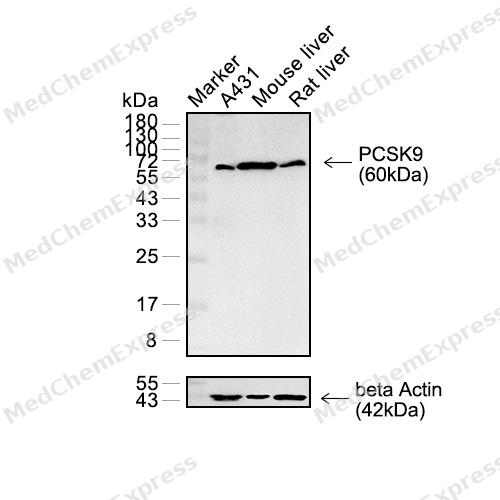 Western blot analysis of extracts from A431 (lane 2(20μg)), Mouse liver (lane 3(20μg)) and Rat liver (lane 4(20μg)) using PCSK9 Rabbit mAb. Proteins were transferred to a PVDF membrane and blocked with 5% non-fat milk in TBST for 2 hour at room temperature. The primary antibody (1/1000) and Loading control antibody (beta Actin, HY-P83730, 1/5000) was used in 5% non-fat milk in TBST at 4°C overnight. Goat Anti-Rabbit/Mouse IgG-HRP Secondary Antibody (1/10000) was used for 1 hour at room temperature.


Background
-
Function
The protein convertase subtilisin/kexin type 9 (PCSK9) is an enzyme encoded by the PCSK9 gene located on human chromosome 1. It is the ninth member of the protein convertase family, a group of enzymes that can activate homologous genes found in many species[1]. PCSK9 is a liver-synthesized protease that plays a major role in regulating the levels of low-density lipoprotein receptors (LDLR) on the surface of liver cells and can inhibit the LDLR recycling pathway. PCSK9 binds to LDLR on the surface of liver cells, escorts LDLR to lysosomes for degradation, and prevents LDLR from recirculating to the cell membrane, effectively increasing the level of circulating LDL. Therefore, inhibiting the activity of the PCSK9 protease can down-regulate circulating LDL levels. PCSK9 is closely associated with various cardiovascular diseases, especially hypercholesterolemia and atherosclerosis[2].
-
Subcellular Localization
Cytoplasm; Secreted; Endosome; Lysosome; Cell surface; Endoplasmic reticulum; Golgi apparatus
-
Expression
Tissue_specificity:It is expressed in neuroepithelial tumors, colon cancers, hepatocytes, pancreatic cell lines, and Schwann cells. -
Isoforms & Post-Translational Modification
Q8NBP7 has 2 isomers: Q8NBP7-1: 74286 Da (predicted); Q8NBP7-2: 20827 Da (predicted).
Cleavage by furin and PCSK5 generates a truncated inactive protein that is unable to induce LDLR degradation;Undergoes autocatalytic cleavage in the endoplasmic reticulum to release the propeptide from the N-terminus and the cleavage of the propeptide is strictly required for its maturation and activation. The cleaved propeptide however remains associated with the catalytic domain through non-covalent interactions, preventing potential substrates from accessing its active site. As a result, it is secreted from cells as a propeptide-containing, enzymatically inactive protein;Phosphorylation protects the propeptide against proteolysis -
Subunit
Monomer. Can self-associate to form dimers and higher multimers which may have increased LDLR degrading activity. The precursor protein but not the mature protein may form multimers. Interacts with APOB, VLDLR, LRP8/APOER2 and BACE1. The full-length immature form (pro-PCSK9) interacts with SCNN1A, SCNN1B and SCNN1G. The pro-PCSK9 form (via C-terminal domain) interacts with LDLR. Interacts (via the C-terminal domain) with ANXA2 (via repeat Annexin 1); the interaction inhibits the degradation of LDLR (PubMed:18799458)
-
SwissProt ID
-
Synonyms
HCHOLA3; LDLCQ1; NARC1; Neural apoptosis regulated convertase 1; PC9; PCSK9; Proprotein convertase 9
-
Research Field
Signal Transduction


Documentation
-
Data Sheet (260 KB)
-
SDS (252 KB)
- English - EN (252 KB)
- Français - FR (252 KB)
- Deutsch - DE (252 KB)
- Norwegian - NO (252 KB)
- Español - ES (252 KB)
- Swedish - SV (252 KB)
- Italian - IT (252 KB)
- Korean - KR (252 KB)
- Portuguese - PT (252 KB)
-
User Guide for Antibodies (1077 KB)
References

 Powered by Bioz
