



PGC1 alpha+beta Antibody (YA3458)
(Synonyms: LEM6 antibody; Ligand effect modulator 6 antibody; PERC antibody; Peroxisome proliferative activated receptor, gamma, coactivator 1 antibody; PGC 1 alpha antibody; PGC-1-beta antibody; PGC-1-related estrogen receptor alpha coactivator antibody; PGC1 antibody; PGC1A antibody; PGC1v antibody; PPAR gamma coactivator 1 alpha antibody; PPAR gamma coactivator-1 beta antibody; PPARGC 1 alpha antibody; PPARGC-1-beta antibody; PPARGC1 antibody; PPARGC1A antibody; Ppargc1b antibody; PRGC1_HUMAN antibody; PRGC2_HUMAN antibody; )
Based on 1 Customer Validation
PGC1 alpha+beta Antibody (YA3458) is a Rabbit-derived and non-conjugated IgG monoclonal antibody, targeting to PGC1 alpha+beta.
-
Host:
Rabbit
-
Isotype:
IgG
-
Application:
WB
-
Reactivity :
Human, Mouse, Rat
-
Formulation:
Supplied in 1*TBS (pH7.4), 0.05% BSA, 40% Glycerol. Preservative: 0.05% Sodium Azide.
-
Conjugation:
Non-conjugated


To place orders, for customer services and technical support, please contact: MedChemExpress USA
Tel: 609-228-6898 E-mail: [email protected] [email protected]





Applications
| Application |
WB

WB: Western Blot
|
|---|---|
| Dilution Ratio | 1:500-1:2000 |


Product Details
PGC1 alpha+beta Antibody (YA3458) is a Rabbit-derived and non-conjugated IgG monoclonal antibody, targeting to PGC1 alpha+beta.
-
Host Rabbit

-
Clonality Monoclonal, Recombinant

-
Species ReactivityHuman, Mouse, Rat
-
Observed Molecular WeightObserved band size: 113 kDa
Note: Due to possible protein modifications or aggregation, the molecular weight should be confirmed by actual measurement, and the predicted value is for reference only.

-
Calculated Molecular Weight Predicted band size: 113 kDa

Entrez Gene: 10891 Human ; 133522 Human ; 170826 Mouse ; 19017 Mouse ; 291567 Rat 83516
SwissProt: Q86YN6 Human ; Q9UBK2 Human ; 415302 Mouse ; O70343 Mouse ; Q8VHJ7 Mouse ; Q811R2 Rat Q9QYK2
OMIM: 608886 Human
Synthetic peptide within Human PGC1 alpha aa 755-798 /798 and aa 269-323 /798.
Endogenous
Affinity purified
Non-conjugated
Unmodified
IgG


Product Properties
-
Appearance
Liquid
-
Formulation
Supplied in 1*TBS (pH7.4), 0.05% BSA, 40% Glycerol. Preservative: 0.05% Sodium Azide.
-
Concentration
Batch-dependent, Please check the COA for the concentration of each lot. Check Lot Concentration
-
Storage & Stability
Stored at -20°C for 1 year. Avoid repeated freeze / thaw cycles.
-
Shipping
Shipping with blue ice.


Verification Images
-
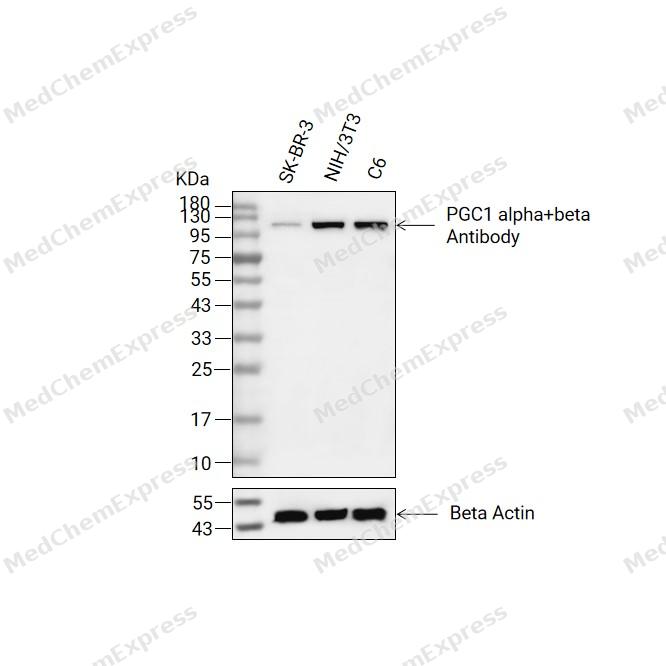 Western blot analysis of extracts from SK-BR-3(lane 2(20ug) , NIH/3T3(lane 3(20ug) and C6(lane 4(20ug) using PGC1 alpha+beta Antibody (HY-P83728) Rabbit mAb. Proteins were transferred to a PVDF membrane and blocked with 5% non-fat milk in TBST for 2 hour at room temperature. The primary antibody (1/1000) and Loading control antibody (Beta Actin, HY-P83730, 1/10000) was used in 5% non-fat milk in TBST at 4°C overnight. Goat Anti-Mouse/Rabbit IgG-HRP Secondary Antibody (1/10000) was used for 1 hour at room temperature.


Background
-
Function
PGC1 alpha+beta is a Q86YN6: Plays a role of stimulator of transcription factors and nuclear receptors activities. Activates transcriptional activity of estrogen receptor alpha, nuclear respiratory factor 1 (NRF1) and glucocorticoid receptor in the presence of glucocorticoids. May play a role in constitutive non-adrenergic-mediated mitochondrial biogenesis as suggested by increased basal oxygen consumption and mitochondrial number when overexpressed. May be involved in fat oxidation and non-oxidative glucose metabolism and in the regulation of energy expenditure. Induces the expression of PERM1 in the skeletal muscle in an ESRRA-dependent manner
Q9UBK2: Transcriptional coactivator for steroid receptors and nuclear receptors. Greatly increases the transcriptional activity of PPARG and thyroid hormone receptor on the uncoupling protein promoter. Can regulate key mitochondrial genes that contribute to the program of adaptive thermogenesis. Plays an essential role in metabolic reprogramming in response to dietary availability through coordination of the expression of a wide array of genes involved in glucose and fatty acid metabolism.
[1][2][3][4][5]. -
Subcellular Localization
Q86YN6: Nucleus
Q9UBK2: Nucleus; Nucleus, PML body; Nucleus; Cytoplasm; Nucleus; Nucleus; Nucleus, PML body; Nucleus -
Expression
Tissue_specificity: Q86YN6: Ubiquitous with higher expression in heart, brain and skeletal muscle
Q9UBK2: Heart, skeletal muscle, liver and kidney. Expressed at lower levels in brain and pancreas and at very low levels in the intestine and white adipose tissue. In skeletal muscle, levels were lower in obese than in lean subjects and fasting induced a 2-fold increase in levels in the skeletal muscle in obese subjects
Induction: Q86YN6: Repressed by saturated fatty acids such as palmitate and stearate in skeletal muscle cells. Induced by insulin and reduced by aging in skeletal muscle biopsies. Down-regulated in type 2 diabetes mellitus subjects as well as in pre-diabetics
Q9UBK2: Transcription is repressed by ZNF746 which binds to 'insulin response sequences' its promoter -
Isoforms & Post-Translational Modification
Q86YN6 has 6 isomers: Q86YN6-1: 113222 Da (predicted); Q86YN6-2: 110981 Da (predicted); Q86YN6-3: 112568 Da (predicted); Q86YN6-4: 110327 Da (predicted); Q86YN6-5: 108919 Da (predicted); Q86YN6-6: 106230 Da (predicted).
-
Subunit
Q86YN6: Interacts with hepatocyte nuclear factor 4-alpha/HNF4A, Sterol regulatory binding transcription factor 1/SREBF1, PPAR-alpha/PPARA, thyroid hormone receptor beta/THRB and host cell factor/HCFC1. Interacts with estrogen-related receptor gamma/ESRRG and alpha/ESRRA. Interacts with PRDM16 (By similarity). Interacts with estrogen receptor alpha/ESR1
Q9UBK2: Homooligomer (PubMed:10713165). -
SwissProt ID
-
Synonyms
LEM6 antibody; Ligand effect modulator 6 antibody; PERC antibody; Peroxisome proliferative activated receptor, gamma, coactivator 1 antibody; PGC 1 alpha antibody; PGC-1-beta antibody; PGC-1-related estrogen receptor alpha coactivator antibody; PGC1 antibody; PGC1A antibody; PGC1v antibody; PPAR gamma coactivator 1 alpha antibody; PPAR gamma coactivator-1 beta antibody; PPARGC 1 alpha antibody; PPARGC-1-beta antibody; PPARGC1 antibody; PPARGC1A antibody; Ppargc1b antibody; PRGC1_HUMAN antibody; PRGC2_HUMAN antibody;


Documentation
-
Data Sheet (258 KB)
-
SDS (254 KB)
- English - EN (254 KB)
- Français - FR (254 KB)
- Deutsch - DE (254 KB)
- Norwegian - NO (254 KB)
- Español - ES (254 KB)
- Swedish - SV (254 KB)
- Italian - IT (254 KB)
- Korean - KR (254 KB)
- Portuguese - PT (254 KB)
-
User Guide for Antibodies (1077 KB)

 Powered by Bioz
