



Phospho-MAPKAPK2 (Thr334) Antibody
(Synonyms: MAPKAPK2; MAP kinase-activated protein kinase 2; MAPK-activated protein kinase 2; MAPKAP kinase 2; MAPKAP-K2; MAPKAPK-2; MK-2; MK2)
Based on 1 Customer Validation
Phospho-MAPKAPK2 (Thr334) Antibody is a Rabbit-derived and non-conjugated IgG polyclonal antibody, targeting to Phospho-MAPKAPK2 (Thr334).
-
Host:
Rabbit
-
Isotype:
IgG
-
Application:
WB, IHC-P, ICC/IF
-
Reactivity :
Human, Mouse, Rat
-
Formulation:
Supplied in PBS containing 150 mM NaCl, 50% glycerol and 0.02% sodium azide, pH 7.4.
-
Conjugation:
Non-conjugated


To place orders, for customer services and technical support, please contact: MedChemExpress USA
Tel: 609-228-6898 E-mail: [email protected] [email protected]





Applications
| Application |
WB

WB: Western Blot
|
IHC-P
IHC-P: Immunohistochemistry-Paraffin
|
ICC/IF
ICC/IF: Immunocytochemistry/
Immunofluorescence |
|---|---|---|---|
| Dilution Ratio | 1:500-1:1000 | 1:50-1:100 | 1:100-1:200 |


Product Details
Phospho-MAPKAPK2 (Thr334) Antibody is a Rabbit-derived and non-conjugated IgG polyclonal antibody, targeting to Phospho-MAPKAPK2 (Thr334).
-
Host Rabbit

-
Clonality Polyclonal

-
Species ReactivityHuman, Mouse, Rat
-
Observed Molecular WeightObserved band size: 49 kDa
Note: Due to possible protein modifications or aggregation, the molecular weight should be confirmed by actual measurement, and the predicted value is for reference only.

-
Calculated Molecular Weight Predicted band size: 46 kDa;

Synthetic peptide of human MAPKAPK2
Affinity Purified
Non-conjugated
Phosphorylated
IgG


Product Properties
-
Appearance
Liquid
-
Formulation
Supplied in PBS containing 150 mM NaCl, 50% glycerol and 0.02% sodium azide, pH 7.4.
-
Concentration
Batch-dependent, Please check the COA for the concentration of each lot. Check Lot Concentration
-
Storage & Stability
Stored at -20°C for 1 year. Avoid repeated freeze / thaw cycles.
-
Shipping
Shipping with blue ice.


Verification Images
-
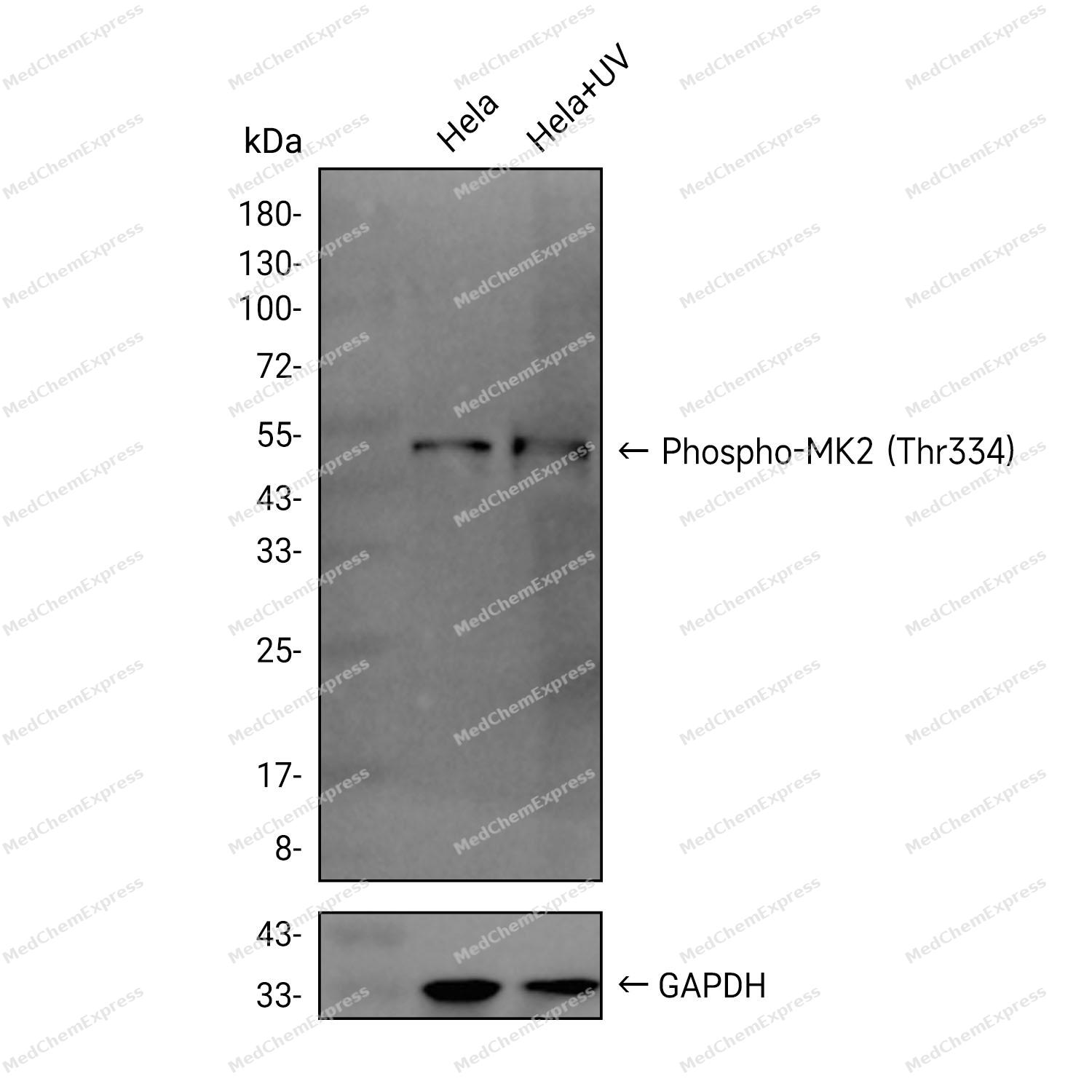 Western blot analysis was performed on extracts from Hela (lane 1, 15 μg), and Hela+UV (lane 2, 15 μg) using Phospho-MK2 (Thr334) Rabbit pAb.Proteins were transferred to a PVDF membrane and blocked with 5% non-fat milk in TBST at 4°C overnight.The primary antibody (1:1000 dilution) and the loading control antibody (GAPDH, HY-P80137, 1:20000 dilution) were incubated in 5% non-fat milk in TBST for 1 hour at 37°C.Goat Anti-Rabbit IgG-HRP Secondary Antibody (1:20000 dilution) was then applied for 40 minutes at 37°C.


Background
-
Function
MAPKAPK2 is a Stress-activated serine/threonine-protein kinase involved in cytokine production, endocytosis, reorganization of the cytoskeleton, cell migration, cell cycle control, chromatin remodeling, DNA damage response and transcriptional regulation. Following stress, it is phosphorylated and activated by MAP kinase p38-alpha/MAPK14, leading to phosphorylation of substrates. Phosphorylates serine in the peptide sequence, Hyd-X-R-X(2)-S, where Hyd is a large hydrophobic residue. Phosphorylates ALOX5, CDC25B, CDC25C, CEP131, ELAVL1, HNRNPA0, HSP27/HSPB1, KRT18, KRT20, LIMK1, LSP1, PABPC1, PARN, PDE4A, RCSD1, RPS6KA3, TAB3 and TTP/ZFP36. Phosphorylates HSF1; leading to the interaction with HSP90 proteins and inhibiting HSF1 homotrimerization, DNA-binding and transactivation activities. Mediates phosphorylation of HSP27/HSPB1 in response to stress, leading to the dissociation of HSP27/HSPB1 from large small heat-shock protein (sHsps) oligomers and impairment of their chaperone activities and ability to protect against oxidative stress effectively. Involved in inflammatory response by regulating tumor necrosis factor (TNF) and IL6 production post-transcriptionally: acts by phosphorylating AU-rich elements (AREs)-binding proteins ELAVL1, HNRNPA0, PABPC1 and TTP/ZFP36, leading to the regulation of the stability and translation of TNF and IL6 mRNAs. Phosphorylation of TTP/ZFP36, a major post-transcriptional regulator of TNF, promotes its binding to 14-3-3 proteins and reduces its ARE mRNA affinity, leading to inhibition of dependent degradation of ARE-containing transcripts. Phosphorylates CEP131 in response to cellular stress induced by ultraviolet irradiation which promotes binding of CEP131 to 14-3-3 proteins and inhibits formation of novel centriolar satellites. Also involved in late G2/M checkpoint following DNA damage through a process of post-transcriptional mRNA stabilization: following DNA damage, relocalizes from nucleus to cytoplasm and phosphorylates HNRNPA0 and PARN, leading to stabilization of GADD45A mRNA. Involved in toll-like receptor signaling pathway (TLR) in dendritic cells: required for acute TLR-induced macropinocytosis by phosphorylating and activating RPS6KA3[1][2].
-
Subcellular Localization
Cytoplasm; Nucleus
-
Expression
Tissue_specificity:It was expressed in all the tissues tested. -
Isoforms & Post-Translational Modification
P49137 has 2 isomers: P49137-1: 45568 Da (predicted); P49137-2: 42203 Da (predicted).
Sumoylation inhibits the protein kinase activity;Phosphorylated and activated by MAP kinase p38-alpha/MAPK14 at Thr-222, Ser-272 and Thr-334 -
Subunit
Heterodimer with p38-alpha/MAPK14; this heterodimer forms a stable complex: molecules are positioned 'face to face' so that the ATP-binding sites of both kinases are at the heterodimer interface (PubMed:12171911, PubMed:17255097, PubMed:17395714, PubMed:17449059, PubMed:17480064, PubMed:17576063). Interacts with PHC2 (PubMed:15094067). Interacts with HSF1 (PubMed:16278218)
-
SwissProt ID
-
Synonyms
MAPKAPK2; MAP kinase-activated protein kinase 2; MAPK-activated protein kinase 2; MAPKAP kinase 2; MAPKAP-K2; MAPKAPK-2; MK-2; MK2


Documentation
-
Data Sheet (259 KB)
-
SDS (313 KB)
- English - EN (313 KB)
- Français - FR (313 KB)
- Deutsch - DE (313 KB)
- Norwegian - NO (313 KB)
- Español - ES (313 KB)
- Swedish - SV (313 KB)
- Italian - IT (313 KB)
- Korean - KR (313 KB)
- Portuguese - PT (313 KB)
-
User Guide for Antibodies (1077 KB)

 Powered by Bioz
