



PRMT3 Antibody (YA1731)
(Synonyms: HRMT1L3)
Based on 1 Customer Validation
PRMT3 Antibody (YA1731) is a Rabbit-derived and non-conjugated IgG monoclonal antibody, targeting to PRMT3.
-
Host:
Rabbit
-
Isotype:
IgG
-
Application:
WB, IHC-P, IP
-
Reactivity :
Human, Mouse, Rat
-
Formulation:
Supplied in 50mM Tris-Glycine(pH 7.4), 0.15M NaCl, 40% Glycerol, 0.01% Sodium azide and 0.05% BSA
-
Conjugation:
Non-conjugated


To place orders, for customer services and technical support, please contact: MedChemExpress USA
Tel: 609-228-6898 E-mail: [email protected] [email protected]





Applications
| Application |
WB

WB: Western Blot
|
IHC-P
IHC-P: Immunohistochemistry-Paraffin
|
IP
IP: Immunoprecipitation
|
|---|---|---|---|
| Dilution Ratio | 1:500-1:1000 | 1:50-1:100 | 1:20 |


Product Details
PRMT3 Antibody (YA1731) is a Rabbit-derived and non-conjugated IgG monoclonal antibody, targeting to PRMT3.
-
Host Rabbit

-
Clonality Recombinant,Monoclonal

-
Species ReactivityHuman, Mouse, Rat
-
Observed Molecular WeightObserved band size: 60 kDa
Note: Due to possible protein modifications or aggregation, the molecular weight should be confirmed by actual measurement, and the predicted value is for reference only.

-
Calculated Molecular Weight Predicted band size: 60 kDa

A synthetic peptide of human PRMT3 aa11-24.
Endogenous
Affinity Purified
Non-conjugated
Unmodified
IgG


Product Properties
-
Appearance
Solution
-
Formulation
Supplied in 50mM Tris-Glycine(pH 7.4), 0.15M NaCl, 40% Glycerol, 0.01% Sodium azide and 0.05% BSA
-
Concentration
Batch-dependent, Please check the COA for the concentration of each lot. Check Lot Concentration
-
Storage & Stability
Stored at -20°C for 1 year. Avoid repeated freeze / thaw cycles.
-
Shipping
Shipping with blue ice.


Verification Images
-
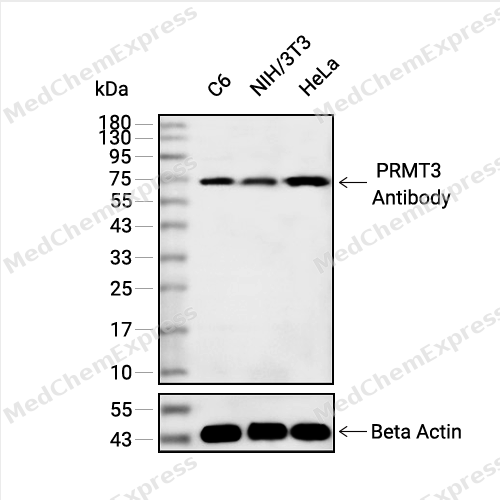 Western blot analysis of extracts from C6(lane 2(20ug), NIH/3T3(lane 3(20ug) and Hela(lane 4(20ug) using PRMT3 Antibody (HY-P81986) Rabbit mAb. Proteins were transferred to a PVDF membrane and blocked with 5% non-fat milk in TBST for 2 hour at room temperature. The primary antibody (1/1000) and Loading control antibody (Beta Actin, HY-P80438, 1/10000) was used in 5% non-fat milk in TBST at 4°C overnight. Goat Anti-Mouse/Rabbit IgG-HRP Secondary Antibody (1/10000) was used for 1 hour at room temperature.
 -
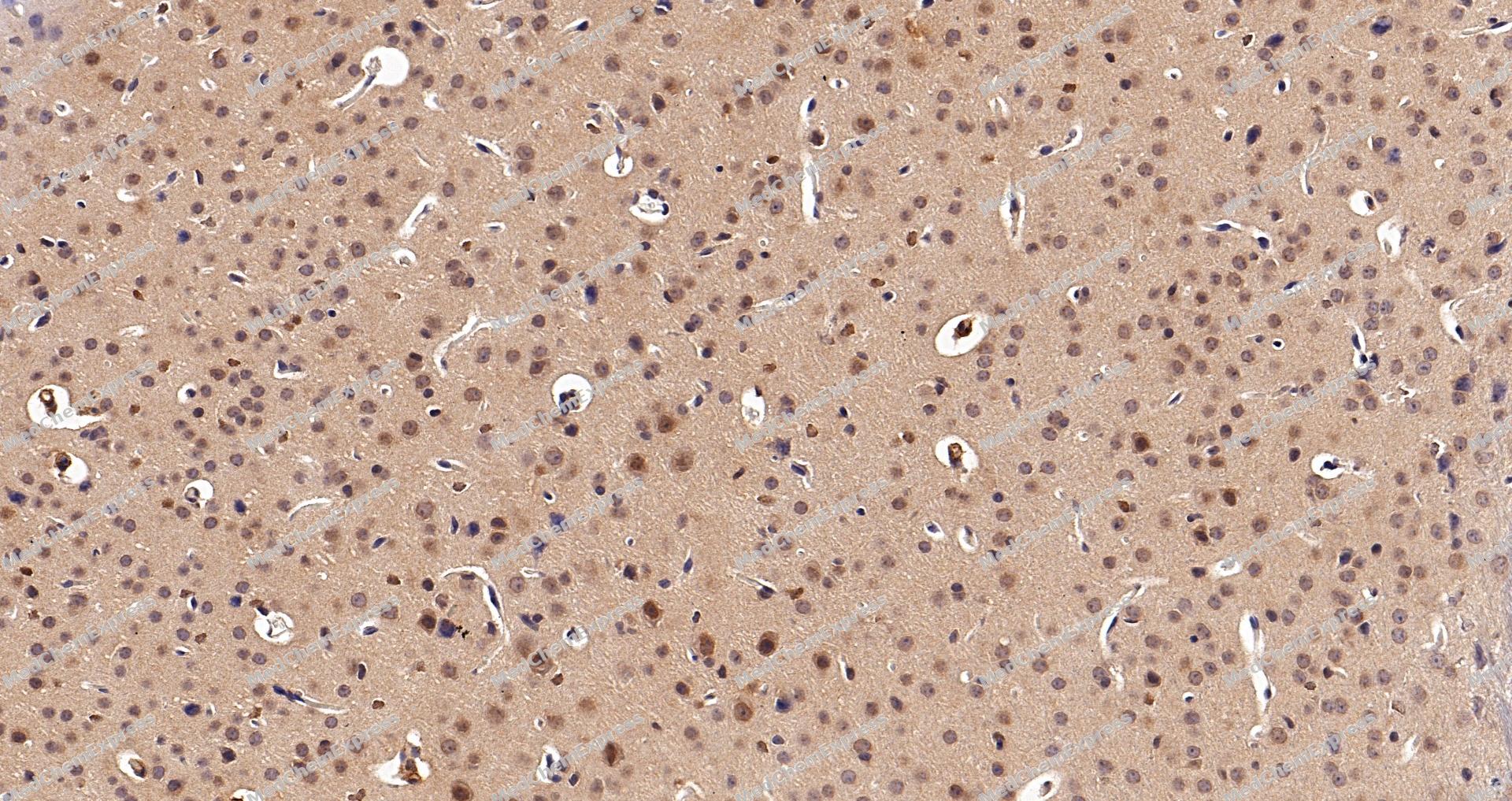 Immunohistochemical analysis of paraffin-embedded Mouse brain tissue using PRMT3 Antibody (YA1731). The section was pre-treated using heat mediated antigen retrieval with Tris-EDTA buffer (pH 8.0) for 8 minutes. The tissues were blocked in QuickBlock for 20 minutes at room temperature, washed with ddH2O and PBS, and then probed with the primary antibody (HY-P81986, 1/100) in 4℃ overnight. The detection was performed using an HRP conjugated compact polymer system. DAB was used as the chromogen. Tissues were counterstained with hematoxylin and mounted with DPX.
 -
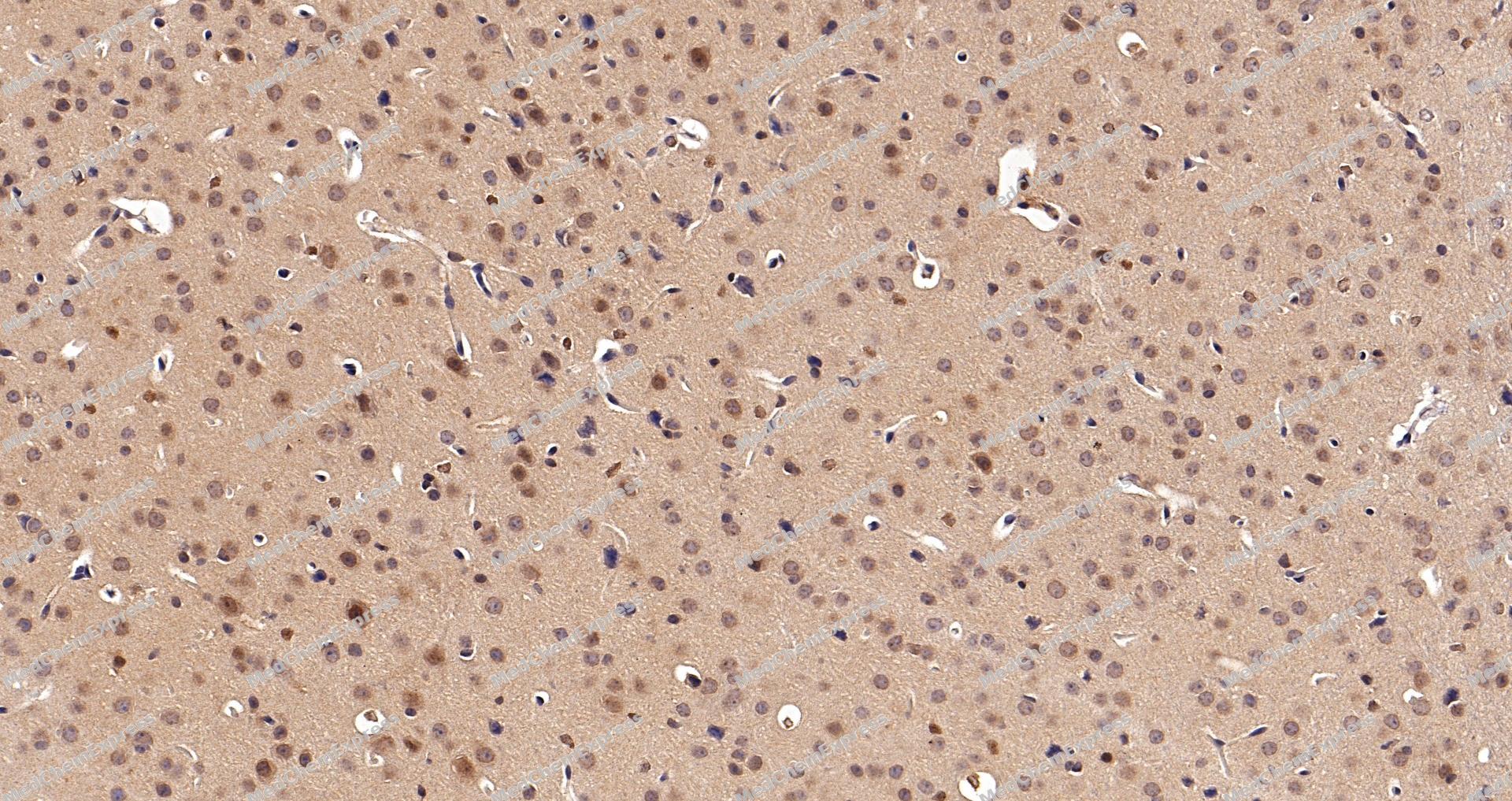 Immunohistochemical analysis of paraffin-embedded Mouse brain tissue using PRMT3 Antibody (YA1731). The section was pre-treated using heat mediated antigen retrieval with Tris-EDTA buffer (pH 8.0) for 8 minutes. The tissues were blocked in QuickBlock for 20 minutes at room temperature, washed with ddH2O and PBS, and then probed with the primary antibody (HY-P81986, 1/100) in 4℃ overnight. The detection was performed using an HRP conjugated compact polymer system. DAB was used as the chromogen. Tissues were counterstained with hematoxylin and mounted with DPX.


Background
-
Function
PRMT3 (protein arginine methyltransferase 3) is a type I protein arginine methyltransferase that catalyzes asymmetric dimethylation of arginine residues and functions as a ribosomal protein methyltransferase involved in ribosome biogenesis and cellular protein synthesis regulation[1][2]. Mechanistically, PRMT3 is distinguished within the PRMT family by the presence of a zinc-finger domain that mediates substrate interaction, enabling regulation of diverse proteins involved in transcriptional control, post-transcriptional regulation, translation, and metabolic signaling pathways[3]. Through these activities, PRMT3 contributes to the control of gene expression and cellular metabolism, linking arginine methylation to fundamental biological processes[3]. In disease contexts, accumulating evidence indicates that PRMT3 participates in oncogenic programs by promoting metabolic reprogramming and gene expression changes associated with tumorigenesis[3]. Experimental studies further demonstrate that PRMT3 can influence cellular metabolism through regulation of glycolytic pathways and other metabolic processes relevant to cancer progression[3]. Compared with related PRMT isoforms, PRMT3 exhibits distinct substrate recognition, subcellular functions, and regulatory mechanisms, highlighting its nonredundant biological role[1][3]. For experimental applications, the allosteric inhibitor SGC707 provides a highly selective chemical probe for PRMT3, exhibiting nanomolar potency and substantial selectivity over other methyltransferases, thereby enabling mechanistic studies of PRMT3-dependent signaling and metabolic regulation[2]. Pharmacological inhibition of PRMT3 has also shown effects on hepatic triglyceride metabolism in preclinical models, supporting its utility for pathway interrogation and therapeutic target validation studies[4].
-
Subcellular Localization
Cytoplasm, cytosol; Nucleus
-
Isoforms & Post-Translational Modification
O60678 has 2 isomers: O60678-1: 59903 Da (predicted); O60678-2: 52902 Da (predicted).
-
Subunit
Monomer and homodimer (By similarity). Interacts with EPB41L3 (via FERM domain); the interaction is direct and inhibits the protein-arginine N-methyltransferase activity of PRMT3 (PubMed:15334060).
-
SwissProt ID
-
Synonyms
HRMT1L3
-
Research Field
Epigenetics and Nuclear Signaling


Documentation
-
Data Sheet (261 KB)
-
SDS (251 KB)
- English - EN (251 KB)
- Français - FR (251 KB)
- Deutsch - DE (251 KB)
- Norwegian - NO (251 KB)
- Español - ES (251 KB)
- Swedish - SV (251 KB)
- Italian - IT (251 KB)
- Korean - KR (251 KB)
- Portuguese - PT (251 KB)
-
User Guide for Antibodies (1077 KB)
References
[1]. Bachand F, et al. PRMT3 is a ribosomal protein methyltransferase that affects the cellular levels of ribosomal subunits. EMBO J. 2004 Jul 7;23(13):2641-50. [Content Brief]
[2]. Kaniskan HÜ, et al. Discovery of Potent and Selective Allosteric Inhibitors of Protein Arginine Methyltransferase 3 (PRMT3). J Med Chem. 2018 Feb 8;61(3):1204-1217. [Content Brief]
[3]. Hsu SH, et al. Protein arginine methyltransferase 3: A crucial regulator in metabolic reprogramming and gene expression in cancers. Cancer Lett. 2023 Feb 1;554:216008. [Content Brief]
[4]. de Jong LM, et al. PRMT3 inhibitor SGC707 reduces triglyceride levels and induces pruritus in Western-type diet-fed LDL receptor knockout mice. Sci Rep. 2022 Jan 10;12(1):483. [Content Brief]

 Powered by Bioz
