



Rad9 Antibody (YA1087)
(Synonyms: RAD9; hRAD9)
Based on 1 Customer Validation
Rad9 Antibody (YA1087) is a Mouse-derived and non-conjugated IgG2b monoclonal antibody, targeting to Rad9.
-
Host:
Mouse
-
Isotype:
IgG
-
Application:
WB, IP
-
Reactivity :
Human, Mouse, Rat, Monkey
-
Formulation:
Supplied in PBS containing 50% glycerol, 0.5% BSA and 0.02% sodium azide, pH 7.3.
-
Conjugation:
Non-conjugated


To place orders, for customer services and technical support, please contact: MedChemExpress USA
Tel: 609-228-6898 E-mail: [email protected] [email protected]





Applications
| Application |
WB

WB: Western Blot
|
IP
IP: Immunoprecipitation
|
|---|---|---|
| Dilution Ratio | 1:500-1:1000 | 1:20 |


Product Details
Rad9 Antibody (YA1087) is a Mouse-derived and non-conjugated IgG2b monoclonal antibody, targeting to Rad9.
-
Host Mouse

-
Clonality Monoclonal

-
Species ReactivityHuman, Mouse, Rat, Monkey
-
Observed Molecular WeightObserved band size: 60 kDa
Note: Due to possible protein modifications or aggregation, the molecular weight should be confirmed by actual measurement, and the predicted value is for reference only.

-
Calculated Molecular Weight Predicted band size: 43 kDa

Purified recombinant human RAD9A protein fragments expressed in E.coli
Endogenous
Affinity Purified
Non-conjugated
Unmodified
IgG


Product Properties
-
Appearance
Solution
-
Formulation
Supplied in PBS containing 50% glycerol, 0.5% BSA and 0.02% sodium azide, pH 7.3.
-
Concentration
Batch-dependent, Please check the COA for the concentration of each lot. Check Lot Concentration
-
Storage & Stability
Stored at -20°C for 1 year. Avoid repeated freeze / thaw cycles.
-
Shipping
Shipping with blue ice.


Verification Images
-
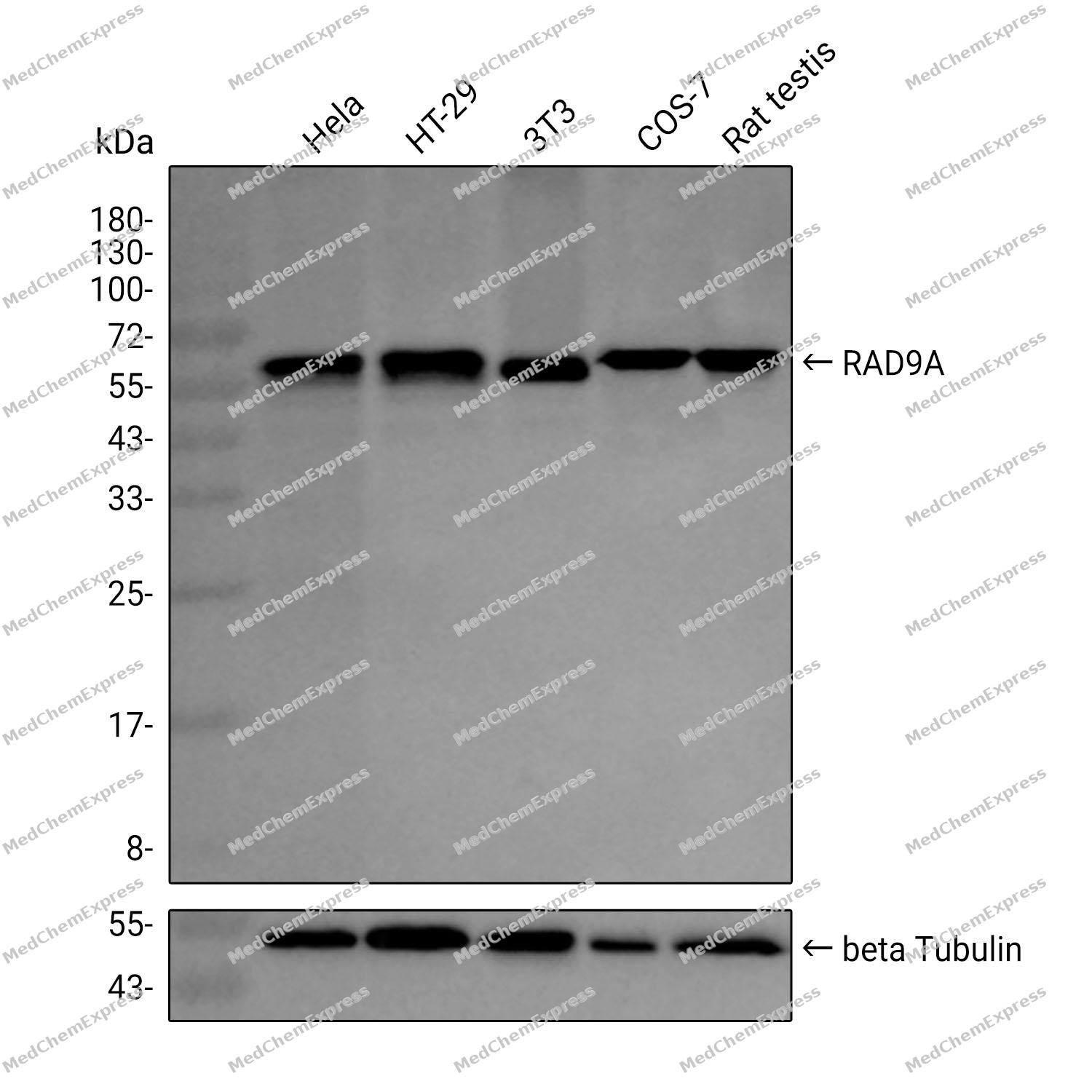 Western blot analysis was performed on extracts from Hela (lane 1, 15 μg), HT-29 (lane 2, 15 μg), 3T3 (lane 3, 15 μg), COS-7 (lane 4, 15 μg), and Rat testis (lane 5, 15 μg) using RAD9A Mouse mAb.Proteins were transferred to a PVDF membrane and blocked with 5% non-fat milk in TBST at 4°C overnight.The primary antibody (1:1000 dilution) and the loading control antibody (beta-Tubulin, HY-P80955, 1:5000 dilution) was incubated in 5% non-fat milk in TBST for 1 hour at 37°C.Goat Anti-Mouse IgG-HRP Secondary Antibody (1:20000 dilution) was then applied for 40 minutes at 37°C.


Background
-
Function
Rad9 component of the 9-1-1 cell-cycle checkpoint response complex that plays a major role in DNA repair. The 9-1-1 complex is recruited to DNA lesion upon damage by the RAD17-replication factor C (RFC) clamp loader complex. Acts then as a sliding clamp platform on DNA for several proteins involved in long-patch base excision repair (LP-BER). The 9-1-1 complex stimulates DNA polymerase beta (POLB) activity by increasing its affinity for the 3'-OH end of the primer-template and stabilizes POLB to those sites where LP-BER proceeds; endonuclease FEN1 cleavage activity on substrates with double, nick, or gap flaps of distinct sequences and lengths; and DNA ligase I (LIG1) on long-patch base excision repair substrates. The 9-1-1 complex is necessary for the recruitment of RHNO1 to sites of double-stranded breaks (DSB) occurring during the S phase. RAD9A possesses 3'->5' double stranded DNA exonuclease activity[1][2][3][4][5].
-
Subcellular Localization
Nucleus
-
Subunit
Component of the toroidal 9-1-1 (RAD9-RAD1-HUS1) complex, composed of RAD9A, RAD1 and HUS1 (PubMed:10359610, PubMed:10777662, PubMed:10846170, PubMed:10884395, PubMed:15314187, PubMed:15556996, PubMed:15871698, PubMed:15897895, PubMed:16216273, PubMed:17575048, PubMed:20545769, PubMed:31135337). The 9-1-1 complex associates with LIG1, POLB, FEN1, RAD17, HDAC1, RPA1 and RPA2 (PubMed:10884395, PubMed:15556996, PubMed:15871698, PubMed:15897895, PubMed:16216273). The 9-1-1 complex associates with the RAD17-RFC complex (PubMed:12578958). RAD9A interacts with BCL2L1, FEN1, RAD9B, ABL1, RPA1, ATAD5 and RPA2 (PubMed:11971963, PubMed:12628935, PubMed:14500360). Interacts with DNAJC7 (PubMed:11573955). Interacts (when phosphorylated) with TOPBP1 (PubMed:17575048, PubMed:20545769, PubMed:31135337)
-
SwissProt ID
-
Synonyms
RAD9; hRAD9
-
Research Field
Epigenetics and Nuclear Signaling


Documentation
-
Data Sheet (261 KB)
-
SDS (251 KB)
- English - EN (251 KB)
- Français - FR (251 KB)
- Deutsch - DE (251 KB)
- Norwegian - NO (251 KB)
- Español - ES (251 KB)
- Swedish - SV (251 KB)
- Italian - IT (251 KB)
- Korean - KR (251 KB)
- Portuguese - PT (251 KB)
-
User Guide for Antibodies (1077 KB)
References
[1]. Bessho T, et al. Human DNA damage checkpoint protein hRAD9 is a 3' to 5' exonuclease. J Biol Chem. 2000 Mar 17;275(11):7451-4. [Content Brief]
[2]. Delacroix S, et al. The Rad9-Hus1-Rad1 (9-1-1) clamp activates checkpoint signaling via TopBP1. Genes Dev. 2007 Jun 15;21(12):1472-7. [Content Brief]
[3]. Takeishi Y, et al. Casein kinase 2-dependent phosphorylation of human Rad9 mediates the interaction between human Rad9-Hus1-Rad1 complex and TopBP1. Genes Cells. 2010 Jun;15(7):761-71. [Content Brief]
[4]. Cotta-Ramusino C, et al. A DNA damage response screen identifies RHINO, a 9-1-1 and TopBP1 interacting protein required for ATR signaling. Science. 2011 Jun 10;332(6035):1313-7. [Content Brief]
[5]. Bigot N, et al. Phosphorylation-mediated interactions with TOPBP1 couple 53BP1 and 9-1-1 to control the G1 DNA damage checkpoint. Elife. 2019 May 28;8:. [Content Brief]

 Powered by Bioz
