



SIRT5 Antibody (YA079)
(Synonyms: SIR2L5, SIRT5, Regulatory protein SIR2 homolog 5, SIR2-like protein 5)
Based on 1 Customer Validation
SIRT5 Antibody (YA079) is a Rabbit-derived and non-conjugated IgG monoclonal antibody, targeting to SIRT5.
-
Host:
Rabbit
-
Isotype:
IgG
-
Application:
WB
-
Reactivity :
Human
-
Formulation:
Supplied in 1*TBS (pH7.4), 0.05% BSA and 40% Glycerol. Preservative: 0.05% Sodium Azide.
-
Conjugation:
Non-conjugated


To place orders, for customer services and technical support, please contact: MedChemExpress USA
Tel: 609-228-6898 E-mail: [email protected] [email protected]





Applications
| Application |
WB

WB: Western Blot
|
|---|---|
| Dilution Ratio | 1:1000-1:2000 |


Product Details
SIRT5 Antibody (YA079) is a Rabbit-derived and non-conjugated IgG monoclonal antibody, targeting to SIRT5.
-
Host Rabbit

-
Clonality Recombinant,Monoclonal

-
Species ReactivityHuman
-
Observed Molecular WeightObserved band size: 30 kDa
Note: Due to possible protein modifications or aggregation, the molecular weight should be confirmed by actual measurement, and the predicted value is for reference only.

-
Calculated Molecular Weight Predicted band size: 34 kDa

Synthetic peptide corresponding to Human SIRT5.AA range:1-160.
Endogenous
Protein A affinity purified.
Non-conjugated
Unmodified
IgG


Product Properties
-
Appearance
Solution
-
Formulation
Supplied in 1*TBS (pH7.4), 0.05% BSA and 40% Glycerol. Preservative: 0.05% Sodium Azide.
-
Concentration
Batch-dependent, Please check the COA for the concentration of each lot. Check Lot Concentration
-
Storage & Stability
Stored at -20°C for 1 year. Avoid repeated freeze / thaw cycles.
-
Shipping
Shipping with blue ice.


Verification Images
-
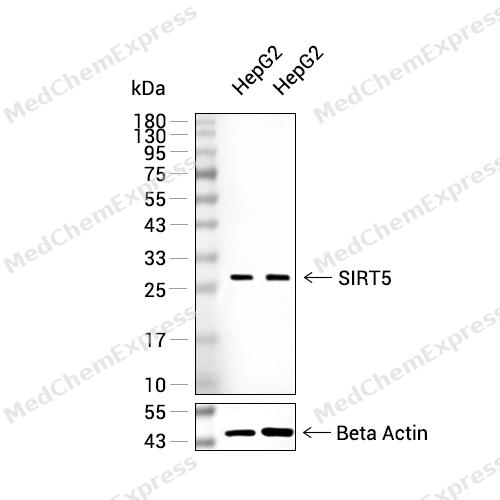 Western blot analysis of extracts from HepG2 (lane 2(20μg), HepG2 (lane 3(40μg), using SIRT5 Antibody. Proteins were transferred to a PVDF membrane and blocked with 5% BSA in TBST for 2 hour at room temperature. The primary antibody and Loading control antibody (Beta Actin, HY-P80438, 1/3000) was used in 5% BSA in TBST at 4°C overnight. Goat Anti-Mouse/Rabbit IgG-HRP Secondary Antibody (HY-P8004/HY-P8001, 1/10,000) was used for 1 hour at room temperature.


Background
-
Function
SIRT5 is an NAD+-dependent mitochondrial sirtuin that functions primarily as a lysine desuccinylase, demalonylase, and deglutarylase rather than a classical deacetylase, thereby regulating post-translational acyl modifications on metabolic proteins[1][2][3]. Mechanistically, SIRT5 preferentially removes negatively charged acyl groups from lysine residues and controls the activity of numerous enzymes involved in mitochondrial metabolism, including pathways linked to the tricarboxylic acid cycle, fatty acid oxidation, ketogenesis, and the urea cycle[1][2][4]. Through broad regulation of the mitochondrial succinylome and related acylomes, SIRT5 contributes to cellular energy homeostasis, oxidative metabolism, and redox balance[4][5][6]. In disease-associated models, altered SIRT5 activity has been linked to cardiac physiology, metabolic disorders, neurodegenerative conditions, and cancer, highlighting its role in metabolic adaptation under physiological and pathological stress[5][6][7]. Experimental studies further demonstrate that SIRT5 deficiency impairs mitochondrial ATP production, increases the AMP/ATP ratio, and activates AMPK signaling during energy stress, supporting a direct role in mitochondrial bioenergetics[8]. Compared with related sirtuin isoforms, SIRT5 is distinguished by its strong preference for negatively charged acyl substrates and its relatively weak deacetylase activity, establishing a unique enzymatic profile within the mammalian sirtuin family[2][3]. For experimental applications, SIRT5 has emerged as a pharmacologically relevant target, and both inhibitors and activity modulators are being investigated to dissect mitochondrial metabolic regulation and disease-associated acylation networks[9].
-
Subcellular Localization
Mitochondrion matrix; Mitochondrion intermembrane space; Cytoplasm, cytosol; Nucleus; Cytoplasm; Mitochondrion; Mitochondrion
-
Expression
Tissue_specificity:Widely expressed -
Isoforms & Post-Translational Modification
Q9NXA8 has 4 isomers: Q9NXA8-1: 33881 Da (predicted); Q9NXA8-2: 32674 Da (predicted); Q9NXA8-3: 31994 Da (predicted); Q9NXA8-4: 21689 Da (predicted).
-
Subunit
Interacts with CPS1 (By similarity). Interacts with PCCA (PubMed:23438705). Monomer (PubMed:17355872). Homodimer (PubMed:17355872). Forms homodimers upon suramin binding (PubMed:17355872)
-
SwissProt ID
-
Synonyms
SIR2L5, SIRT5, Regulatory protein SIR2 homolog 5, SIR2-like protein 5
-
Research Field
Epigenetics and Nuclear Signaling


Documentation
-
Data Sheet (260 KB)
-
SDS (251 KB)
- English - EN (251 KB)
- Français - FR (251 KB)
- Deutsch - DE (251 KB)
- Norwegian - NO (251 KB)
- Español - ES (251 KB)
- Swedish - SV (251 KB)
- Italian - IT (251 KB)
- Korean - KR (251 KB)
- Portuguese - PT (251 KB)
-
User Guide for Antibodies (1077 KB)
References

 Powered by Bioz
