



Sortilin Antibody (YA3243)
(Synonyms: 100 kDa NT receptor; Glycoprotein 95; Gp95; LDLCQ6; Neurotensin receptor 3; NT3; NTR3; SORT 1; Sortilin 1)Based on 1 publication(s) in Google Scholar
Sortilin Antibody (YA3243) is a Rabbit-derived and non-conjugated IgG monoclonal antibody, targeting to Sortilin.
-
Host:
Rabbit
-
Isotype:
IgG
-
Application:
WB, IHC-P
-
Reactivity :
Human, Rat
-
Formulation:
Supplied in 50mM Tris-Glycine(pH 7.4), 0.15M NaCl, 40% Glycerol, 0.01% Sodium azide and 0.05% BSA
-
Conjugation:
Non-conjugated


To place orders, for customer services and technical support, please contact: MedChemExpress USA
Tel: 609-228-6898 E-mail: [email protected] [email protected]




Publications Citing Use of MedChemExpress (MCE) Sortilin Antibody (YA3243)
More

Applications
| Application |
WB

WB: Western Blot
|
IHC-P
IHC-P: Immunohistochemistry-Paraffin
|
|---|---|---|
| Dilution Ratio | 1:500-1:1000 | 1:50-1:100 |


Product Details
Sortilin Antibody (YA3243) is a Rabbit-derived and non-conjugated IgG monoclonal antibody, targeting to Sortilin.
-
Host Rabbit

-
Clonality Recombinant, Monoclonal

-
Species ReactivityHuman, Rat
-
Observed Molecular WeightObserved band size: 92 kDa
Note: Due to possible protein modifications or aggregation, the molecular weight should be confirmed by actual measurement, and the predicted value is for reference only.

-
Calculated Molecular Weight Predicted band size: 92 kDa

Entrez Gene: 6272 Human ; 20661 Mouse ; 83576 Rat
SwissProt: Q99523 Human ; Q6PHU5 Mouse ; O54861 Rat
OMIM: 602458 Human
Recombinant protein of human Sortilin/NT3
Endogenous
Affinity Purified
Non-conjugated
Unmodified
IgG


Product Properties
-
Appearance
Liquid
-
Formulation
Supplied in 50mM Tris-Glycine(pH 7.4), 0.15M NaCl, 40% Glycerol, 0.01% Sodium azide and 0.05% BSA
-
Concentration
Batch-dependent, Please check the COA for the concentration of each lot. Check Lot Concentration
-
Storage & Stability
Stored at -20°C for 1 year. Avoid repeated freeze / thaw cycles.
-
Shipping
Shipping with blue ice.


Publications (1)
-
Journal Impact Factor
-
Most Recent
-
J Med Chem
2026 Mar 12;69(5):6254-6265. PMID: 41773941


Verification Images
-
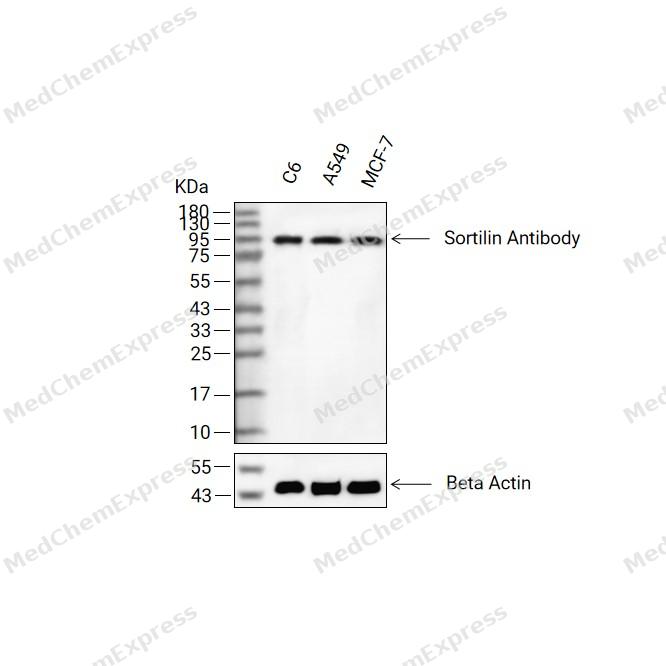 Western blot analysis of extracts from C6(lane 2(20ug) , A549(lane 3(20ug) and MCF-7(lane 4(20ug) using Sortilin Antibody (HY-P83498) Rabbit mAb. Proteins were transferred to a PVDF membrane and blocked with 5% non-fat milk in TBST for 2 hour at room temperature. The primary antibody (1/1000) and Loading control antibody (Beta Actin, HY-P83730, 1/10000) was used in 5% non-fat milk in TBST at 4°C overnight. Goat Anti-Mouse/Rabbit IgG-HRP Secondary Antibody (1/10000) was used for 1 hour at room temperature.
 -
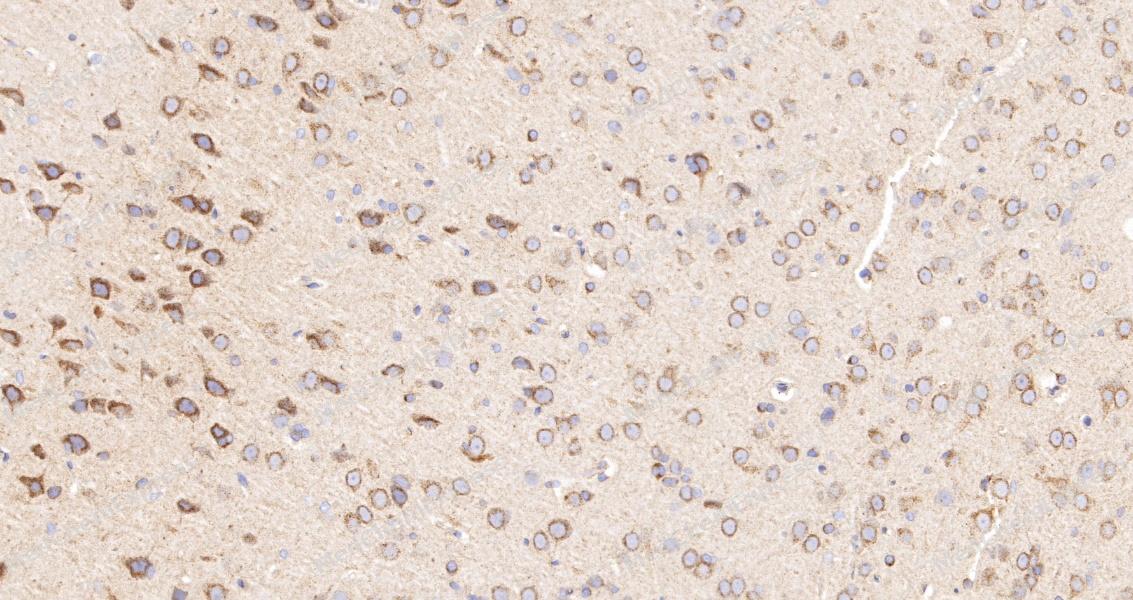 Immunohistochemical analysis of paraffin-embedded rat brain tissue using Sortilin Antibody. The section was pre-treated using heat mediated antigen retrieval with sodium citrate buffer (pH 6.0) for 8 minutes. The tissues were blocked in QuickBlock for 20 minutes at room temperature, washed with ddH2O and PBS, and then probed with the primary antibody at 1/100 dilution in 4℃ overnight. The detection was performed using an HRP conjugated compact polymer system. DAB was used as the chromogen. Tissues were counterstained with hematoxylin and mounted with DPX.
 -
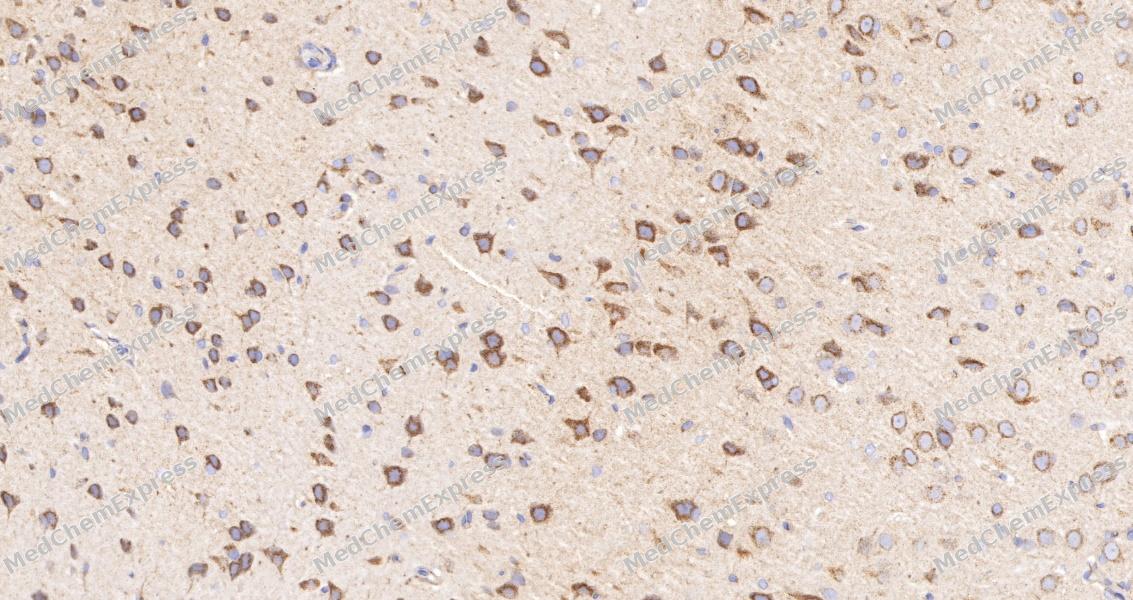 Immunohistochemical analysis of paraffin-embedded rat brain tissue using Sortilin Antibody. The section was pre-treated using heat mediated antigen retrieval with sodium citrate buffer (pH 6.0) for 8 minutes. The tissues were blocked in QuickBlock for 20 minutes at room temperature, washed with ddH2O and PBS, and then probed with the primary antibody at 1/100 dilution in 4℃ overnight. The detection was performed using an HRP conjugated compact polymer system. DAB was used as the chromogen. Tissues were counterstained with hematoxylin and mounted with DPX.


Background
-
Function
Sortilin functions as a sorting receptor in the Golgi compartment and as a clearance receptor on the cell surface. Required for protein transport from the Golgi apparatus to the lysosomes by a pathway that is independent of the mannose-6-phosphate receptor (M6PR). Lysosomal proteins bind specifically to the receptor in the Golgi apparatus and the resulting receptor-ligand complex is transported to an acidic prelysosomal compartment where the low pH mediates the dissociation of the complex. The receptor is then recycled back to the Golgi for another round of trafficking through its binding to the retromer. Also required for protein transport from the Golgi apparatus to the endosomes. Promotes neuronal apoptosis by mediating endocytosis of the proapoptotic precursor forms of BDNF (proBDNF) and NGFB (proNGFB). Also acts as a receptor for neurotensin. May promote mineralization of the extracellular matrix during osteogenic differentiation by scavenging extracellular LPL. Probably required in adipocytes for the formation of specialized storage vesicles containing the glucose transporter SLC2A4/GLUT4 (GLUT4 storage vesicles, or GSVs). These vesicles provide a stable pool of SLC2A4 and confer increased responsiveness to insulin. May also mediate transport from the endoplasmic reticulum to the Golgi[1].
-
Subcellular Localization
Golgi apparatus, Golgi stack membrane; Single-pass type I membrane protein; Endosome membrane; Single-pass type I membrane protein; Endoplasmic reticulum membrane; Single-pass type I membrane protein; Nucleus membrane; Single-pass type I membrane protein; Cell membrane; Single-pass type I membrane protein; Extracellular side; Lysosome membrane; Single-pass type I membrane protein
-
Expression
Tissue_specificity:Expressed in brain and prostate (at protein level) . Expressed at high levels in brain, spinal cord, heart, skeletal muscle, thyroid, placenta and testis. Expressed at lower levels in lymphoid organs, kidney, colon and liver
Induction:During osteoblast differentiation -
Isoforms & Post-Translational Modification
Q99523 has 2 isomers: Q99523-1: 92068 Da (predicted); Q99523-2: 77375 Da (predicted).
The N-terminal propeptide is cleaved by furin and possibly other homologous proteases;Palmitoylated (PubMed:18817523). Undergoes cysteine S-palmitoylation which promotes the partitioning of the receptor into an endosomal membrane subdomain where it can interact with the retromer cargo-selective complex which mediates its retrograde trafficking to the Golgi apparatus (PubMed:18817523);Phosphorylation at Ser-825 facilitates the interaction with GGA1 -
Subunit
Interacts with LPL and SLC2A4 (By similarity). Interacts with the cytosolic adapter proteins GGA1 and GGA2 (PubMed:16787399, PubMed:20015111). Interacts with numerous ligands including the receptor-associated protein LRPAP1/RAP, GM2A and NTS. Forms a complex with NGFR which binds specifically to the precursor forms of NGFB (proNGFB) and BDNF (proBDNF). Interacts with the Trk receptors NTRK1, NTRK2 and NTRK3; may regulate their anterograde axonal transport and signaling. Interacts with CLN5 (PubMed:22431521). Interacts with PSAP (PubMed:14657016, PubMed:22431521). Interacts with GRN; this interaction mediates endocytosis and lysosome delivery of progranulin; interaction occurs at the neuronal cell surface in a stressed nervous system (PubMed:21092856). Interacts with the heterotrimeric retromer cargo-selective complex (CSC), also described as vacuolar protein sorting subcomplex (VPS), formed by VPS26 (VPS26A or VPS26B), VPS29 and VPS35; which is involved in retrograde trafficking of the receptor from endosomes to the Golgi apparatus (PubMed:18817523). Interacts with SMPD1; the interaction is required for SMPD1 targeting to lysosomes (PubMed:16787399)
-
SwissProt ID
-
Synonyms
100 kDa NT receptor; Glycoprotein 95; Gp95; LDLCQ6; Neurotensin receptor 3; NT3; NTR3; SORT 1; Sortilin 1
-
Research Field
Neuroscience
Documentation
-
Data Sheet (234 KB)
-
SDS (252 KB)
- English - EN (252 KB)
- Français - FR (252 KB)
- Deutsch - DE (252 KB)
- Norwegian - NO (252 KB)
- Español - ES (252 KB)
- Swedish - SV (252 KB)
- Italian - IT (252 KB)
- Korean - KR (252 KB)
- Portuguese - PT (252 KB)
-
User Guide for Antibodies (1077 KB)

 Powered by Bioz
