



Sortilin/SORT1 Protein, Human (HEK293, His)

Based on 1 Customer Validation
The Sortilin/SORT1 protein acts as a sorting receptor in the Golgi apparatus and as a clearance receptor on the cell surface. It plays a crucial role in protein transport to lysosomes, independent of M6PR. Sortilin/SORT1 Protein, Human (HEK293, His) is the recombinant human-derived Sortilin/SORT1 protein, expressed by HEK293 , with C-His labeled tag.
- Species: Human
- Source: HEK293
-
Storage:Stored at -20°C for 2 years from date of receipt. After reconstitution, it is stable at 4°C for 1 week or -20°C for longer (with carrier protein). It is recommended to freeze aliquots at -20°C or -80°C for extended storage.


To place orders, for customer services and technical support, please contact: MedChemExpress USA
Tel: 609-228-6898 E-mail: [email protected] [email protected]


-
 Biological Activity
-
Technical Parameters
-
Product Properties
- Documentation
- Help & FAQs




Biological Activity
Description
The Sortilin/SORT1 protein acts as a sorting receptor in the Golgi apparatus and as a clearance receptor on the cell surface. It plays a crucial role in protein transport to lysosomes, independent of M6PR. Sortilin/SORT1 Protein, Human (HEK293, His) is the recombinant human-derived Sortilin/SORT1 protein, expressed by HEK293 , with C-His labeled tag.
Background
Sortilin (SORT1) protein functions both as a sorting receptor within the Golgi compartment and as a clearance receptor on the cell surface. It plays a crucial role in protein transport from the Golgi apparatus to lysosomes, independent of the mannose-6-phosphate receptor (M6PR). In this process, lysosomal proteins specifically bind to the receptor in the Golgi, forming a receptor-ligand complex that is transported to an acidic prelysosomal compartment. The low pH in this compartment mediates complex dissociation, and the receptor is recycled back to the Golgi via binding to the retromer. Additionally, Sortilin is involved in protein transport from the Golgi to endosomes. It facilitates neuronal apoptosis by mediating the endocytosis of proapoptotic precursor forms of BDNF and NGFB, while also acting as a receptor for neurotensin. In adipocytes, Sortilin is likely required for the formation of specialized storage vesicles containing the glucose transporter SLC2A4 (GLUT4), enhancing responsiveness to insulin. The protein interacts with various partners, including ligands like LRPAP1/RAP, GM2A, and NTS, as well as participating in a complex with NGFR. Sortilin also engages with cytosolic adapter proteins, such as GGA1 and GGA2, and forms interactions with proteins like CLN5, PSAP, GRN, and SMPD1, contributing to its diverse cellular functions.
Verified Bioactivity
Immobilized Recombinant Human Sortilin Protein at 4 μg/mL (100 μL/well) can bind Biotinylated Recombinant Human beta -NGF Protein. The ED50 for this effect is ≤273.8 ng/mL.
MCE Validation Data
-
Purity - SDS-PAGE
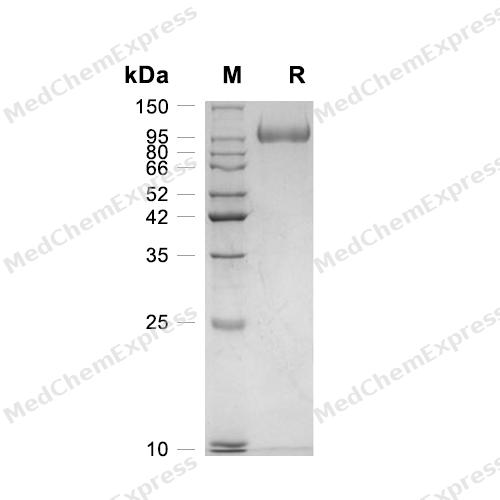
Purity - SDS-PAGE
-
Bioactivity - ELISA
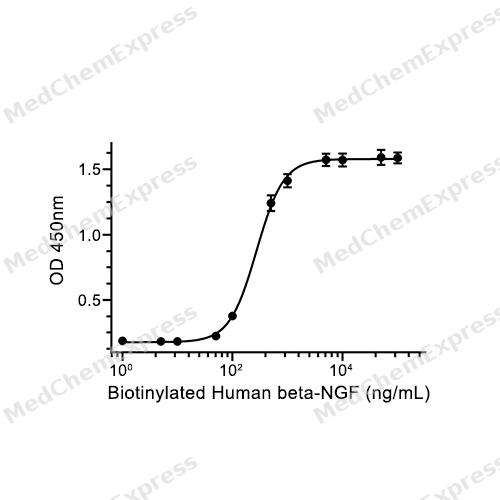
Bioactivity - ELISA


Technical Parameters
-
Species Human
-
Source HEK293
-
Tag C-His
-
Accession
Q99523-1 (S78-N755)
-
Molecular Construction
-
N-term
-
SORT1 (S78-N755)
Accession # Q99523-1 -
His
-
C-term
-
-
Protein Length
Extracellular Domain
-
Synonyms
SORT1; 100 KDa NT Receptor; Sortilin 1; Glycoprotein 95; Gp95; Sortilin; NT3; NTR3; Neurotensin Receptor 3; LDLCQ6
-
AA Sequence
SAPGEDEECGRVRDFVAKLANNTHQHVFDDLRGSVSLSWVGDSTGVILVLTTFHVPLVIMTFGQSKLYRSEDYGKNFKDITDLINNTFIRTEFGMAIGPENSGKVVLTAEVSGGSRGGRIFRSSDFAKNFVQTDLPFHPLTQMMYSPQNSDYLLALSTENGLWVSKNFGGKWEEIHKAVCLAKWGSDNTIFFTTYANGSCKADLGALELWRTSDLGKSFKTIGVKIYSFGLGGRFLFASVMADKDTTRRIHVSTDQGDTWSMAQLPSVGQEQFYSILAANDDMVFMHVDEPGDTGFGTIFTSDDRGIVYSKSLDRHLYTTTGGETDFTNVTSLRGVYITSVLSEDNSIQTMITFDQGGRWTHLRKPENSECDATAKNKNECSLHIHASYSISQKLNVPMAPLSEPNAVGIVIAHGSVGDAISVMVPDVYISDDGGYSWTKMLEGPHYYTILDSGGIIVAIEHSSRPINVIKFSTDEGQCWQTYTFTRDPIYFTGLASEPGARSMNISIWGFTESFLTSQWVSYTIDFKDILERNCEEKDYTIWLAHSTDPEDYEDGCILGYKEQFLRLRKSSVCQNGRDYVVTKQPSICLCSLEDFLCDFGYYRPENDSKCVEQPELKGHDLEFCLYGREEHLTTNGYRKIPGDKCQGGVNPVREVKDLKKKCTSNFLSPEKQNSKSN
-
Predicted Molecular Mass
75.7 kDa
-
Molecular Weight
Approximately 80-97 kDa, based on SDS-PAGE under reducing conditions, due to the glycosylation.
-
Glycosylation
Yes
-
Purity
≥ 95%, as determined by reducing SDS-PAGE.


Product Properties
Lyophilized powder
1.Lyophilized from a 0.22 μm filtered solution of 20 mM PB, 150 mM NaCl, pH 7.4.
2.Lyophilized from a 0.22 μm filtered solution of PBS, pH 7.4, 5% trehalose, 7.4 mannitol, 0.01% Tween 80.
3.Lyophilized from a 0.22 μm filtered solution of PBS, pH 7.4, 8% trehalose.
Please refer to the lot-specific COA for specific buffer information.
<1 EU/μg, determined by LAL method.
It is not recommended to reconstitute to a concentration less than 100 μg/mL in ddH2O. For long term storage it is recommended to add a carrier protein (0.1% BSA, 5% HSA, 10% FBS or 5% Trehalose).
Stored at -20°C for 2 years from date of receipt. After reconstitution, it is stable at 4°C for 1 week or -20°C for longer (with carrier protein). It is recommended to freeze aliquots at -20°C or -80°C for extended storage.
Room temperature in continental US; may vary elsewhere.


Documentation
-
Data Sheet (240 KB)
-
SDS (252 KB)
- English - EN (252 KB)
- Français - FR (252 KB)
- Deutsch - DE (252 KB)
- Norwegian - NO (252 KB)
- Español - ES (252 KB)
- Swedish - SV (252 KB)
- Italian - IT (252 KB)
- Korean - KR (252 KB)
- Portuguese - PT (252 KB)
-
Handling Instructions (2659 KB)

Calculators
Concentration (start) × Volume (start) = Concentration (final) × Volume (final)


 Powered by Bioz

