



Transcription Factor E3 Antibody (YA5514)
(Synonyms: BHLHE33, TFE3, Transcription factor E3, Class E basic helix-loop-helix protein 33, bHLHe33)
Based on 1 Customer Validation
Transcription Factor E3 Antibody (YA5514) is a Mouse-derived and non-conjugated IgG1 monoclonal antibody, targeting to Transcription Factor E3.
-
Host:
Mouse
-
Isotype:
IgG
-
Application:
WB, IHC-P, ICC/IF, IP, ELISA
-
Reactivity :
Human, Mouse, Bovin,
-
Formulation:
Supplied in PBS, 50% glycerol, 0.05% Proclin 300, 0.05%BSA
-
Conjugation:
Non-conjugated


To place orders, for customer services and technical support, please contact: MedChemExpress USA
Tel: 609-228-6898 E-mail: [email protected] [email protected]





Applications
| Application |
IHC-P

IHC-P: Immunohistochemistry-Paraffin
|
WB
WB: Western Blot
|
ICC/IF
ICC/IF: Immunocytochemistry/
Immunofluorescence |
ELISA
ELISA: Enzyme Linked Immunosorbent Assay
|
|---|---|---|---|---|
| Dilution Ratio | 1:200-1000 | 1:500-2000 | 1:100-500 | 1:1000-5000 |


Product Details
Transcription Factor E3 Antibody (YA5514) is a Mouse-derived and non-conjugated IgG1 monoclonal antibody, targeting to Transcription Factor E3.
-
Host Mouse

-
Clonality Monoclonal

-
Species ReactivityHuman, Mouse, Bovin,
-
Observed Molecular WeightObserved band size: 62 kDa
Note: Due to possible protein modifications or aggregation, the molecular weight should be confirmed by actual measurement, and the predicted value is for reference only.

-
Calculated Molecular Weight Predicted band size: 62 kDa

Synthesized peptide derived from human TFE3 AA range: 100-200
Protein G
Non-conjugated
Unmodified
IgG


Product Properties
-
Appearance
Solution
-
Formulation
Supplied in PBS, 50% glycerol, 0.05% Proclin 300, 0.05%BSA
-
Concentration
Batch-dependent, Please check the COA for the concentration of each lot. Check Lot Concentration
-
Storage & Stability
Stored at -20°C for 1 year. Avoid repeated freeze / thaw cycles.
-
Shipping
Shipping with blue ice.


Verification Images
-
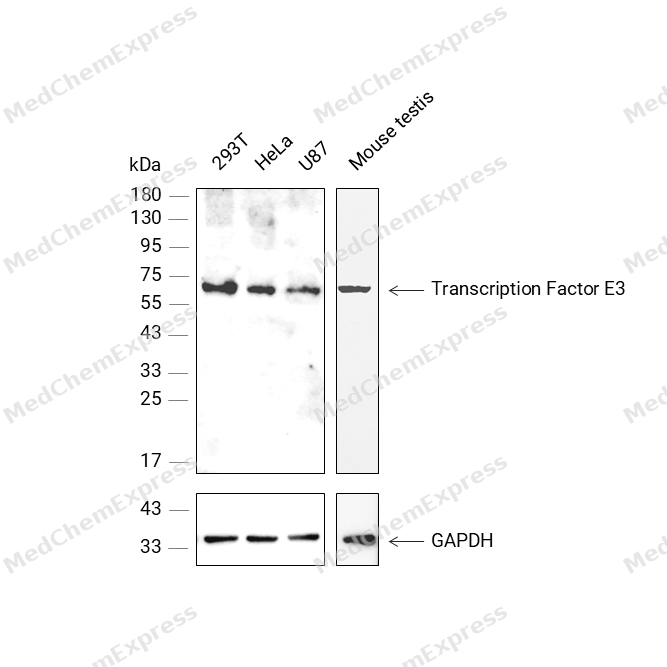 Western blot analysis was performed on protein extracts (25 μg) from 293T (lane 1), HeLa (lane 2), U87 (lane 3) and Mouse testis (lane 4) using Transcription Factor E3 antibody. Proteins were transferred onto a 0.45 μm PVDF membrane using the Trans-Blot® Turbo™ system for 13 min. The membrane was then blocked with 5% nonfat milk in TBST (HY-K1025) for 1 h at room temperature. The primary antibody (1:1000) and loading control antibody GAPDH Antibody (HRP) (HY-P80954A) (1:5000) were diluted in 5% nonfat milk in TBST and incubated with the membrane overnight at 4°C. After washing, the membrane of primary antibody was incubated with HRP-conjugated goat anti-rabbit/mouse IgG secondary antibody (HY-P8001/HY-P8004) (1:5000) diluted in 5% nonfat milk in TBST for 1 h at room temperature. Protein bands were visualized using an Ultra High Sensitivity ECL detection kit (HY-K1005).


Background
-
Function
Transcription Factor E3 transcription factor that acts as a master regulator of lysosomal biogenesis and immune response. Specifically recognizes and binds E-box sequences (5'-CANNTG-3'); efficient DNA-binding requires dimerization with itself or with another MiT/TFE family member such as TFEB or MITF. Involved in the cellular response to amino acid availability by acting downstream of MTOR: in the presence of nutrients, TFE3 phosphorylation by MTOR promotes its inactivation. Upon starvation or lysosomal stress, inhibition of MTOR induces TFE3 dephosphorylation, resulting in transcription factor activity. Specifically recognizes and binds the CLEAR-box sequence (5'-GTCACGTGAC-3') present in the regulatory region of many lysosomal genes, leading to activate their expression, thereby playing a central role in expression of lysosomal genes. Maintains the pluripotent state of embryonic stem cells by promoting the expression of genes such as ESRRB; mTOR-dependent TFE3 cytosolic retention and inactivation promotes exit from pluripotency. Required to maintain the naive pluripotent state of hematopoietic stem cell; mTOR-dependent cytoplasmic retention of TFE3 promotes the exit of hematopoietic stem cell from pluripotency. TFE3 activity is also involved in the inhibition of neuronal progenitor differentiation. Acts as a positive regulator of browning of adipose tissue by promoting expression of target genes; mTOR-dependent phosphorylation promotes cytoplasmic retention of TFE3 and inhibits browning of adipose tissue. In association with TFEB, activates the expression of CD40L in T-cells, thereby playing a role in T-cell-dependent antibody responses in activated CD4(+) T-cells and thymus-dependent humoral immunity. Specifically recognizes the MUE3 box, a subset of E-boxes, present in the immunoglobulin enhancer. It also binds very well to a USF/MLTF site. Promotes TGF-beta-induced transcription of COL1A2; via its interaction with TSC22D1 at E-boxes in the gene proximal promoter. May regulate lysosomal positioning in response to nutrient deprivation by promoting the expression of PIP4P1[1][2][3][4][5][6][7].
-
Subcellular Localization
Cytoplasm, cytosol; Nucleus; Lysosome membrane
-
Expression
Tissue_specificity:Widely present in human tissues -
Isoforms & Post-Translational Modification
P19532 has 2 isomers: P19532-1: 61521 Da (predicted); P19532-2: 11363 Da (predicted).
Sumoylated; does not affect dimerization with MITF;Phosphorylation ar Ser-47 and Ser-321 by MTOR via non-canonical mTORC1 pathway regulates its stability and subcellular location, respectively (PubMed:21209915, PubMed:24448649, PubMed:30733432, PubMed:36608670). When nutrients are present, phosphorylation by MTOR at Ser-47 promotes ubiquitination by the SCF(BTRC) complex, followed by degradation (PubMed:36608670). When nutrients are present, phosphorylation by MTOR at Ser-321 also promotes association with 14-3-3/YWHA adapters and retention in the cytosol (PubMed:24448649, PubMed:30733432). Phosphorylation at Ser-47 plays a more critical role than phosphorylation at Ser-321 for TFE3 inactivation (PubMed:36608670). Inhibition of mTORC1, starvation and lysosomal disruption, promotes dephosphorylation and transcription factor activity (PubMed:30733432, PubMed:36608670);Ubiquitinated by the SCF(BTRC) and SCF(FBXW11) complexes following phosphorylation at Ser-47 by MTOR, leading to its degradation by the proteasome -
Subunit
Homodimer and heterodimer; with TFEB or MITF (PubMed:15507434, PubMed:1748288). Interacts with RRAGC/RagC GDP-bound and RRAGD/RagD GDP-bound; promoting its recruitment to lysosomal membrane in the presence of nutrients (PubMed:24448649, PubMed:36608670).
-
SwissProt ID
-
Synonyms
BHLHE33, TFE3, Transcription factor E3, Class E basic helix-loop-helix protein 33, bHLHe33


Documentation
-
Data Sheet (235 KB)
-
SDS (251 KB)
- English - EN (251 KB)
- Français - FR (251 KB)
- Deutsch - DE (251 KB)
- Norwegian - NO (251 KB)
- Español - ES (251 KB)
- Swedish - SV (251 KB)
- Italian - IT (251 KB)
- Korean - KR (251 KB)
- Portuguese - PT (251 KB)
-
User Guide for Antibodies (1077 KB)

 Powered by Bioz
