



TSLPR Antibody (YA4506)
(Synonyms: CRL2; TSLPR; CRLF2Y)
Based on 1 Customer Validation
TSLPR Antibody (YA4506) is a Mouse-derived and non-conjugated IgG1 monoclonal antibody, targeting to TSLPR.
-
Host:
Mouse
-
Isotype:
IgG
-
Application:
IHC-P, FC, ELISA
-
Reactivity :
Human
-
Formulation:
Supplied in PBS with 0.05% sodium azide
-
Conjugation:
Non-conjugated


To place orders, for customer services and technical support, please contact: MedChemExpress USA
Tel: 609-228-6898 E-mail: [email protected] [email protected]





Applications
| Application |
IHC-P

IHC-P: Immunohistochemistry-Paraffin
|
FC
FC: Flow Cytometry
|
ELISA
ELISA: Enzyme Linked Immunosorbent Assay
|
|---|---|---|---|
| Dilution Ratio | 1:200-1:1000 | 1:200-1:400 | 1:10000 |


Product Details
TSLPR Antibody (YA4506) is a Mouse-derived and non-conjugated IgG1 monoclonal antibody, targeting to TSLPR.
-
Host Mouse

-
Clonality Monoclonal

-
Species ReactivityHuman
-
Observed Molecular WeightObserved band size: 48 kDa
Note: Due to possible protein modifications or aggregation, the molecular weight should be confirmed by actual measurement, and the predicted value is for reference only.

-
Calculated Molecular Weight Predicted band size: 42 kDa

Purified recombinant fragment of human TSLPR (AA: extra(23-231)) expressed in E. Coli.
affinity purified.
Non-conjugated
Unmodified
IgG


Product Properties
-
Appearance
Solution
-
Formulation
Supplied in PBS with 0.05% sodium azide
-
Concentration
Batch-dependent, Please check the COA for the concentration of each lot. Check Lot Concentration
-
Storage & Stability
Stored at -20°C for 1 year. Avoid repeated freeze / thaw cycles.
-
Shipping
Shipping with blue ice.


Verification Images
-
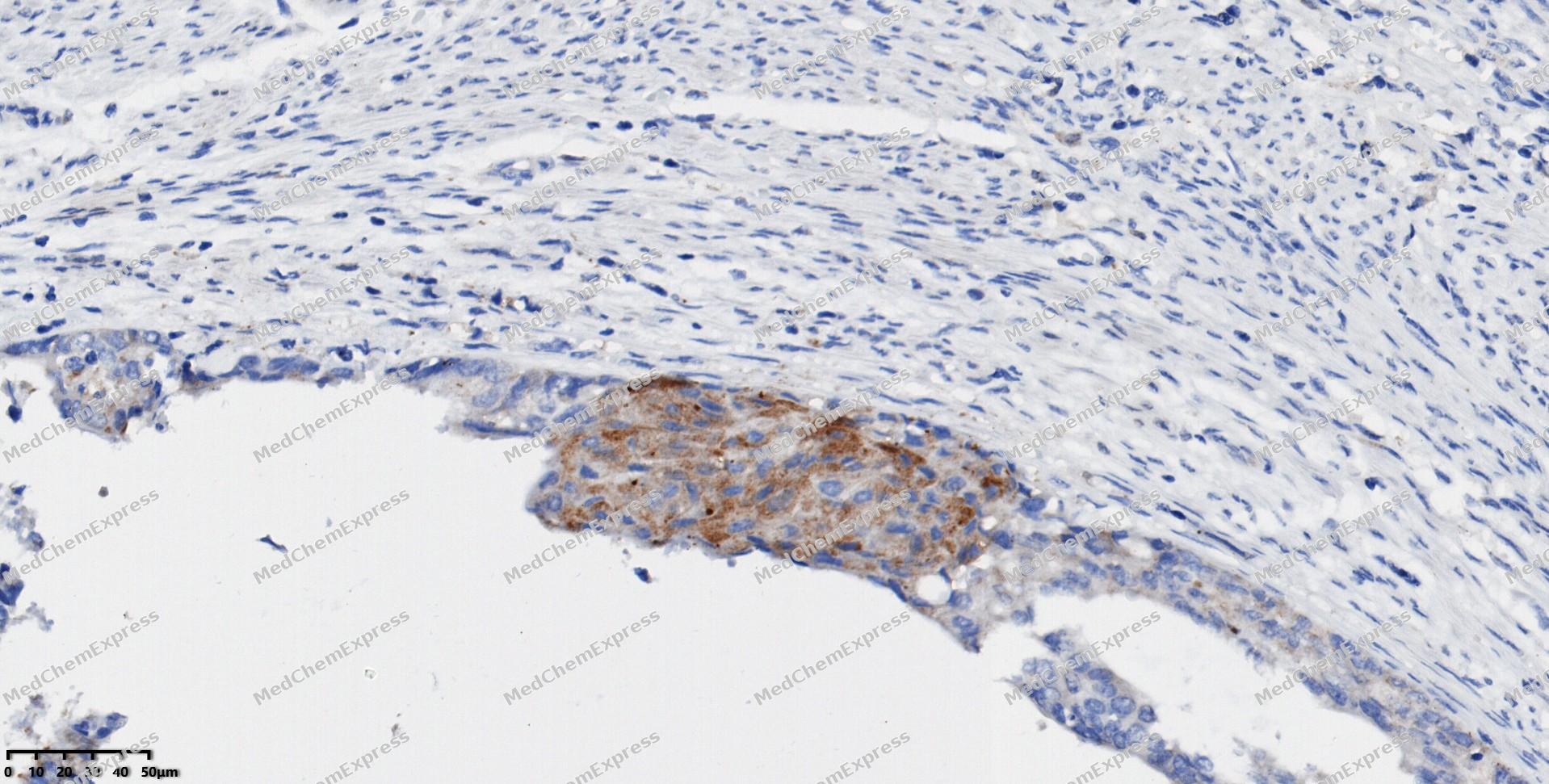 Immunohistochemical analysis of paraffin-embedded human cervical cancer using TSLPR antibody. The section was pre-treated using heat mediated antigen retrieval with EDTA (pH 9.0) for 14 minutes. The tissues were blocked in 5% BSA for 30 minutes at room temperature, washed with TBST, and then probed with the primary antibody (HY-P84809, 1/1000) for 1 hour at room temperature. The detection was performed using Polymer HRP-conjugated Goat Anti-Mouse/Rabbit lgG(H&L) secondary antibody (HY-P83652). DAB was used as the chromogen. Tissues were counterstained with hematoxylin and mounted with DPX.


Background
-
Function
TSLPR is a Phosphatidylserine receptor that plays an important functional role in regulatory B-cells homeostasis including generation, expansion and suppressor functions. As P-selectin/SELPLG ligand, plays a specialized role in activated but not naive T-cell trafficking during inflammatory responses. Controls thereby T-cell accumulation in the inflamed central nervous system (CNS) and the induction of autoimmune disease. Also regulates expression of various anti-inflammatory cytokines and co-inhibitory ligands including IL10. Acts as a regulator of T-cell proliferation. May play a role in kidney injury and repair; (Microbial infection) Acts as a receptor for Hepatitis A virus; (Microbial infection) Acts as a receptor for Ebolavirus and Marburg virus by binding exposed phosphatidyl-serine at the surface of virion membrane. Serves as a dual receptor for Ebolavirus by also interacting with envelope glycoprotein GP; (Microbial infection) Acts as a receptor for Dengue virus by binding exposed phosphatidyl-serine at the surface of virion membrane. TIM1 and Dengue virus are co-internalized during virus entry; (Microbial infection) Acts as a receptor for Zika virus by binding to envelope protein E; (Microbial infection) Plays a positive role in Chikungunya virus cell entry[1][2][3][4][5][6].
-
Subcellular Localization
Cell membrane; Single-pass type I membrane protein
-
Expression
Tissue_specificity:It is widely expressed, with the highest expression levels in the kidneys and testes. During the development of helper T cell responses, it is expressed by activated CD4+ T cells.
Induction:Up-regulated in the kidney in renal diseases (at protein level) -
Subunit
Interacts with STAM (PubMed:29742433). Interacts with SELPLG (PubMed:24703780)
-
SwissProt ID
-
Synonyms
CRL2; TSLPR; CRLF2Y


Documentation
-
Data Sheet (261 KB)
-
SDS (251 KB)
- English - EN (251 KB)
- Français - FR (251 KB)
- Deutsch - DE (251 KB)
- Norwegian - NO (251 KB)
- Español - ES (251 KB)
- Swedish - SV (251 KB)
- Italian - IT (251 KB)
- Korean - KR (251 KB)
- Portuguese - PT (251 KB)
-
User Guide for Antibodies (1077 KB)
References
[1]. Angiari S, et al. TIM-1 glycoprotein binds the adhesion receptor P-selectin and mediates T cell trafficking during inflammation and autoimmunity. Immunity. 2014 Apr 17;40(4):542-53. [Content Brief]
[2]. van Timmeren MM, et al. Tubular kidney injury molecule-1 (KIM-1) in human renal disease. J Pathol. 2007 Jun;212(2):209-17. [Content Brief]
[3]. Kondratowicz AS, et al. T-cell immunoglobulin and mucin domain 1 (TIM-1) is a receptor for Zaire Ebolavirus and Lake Victoria Marburgvirus. Proc Natl Acad Sci U S A. 2011 May 17;108(20):8426-31. [Content Brief]
[4]. Yuan S, et al. TIM-1 acts a dual-attachment receptor for Ebolavirus by interacting directly with viral GP and the PS on the viral envelope. Protein Cell. 2015 Nov;6(11):814-24. [Content Brief]
[5]. Meertens L, et al. The TIM and TAM families of phosphatidylserine receptors mediate dengue virus entry. Cell Host Microbe. 2012 Oct 18;12(4):544-57. [Content Brief]
[6]. Dejarnac O, et al. TIM-1 Ubiquitination Mediates Dengue Virus Entry. Cell Rep. 2018 May 8;23(6):1779-1793. [Content Brief]

 Powered by Bioz
