



TYRO3 Antibody (YA7188)
(Synonyms: BYK; Brt; Dtk; RSE; Sky; Tif)
Based on 1 Customer Validation
TYRO3 Antibody (YA7188) is a Rabbit-derived and non-conjugated IgG monoclonal antibody, targeting to TYRO3.
-
Host:
Rabbit
-
Isotype:
IgG
-
Application:
WB
-
Reactivity :
Human, Rat
-
Formulation:
Supplied in 1*TBS (pH7.4), 0.05% BSA, 40% Glycerol. Preservative: 0.05% Sodium Azide.
-
Conjugation:
Non-conjugated


To place orders, for customer services and technical support, please contact: MedChemExpress USA
Tel: 609-228-6898 E-mail: [email protected] [email protected]





Applications
| Application |
WB

WB: Western Blot
|
|---|---|
| Dilution Ratio | 1:1,000 |


Product Details
TYRO3 Antibody (YA7188) is a Rabbit-derived and non-conjugated IgG monoclonal antibody, targeting to TYRO3.
-
Host Rabbit

-
Clonality Monoclonal,Recombinant

-
Species ReactivityHuman, Rat
-
Observed Molecular WeightObserved band size: 110-140 kDa
Note: Due to possible protein modifications or aggregation, the molecular weight should be confirmed by actual measurement, and the predicted value is for reference only.

-
Calculated Molecular Weight Predicted band size: 97 kDa

Synthetic peptide within Human TYRO3 aa 841-890 / 890.
affinity purified.
Non-conjugated
Unmodified
IgG


Product Properties
-
Appearance
Solution
-
Formulation
Supplied in 1*TBS (pH7.4), 0.05% BSA, 40% Glycerol. Preservative: 0.05% Sodium Azide.
-
Concentration
Batch-dependent, Please check the COA for the concentration of each lot. Check Lot Concentration
-
Storage & Stability
Stored at -20°C for 1 year. Avoid repeated freeze / thaw cycles.
-
Shipping
Shipping with blue ice.


Verification Images
-
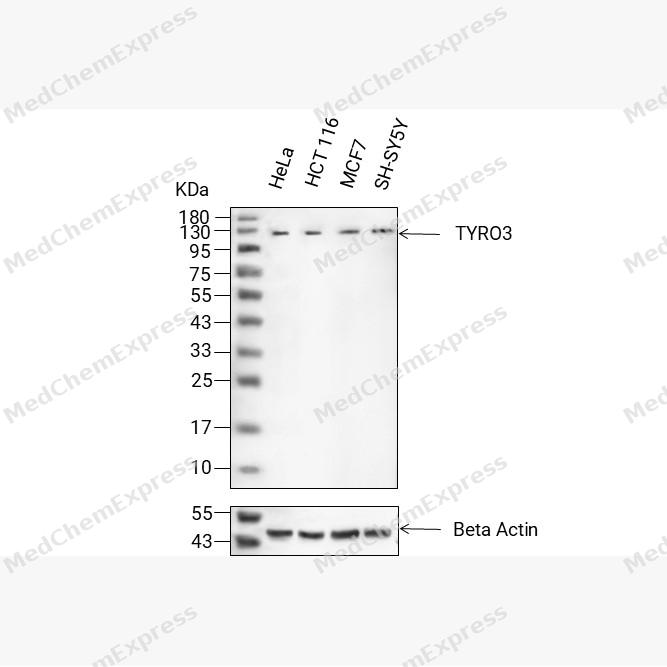 Western blot analysis of extracts from HeLa (lane 2(20μg), HCT 116 (lane 3(20μg), MCF7 (lane 4(20μg) and SH-SY5Y (lane 5(20μg) using TYRO3 Antibody (HY-P87503) Rabbit mAb. Proteins were transferred to a PVDF membrane and blocked with 5% non-fat milk in TBST for 2 hour at room temperature. The primary antibody (1/1000)and Loading control antibody (Beta Actin, HY-P80993, 1/10000) was used in 5% non-fat milk in TBST at 4°C overnight. Goat Anti-Rabbit IgG-HRP Secondary Antibody (1/10000) was used for 1 hour at room temperature.


Background
-
Function
Tyro3 is a member of the TAM (TYRO3, AXL, MER) receptor tyrosine kinase family, which plays critical roles in immune regulation and phagocytosis. It is primarily expressed in the central nervous system and has been implicated in neuroinflammation and neurodegenerative diseases[1]. Tyro3 functions as a receptor for phosphatidylserine (PS), mediating the clearance of apoptotic cells through efferocytosis[2]. This process is essential for maintaining tissue homeostasis and preventing autoimmunity[3]. Recent studies have shown that Tyro3 signaling contributes to microglial quiescence and suppresses pro-inflammatory responses in the brain[3]. Furthermore, dysregulation of Tyro3 has been associated with pathological conditions such as Alzheimer’s disease and multiple sclerosis[4].
-
Subcellular Localization
Cell membrane; Lipid-anchor; Cytoplasmic side; Postsynaptic density; Synapse; Cytoplasm; Cell projection, axon; Cell projection, dendritic spine; Cell projection, dendrite; Presynapse
-
Expression
Tissue_specificity:brain -
Isoforms & Post-Translational Modification
P78352 has 3 isomers: P78352-1: 80495 Da (predicted); P78352-2: 85430 Da (predicted); P78352-3: 80125 Da (predicted).
Palmitoylated (PubMed:26701913). Palmitoylation is required for targeting to postsynaptic density, plasma membrane and synapses (By similarity). Palmitoylation by ZDHHC2 occurs when the synaptic activity decreases and induces DLG4 synaptic clustering (By similarity). Palmitoylation by ZDHHC15 regulates trafficking to the postsynaptic density and function in synaptogenesis (By similarity). Palmitoylation may play a role in glutamate receptor GRIA1 synapse clustering (By similarity). Depalmitoylated by ABHD17A and ABHD17B and to a lesser extent by ABHD17C, ABHD12, ABHD13, LYPLA1 and LYPLA2 (PubMed:26701913). Undergoes rapid synaptic palmitoylation/depalmitoylation cycles during neuronal development which slow down in mature neurons (By similarity);Ubiquitinated by MDM2 in response to NMDA receptor activation, leading to proteasome-mediated degradation of DLG4 which is required for AMPA receptor endocytosis -
Subunit
Interacts through its PDZ domains with ANO2 and NETO1 (By similarity). Interacts through its first two PDZ domains with GRIN2A, GRIN2B, GRIN2C, GRIN2D (By similarity). Interacts with ASIC3 (By similarity). Interacts with SEMA4C (By similarity). Interacts with CXADR (By similarity). Interacts with KCND2 (By similarity). Interacts with SYNGAP1 (By similarity). Interacts with LRRC4 and LRRC4B (By similarity). Interacts with ERBB4 (PubMed:10725395). Interacts with KCNA1, KCNA2, KCNA3 and KCNA4 (PubMed:7477295). Interacts through its first PDZ domain with GRIK2, KCNA4 and CRIPT (PubMed:11744724). Interacts through its second PDZ domain with the PDZ domain of NOS1 or the C-terminus of CAPON (By similarity). Interacts through its third PDZ domain with NLGN1 and CRIPT, and probably with NLGN2 and NLGN3 (PubMed:9278515). Interacts through its guanylate kinase-like domain with KIF13B (PubMed:10859302). Interacts through its guanylate kinase-like domain with DLGAP1/GKAP, DLGAP2, DLGAP3, DLGAP4, MAP1A, BEGAIN and SIPA1L1 (By similarity). Isoform 2 interacts through an L27 domain with HGS/HRS and the first L27 domain of CASK (PubMed:12151521). Interacts with ADR1B and ANKS1B (By similarity). May interact with HTR2A (By similarity). Interacts with ADAM22 (PubMed:27066583). Interacts with KLHL17 and LGI1 (By similarity). Interacts with FRMPD4 (via C-terminus) (PubMed:19118189). Interacts with LRFN1, LRFN2 and LRFN4 (PubMed:16630835). Interacts (via N-terminal tandem pair of PDZ domains) with GPER1 (via C-terminus tail motif); the interaction is direct and induces the increase of GPER1 protein levels residing at the plasma membrane surface in a estradiol-independent manner (By similarity). Interacts (via N-terminus tandem pair of PDZ domains) with NOS1 (via N-terminal domain) (By similarity). Interacts with SHANK3 (By similarity). Interacts with KCNJ4 (By similarity). Interacts with GPR85 (PubMed:25780553). Interacts with CACNG2 and MPP2 (via the SH3-Guanylate kinase-like sub-module) (By similarity). Interacts with ADGRB1 (PubMed:23782696). Found in a complex with PRR7 and GRIN1 (By similarity). Interacts (via PDZ3 domain and to lesser degree via PDZ2 domain) with PRR7 (By similarity). Component of the postsynaptic hippocampal AMPA-type glutamate receptor (AMPAR) complex, at least composed of pore forming AMPAR subunits GRIA1, GRIA2 and GRIA3 and AMPAR auxiliary proteins SHISA6 and SHISA7. Interacts (via its first two PDZ domains) with SHISA6 and SHISA7 (via PDZ-binding motif); the interaction is direct (By similarity). Interacts with RPH3A and GRIN2A; this ternary complex regulates NMDA receptor composition at postsynaptic membranes (By similarity). Interacts with ABR and BCR (PubMed:20962234). Interacts with DGKI (via PDZ-binding motif); controls the localization of DGKI to the synapse (PubMed:21119615). Interacts with C9orf72, SMCR8 and RAB39B (By similarity). Interacts with ZDHHC5 (PubMed:26334723). Interacts with PTEN (via PDZ domain-binding motif); the interaction is induced by NMDA and is required for PTEN location at postsynaptic density (By similarity). Found in a complex with GRIA1, GRIA2, GRIA3, GRIA4, CACNG8 and CNIH2 (By similarity). Interacts with FAM81A; the interaction facilitates condensate formation via liquid-liquid phase separation (By similarity). Interacts with ADGRL3 (By similarity). Interacts with SORCS3 (By similarity)
-
SwissProt ID
-
Synonyms
BYK; Brt; Dtk; RSE; Sky; Tif


Documentation
-
Data Sheet (262 KB)
-
SDS (251 KB)
- English - EN (251 KB)
- Français - FR (251 KB)
- Deutsch - DE (251 KB)
- Norwegian - NO (251 KB)
- Español - ES (251 KB)
- Swedish - SV (251 KB)
- Italian - IT (251 KB)
- Korean - KR (251 KB)
- Portuguese - PT (251 KB)
-
User Guide for Antibodies (1077 KB)
References
[1]. Bordon Y. Microbiota: Gut bacteria cross malaria. Nat Rev Immunol. 2015 Jan;15(1):1. doi: 10.1038/nri3796. PMID: 25534616. et al. Microbiota: Gut bacteria cross malaria. Nat Rev Immunol. 2015 Jan;15(1):1. [Content Brief]
[2]. Kleaveland B, et al. A Network of Noncoding Regulatory RNAs Acts in the Mammalian Brain. Cell. 2018 Jul 12;174(2):350-362.e17. [Content Brief]
[3]. Kiros M, et al. Trends in HIV-1 pretreatment drug resistance and HIV-1 variant dynamics among antiretroviral therapy-naive Ethiopians from 2003 to 2018: a pooled sequence analysis. Virol J. 2023 Oct 25;20(1):243. [Content Brief]
[4]. Tasaka GI, et al. The Temporal Association Cortex Plays a Key Role in Auditory-Driven Maternal Plasticity. Neuron. 2020 Aug 5;107(3):566-579.e7. [Content Brief]

 Powered by Bioz
