



UCP2 Antibody (YA4104)
(Synonyms: UCPH; BMIQ4; SLC25A8)UCP2 Antibody (YA4104) is a Mouse-derived and non-conjugated IgG2a monoclonal antibody, targeting to UCP2.
-
Host:
Mouse
-
Isotype:
IgG2a
-
Application:
ICC/IF, FC, ELISA
-
Reactivity :
Human
-
Formulation:
Supplied in PBS with 0.05% sodium azide
-
Conjugation:
Non-conjugated


To place orders, for customer services and technical support, please contact: MedChemExpress USA
Tel: 609-228-6898 E-mail: [email protected] [email protected]





Applications
| Application |
ICC/IF

ICC/IF: Immunocytochemistry/
Immunofluorescence |
FC
FC: Flow Cytometry
|
ELISA
ELISA: Enzyme Linked Immunosorbent Assay
|
|---|---|---|---|
| Dilution Ratio | 1:200-1:1000 | 1:200-1:400 | 1:10000 |


Product Details
UCP2 Antibody (YA4104) is a Mouse-derived and non-conjugated IgG2a monoclonal antibody, targeting to UCP2.
-
Host Mouse

-
Clonality Monoclonal

-
Species ReactivityHuman
-
Observed Molecular WeightObserved band size: 33 kDa
Note: Due to possible protein modifications or aggregation, the molecular weight should be confirmed by actual measurement, and the predicted value is for reference only.

-
Calculated Molecular Weight Predicted band size: 33 kDa

Purified recombinant fragment of human UCP2 (AA: 1-309) expressed in E. Coli.
affinity purified.
Non-conjugated
Unmodified
IgG2a


Product Properties
-
Appearance
Solution
-
Formulation
Supplied in PBS with 0.05% sodium azide
-
Storage & Stability
Stored at -20°C for 1 year. Avoid repeated freeze / thaw cycles.
-
Shipping
Shipping with blue ice.


Verification Images
-
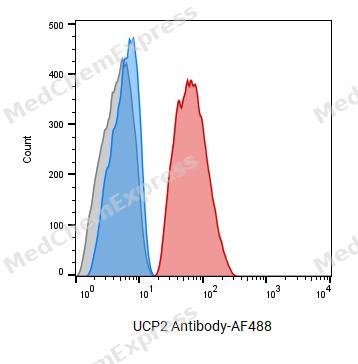 Flow cytometric analysis of 1X10^6 Hela cells labeling UCP2 Antibody(red). Cells were fixed with 4% paraformaldehyde and permeabilised with 0.2% Triton X-100. Then stained with the primary antibody at 1/400 dilution overnight at 4℃. AF 488 Goat Anti-mouse IgG H&L was used as the secondary antibody at 1/1,000 dilution for 45 minutes at room temperature. Mouse IgG Isotype Control (blue) was used as the isotype control, cells without incubation with primary antibody were used as the unlabeled control (black).
 -
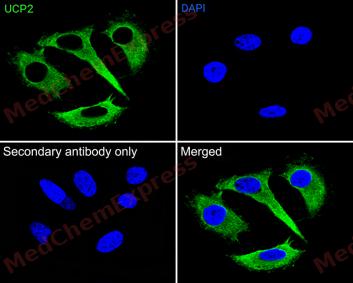 Immunofluorescence analysis of Hela cells labeling UCP2 antibody at 1/50 dilution. Cells were fixed in 4% paraformaldehyde for 15 minutes at room temperature, permeabilized with 0.1% Triton X-100 in PBS for 15 minutes at room temperature, then blocked with 1% BSA in 10% negative goat serum for 1 hour at room temperature.Cells were then incubated with UCP2 antibody at 1/50 dilution in 1% BSA in PBST overnight at 4 ℃. AF 488 Goat Anti-mouse IgG H&L (green) was used as the secondary antibody at 1/500 dilution. PBS instead of the primary antibody was used as the secondary antibody only control. The Nuclear counterstain was DAPI (Blue)


Background
-
Function
UCP2 is an Antiporter that exports dicarboxylate intermediates of the Krebs cycle in exchange for phosphate plus a proton across the inner membrane of mitochondria, a process driven by mitochondrial motive force with an overall impact on glycolysis, glutaminolysis and glutathione-dependent redox balance. Continuous export of oxaloacetate and related four-carbon dicarboxylates from mitochondrial matrix into the cytosol negatively regulates the oxidation of acetyl-CoA substrates via the Krebs cycle, lowering the ATP/ADP ratio and reactive oxygen species (ROS) production. May mediate inducible proton entry into the mitochondrial matrix affecting ATP turnover as a protection mechanism against oxidative stress. The proton currents are most likely associated with fatty acid flipping across the inner membrane of mitochondria in a metabolic process regulated by free fatty acids and purine nucleotides. Regulates the use of glucose as a source of energy. Required for glucose-induced DRP1-dependent mitochondrial fission and neuron activation in the ventromedial nucleus of the hypothalamus (VMH). This mitochondrial adaptation mechanism modulates the VMH pool of glucose-excited neurons with an impact on systemic glucose homeostasis. Regulates ROS levels and metabolic reprogramming of macrophages during the resolution phase of inflammation. Attenuates ROS production in response to IL33 to preserve the integrity of the Krebs cycle required for persistent production of itaconate and subsequent GATA3-dependent differentiation of inflammation-resolving alternatively activated macrophages. Can unidirectionally transport anions including L-malate, L-aspartate, phosphate and chloride ions. Does not mediate adaptive thermogenesis[1][2][3][4][5][6].
-
Subcellular Localization
Mitochondrion inner membrane; Multi-pass membrane protein
-
Expression
Tissue_specificity:Widely expressed in adult human tissues, including tissues rich in macrophages. Most expressed in white adipose tissue and skeletal muscle -
Subunit
Homotetramer. Adopts an asymmetrical dimer of dimers functional form
-
SwissProt ID
-
Synonyms
UCPH; BMIQ4; SLC25A8


Documentation

 Powered by Bioz
