



VRK1 Antibody (YA7880)
(Synonyms: PCH1; PCH1A)
Based on 1 Customer Validation
VRK1 Antibody (YA7880) is a Mouse-derived and non-conjugated IgG1 monoclonal antibody, targeting to VRK1.
-
Host:
Mouse
-
Isotype:
IgG
-
Application:
WB
-
Reactivity :
Human, Mouse, Rat
-
Formulation:
Spplied in PBS (pH 7.3) containing 1% BSA, 50% glycerol and 0.02% sodium azide.
-
Conjugation:
Non-conjugated


To place orders, for customer services and technical support, please contact: MedChemExpress USA
Tel: 609-228-6898 E-mail: [email protected] [email protected]





Applications
| Application |
WB

WB: Western Blot
|
|---|---|
| Dilution Ratio | 1:500-2000 |


Product Details
VRK1 Antibody (YA7880) is a Mouse-derived and non-conjugated IgG1 monoclonal antibody, targeting to VRK1.
-
Host Mouse

-
Clonality Monoclonal

-
Species ReactivityHuman, Mouse, Rat
-
Calculated Molecular Weight Predicted band size: 45.3 kDa

Human recombinant protein fragment corresponding to amino acids 1-230 of human VRK1 produced in E.coli.
Endogenous
Affinity purified
Non-conjugated
Unmodified
IgG


Product Properties
-
Appearance
Solution
-
Formulation
Spplied in PBS (pH 7.3) containing 1% BSA, 50% glycerol and 0.02% sodium azide.
-
Concentration
Batch-dependent, Please check the COA for the concentration of each lot. Check Lot Concentration
-
Storage & Stability
Stored at -20°C for 1 year. Avoid repeated freeze / thaw cycles.
-
Shipping
Shipping with blue ice.


Verification Images
-
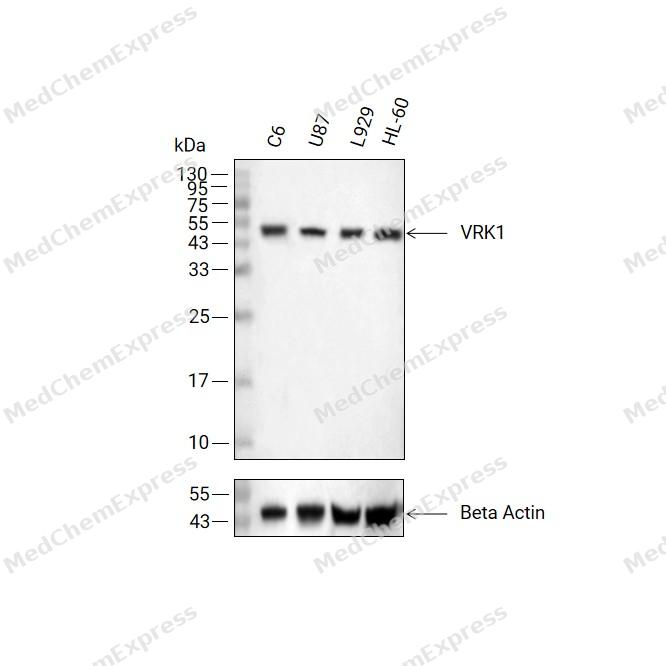 Western blot analysis of extracts from C6 (lane2(20μg), U87 (lane3(20μg), L929 (lane4(20μg) and HL-60 (lane5(20μg) using VRK1 Antibody (HY-P88196). Proteins were transferred to a PVDF membrane and blocked with 5% non-fat milk in TBST at 4°C overnight. The primary antibody (1/1000) and Loading control antibody (Beta Actin, HY-P80993, 1/10,000) was used in 5% non-fat milk in TBST for 2 hour at room temperature. Goat Anti-Mouse IgG-HRP Secondary Antibody (HY-P8004, 1/10,000) was used for 1 hour at room temperature.


Background
-
Function
VRK1 is a nuclear Ser/Thr chromatin kinase that phosphorylates p53, histones, and DNA-damage-response proteins, linking cell proliferation with chromatin stability[1][2][3]. Mechanistically, VRK1 supports cell-cycle entry, G2/M chromatin condensation, and non-homologous end joining through γH2AX, NBS1, and 53BP1 foci formation after ionizing radiation or chemotherapy[1][2]. In p53 signaling, VRK1 phosphorylates p53 at Thr18, stabilizes transcriptionally active p53, and participates in a regulatory loop that modulates DNA-damage responses[3]. In disease models, VRK1 overexpression associates with tumor progression and resistance to genotoxic treatments, and VRK1 loss reduces 53BP1 repair foci after ionizing radiation or doxorubicin in breast cancer cells[1][4]. Compared with related isoforms, VRK1 is mostly nuclear, whereas VRK2A anchors to endoplasmic-reticulum and mitochondrial membranes and VRK2B distributes in cytosol and nucleus, suggesting localization-dependent substrate access[5]. For experimental applications, kinase-inhibitor profiling shows VRK1 and VRK2 have different sensitivity patterns, providing a framework for designing VRK1-selective inhibitors with reduced VRK2 cross-inhibition[6].
-
Subcellular Localization
Nucleus,Cytoplasm,Nucleus, Cajal body
-
Expression
Tissue_Specificity: Widely expressed. Highly expressed in fetal liver, testis and thymus -
Isoforms & Post-Translational Modification
Q99986: 396 amino acids, molecular weight 45476 Da.
-
Subunit
Interacts with HDAC1, KAT2B, SETDB1, KDM3A and KDM4A (PubMed:37179361)
-
SwissProt ID
-
Synonyms
PCH1; PCH1A


Documentation
References
[1]. Campillo-Marcos I, et al. The human VRK1 chromatin kinase in cancer biology. Cancer Lett. 2021 Apr 10;503:117-128. [Content Brief]
[2]. Sanz-García M, et al. Vaccinia-related kinase 1 (VRK1) is an upstream nucleosomal kinase required for the assembly of 53BP1 foci in response to ionizing radiation-induced DNA damage. J Biol Chem. 2012 Jul 6;287(28):23757-68. [Content Brief]
[3]. Vega FM, et al. p53 Stabilization and accumulation induced by human vaccinia-related kinase 1. Mol Cell Biol. 2004 Dec;24(23):10366-80. [Content Brief]
[4]. Salzano M, et al. Vaccinia-related kinase 1 (VRK1) confers resistance to DNA-damaging agents in human breast cancer by affecting DNA damage response. Oncotarget. 2014 Apr 15;5(7):1770-8. [Content Brief]
[5]. Blanco S, et al. The subcellular localization of vaccinia-related kinase-2 (VRK2) isoforms determines their different effect on p53 stability in tumour cell lines. FEBS J. 2006 Jun;273(11):2487-504. [Content Brief]
[6]. Vázquez-Cedeira M, et al. Differential inhibitor sensitivity between human kinases VRK1 and VRK2. PLoS One. 2011;6(8):e23235. [Content Brief]

 Powered by Bioz
