



YY1 Antibody (YA2446)
(Synonyms: YY1; Delta transcription factor; INO80 complex subunit S; NF-E1; Yin and yang 1; YY-1)
Based on 1 Customer Validation
YY1 Antibody (YA2446) is a rabbit-derived non-conjugated IgG monoclonal antibody (Clone NO.: YA2446), targeting YY1. It can be used as a loading control antibody.
-
Host:
Rabbit
-
Isotype:
IgG
-
Application:
WB, IHC-P, ICC/IF, FC
-
Reactivity :
Human, Mouse, Rat
-
Formulation:
Supplied in 50mM Tris-Glycine(pH 7.4), 0.15M NaCl, 40% Glycerol, 0.01% Sodium azide and 0.05% BSA
-
Conjugation:
Non-conjugated


To place orders, for customer services and technical support, please contact: MedChemExpress USA
Tel: 609-228-6898 E-mail: [email protected] [email protected]





Applications
| Application |
WB

WB: Western Blot
|
IHC-P
IHC-P: Immunohistochemistry-Paraffin
|
ICC/IF
ICC/IF: Immunocytochemistry/
Immunofluorescence |
FC
FC: Flow Cytometry
|
|---|---|---|---|---|
| Dilution Ratio | 1:1000-1:5000 | 1:50-1:100 | 1:20-1:50 | 1:20-1:50 |


Product Details
YY1 Antibody (YA2446) is a rabbit-derived non-conjugated IgG monoclonal antibody (Clone NO.: YA2446), targeting YY1. It can be used as a loading control antibody.
-
Host Rabbit

-
Clonality Recombinant,Monoclonal

-
Species ReactivityHuman, Mouse, Rat
-
Observed Molecular WeightObserved band size: 65 kDa
Note: Due to possible protein modifications or aggregation, the molecular weight should be confirmed by actual measurement, and the predicted value is for reference only.

-
Calculated Molecular Weight Predicted band size: 45 kDa

Entrez Gene: 7528 Human ; 22632 Mouse ; 24919 Rat
SwissProt: P25490 Human ; Q00899 Mouse ;
OMIM: 617557 Human
A synthetic peptide of human YY1
Endogenous
Affinity Purified
Non-conjugated
Unmodified
IgG


Product Properties
-
Appearance
Solution
-
Formulation
Supplied in 50mM Tris-Glycine(pH 7.4), 0.15M NaCl, 40% Glycerol, 0.01% Sodium azide and 0.05% BSA
-
Concentration
Batch-dependent, Please check the COA for the concentration of each lot. Check Lot Concentration
-
Storage & Stability
Stored at -20°C for 1 year. Avoid repeated freeze / thaw cycles.
-
Shipping
Shipping with blue ice.


Verification Images
-
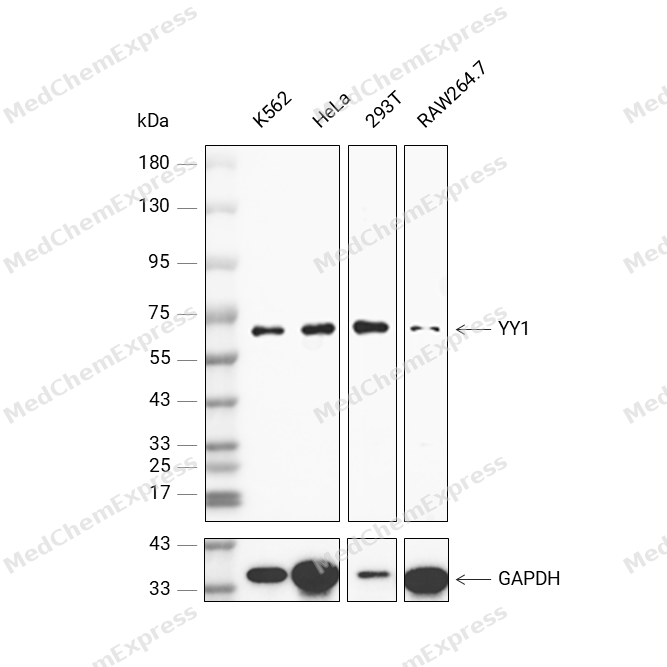 Western blot analysis was performed on protein extracts (25 μg) from K562 (lane 2), HeLa (lane 3), 293T (lane 4) and RAW264.7 (lane 5) using YY1 antibody. Proteins were transferred onto a 0.45 μm PVDF membrane using the Trans-Blot® Turbo™ system for 13 min. The membrane was then blocked with 5% nonfat milk in TBST (HY-K1025) for 1 h at room temperature. The primary antibody (1:1000) and loading control antibody GAPDH Antibody (HRP) (HY-P80954A) (1:5000) were diluted in 5% nonfat milk in TBST and incubated with the membrane overnight at 4°C. After washing, the membrane of primary antibody was incubated with HRP-conjugated goat anti-rabbit/mouse IgG secondary antibody (HY-P8001/HY-P8004) (1:5000) diluted in 5% nonfat milk in TBST for 1 h at room temperature. Protein bands were visualized using an Ultra High Sensitivity ECL detection kit (HY-K1005).


Background
-
Function
YY1 multifunctional transcription factor that exhibits positive and negative control on a large number of cellular and viral genes by binding to sites overlapping the transcription start site. Binds to the consensus sequence 5'-CCGCCATNTT-3'; some genes have been shown to contain a longer binding motif allowing enhanced binding; the initial CG dinucleotide can be methylated greatly reducing the binding affinity. The effect on transcription regulation is depending upon the context in which it binds and diverse mechanisms of action include direct activation or repression, indirect activation or repression via cofactor recruitment, or activation or repression by disruption of binding sites or conformational DNA changes. Its activity is regulated by transcription factors and cytoplasmic proteins that have been shown to abrogate or completely inhibit YY1-mediated activation or repression. For example, it acts as a repressor in absence of adenovirus E1A protein but as an activator in its presence. Acts synergistically with the SMAD1 and SMAD4 in bone morphogenetic protein (BMP)-mediated cardiac-specific gene expression. Binds to SMAD binding elements (SBEs) (5'-GTCT/AGAC-3') within BMP response element (BMPRE) of cardiac activating regions. May play an important role in development and differentiation. Proposed to recruit the PRC2/EED-EZH2 complex to target genes that are transcriptional repressed. Involved in DNA repair. In vitro, binds to DNA recombination intermediate structures (Holliday junctions). Plays a role in regulating enhancer activation. Recruits the PR-DUB complex to specific gene-regulatory regions; Proposed core component of the chromatin remodeling INO80 complex which is involved in transcriptional regulation, DNA replication and probably DNA repair; proposed to target the INO80 complex to YY1-responsive elements[1][2][3][4][5][6][7][8][9].
-
Subcellular Localization
Nucleus matrix
-
Subunit
Interacts with YAF2 through the region encompassing the first and second zinc fingers (PubMed:9016636). Component of the chromatin remodeling INO80 complex; specifically part of a complex module associated with the DBINO domain of INO80 (PubMed:17721549, PubMed:18026119, PubMed:18922472, PubMed:21303910). Interacts with EED and EZH2; the interactions are indicative for an association with the PRC2/EED-EZH2 complex (PubMed:11158321). Interacts with SFMBT2 (PubMed:23385818). Found in a complex with SMAD1 and SMAD4 (PubMed:15329343). Found in a complex with YY1, SIN3A and HDAC1 (By similarity). Accessory component of the polycomb repressive deubiquitinase (PR-DUB) complex, at least composed of BAP1, one of ASXL1, ASXL2 or (probably) ASXL3 and one of MBD5 or MBD6; the PR-DUB core associates with a number of accessory proteins, including FOXK1, FOXK2, KDM1B, HCFC1, YY1 and OGT (PubMed:20805357). Interacts (via Gly-rich region) with HCFC1; the interaction is direct (PubMed:20805357). Interacts (via C-terminal zinc-finger domains) with BAP1 (via ULD domain); the interaction is direct and requires HCFC1 (PubMed:20805357)
-
SwissProt ID
-
Synonyms
YY1; Delta transcription factor; INO80 complex subunit S; NF-E1; Yin and yang 1; YY-1
-
Research Field
Epigenetics and Nuclear Signaling


Documentation
References
[1]. Lee KH, et al. SMAD-mediated modulation of YY1 activity regulates the BMP response and cardiac-specific expression of a GATA4/5/6-dependent chick Nkx2.5 enhancer. Development. 2004 Oct;131(19):4709-23. [Content Brief]
[2]. Cai Y, et al. YY1 functions with INO80 to activate transcription. Nat Struct Mol Biol. 2007 Sep;14(9):872-4. [Content Brief]
[3]. Cao Y, et al. Whole exome sequencing of insulinoma reveals recurrent T372R mutations in YY1. Nat Commun. 2013;4:2810. [Content Brief]
[4]. Cromer MK, et al. Neomorphic effects of recurrent somatic mutations in Yin Yang 1 in insulin-producing adenomas. Proc Natl Acad Sci U S A. 2015 Mar 31;112(13):4062-7. [Content Brief]
[5]. Shi Y, et al. Transcriptional repression by YY1, a human GLI-Krüppel-related protein, and relief of repression by adenovirus E1A protein. Cell. 1991 Oct 18;67(2):377-88. [Content Brief]
[6]. Satijn DP, et al. The polycomb group protein EED interacts with YY1, and both proteins induce neural tissue in Xenopus embryos. Mol Cell Biol. 2001 Feb;21(4):1360-9. [Content Brief]
[7]. Wu S, et al. A YY1-INO80 complex regulates genomic stability through homologous recombination-based repair. Nat Struct Mol Biol. 2007 Dec;14(12):1165-72. [Content Brief]
[8]. Gabriele M, et al. YY1 Haploinsufficiency Causes an Intellectual Disability Syndrome Featuring Transcriptional and Chromatin Dysfunction. Am J Hum Genet. 2017 Jun 1;100(6):907-925. [Content Brief]
[9]. Yu H, et al. The ubiquitin carboxyl hydrolase BAP1 forms a ternary complex with YY1 and HCF-1 and is a critical regulator of gene expression. Mol Cell Biol. 2010 Nov;30(21):5071-85. [Content Brief]

 Powered by Bioz
