



Aspartame acesulfame
Based on 3 publication(s) in Google Scholar
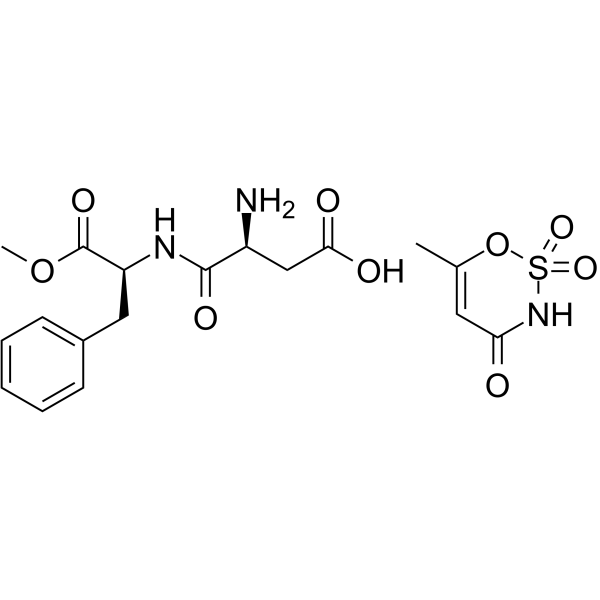
Aspartame acesulfame is a methyl ester of a dipeptide. Aspartame acesulfame can be used as a synthetic nonnutritive sweetener. Aspartame acesulfame is composed of phenylalanine (50%), aspartic acid (40%) and methanol (10%).
商品は「研究用試薬」です。人や動物の医療用・臨床診断用・食品用の製品ではありません。
研究用途以外に使用した場合、当社は一切の責任を負いかねます。
- CAS 番号: 106372-55-8
- 分子式: C18H23N3O9S
- 分子量:457.45
-
保管条件:
Please store the product under the recommended conditions in the Certificate of Analysis.

To place orders, for customer services and technical support, please contact: MedChemExpress USA
Tel: 609-228-6898 E-mail: [email protected] [email protected]


-
 生物活性
生物活性
-
化学情報
- 純度とドキュメンテーション
- 参考文献
-
 Help & FAQs


MedChemExpress(MCE)の使用を引用している文献 Aspartame acesulfame
More Customer Validation & Images

-
Bio/Physico-chemical Assay

-
Bio/Physico-chemical Assay

-
Cell Imaging/Staining

-
Cell Proliferation/Viability Assay


生物活性
製品説明
体外実験
Aspartame is composed of phenylalanine (an important role in neurotransmitter regulation), aspartic acid (an excitatory neurotransmitter in the central nervous system) and methanol[2].
MedChemExpress (MCE) has not independently confirmed the accuracy of these methods. They are for reference only. .
体内実験
MedChemExpress (MCE) has not independently confirmed the accuracy of these methods. They are for reference only.
臨床実験
| NCT Number | Sponsor | Condition | Start Date |
Phase

|
|---|---|---|---|---|
| NCT01329991 | Plexxikon| | 2011-05 | PHASE1 |


化学情報
-
CAS 番号 106372-55-8
-
分子量 457.45
-
分子式 C18H23N3O9S
-
輸送条件
Room temperature in continental US; may vary elsewhere.
-
保管条件
Please store the product under the recommended conditions in the Certificate of Analysis.


Publications (3)
-
Journal Impact Factor
-
Most Recent
-
Environ Pollut
Evaluation of aspartame effects at environmental concentration on early development of zebrafish: Morphology and transcriptome1. [Abstract]2024 Nov 15:361:124792. PMID: 39182820 -
-
Naunyn Schmiedebergs Arch Pharmacol
Integrated network toxicology and experimental validation to investigate potential mechanisms associated with aspartame-induced malignant phenotypic changes in colorectal cancer. [Abstract]2026 Jun 19. PMID: 42319418
Aspartame acesulfame purchased from MedChemExpress. Usage Cited in: Naunyn Schmiedebergs Arch Pharmacol. 2026 Jun 19. [Abstract]
Venn diagram showing the overlap between CRC-related candidate genes and APM (Aspartame) candidate targets, resulting in 26 APM-CRC common candidate genes.
Aspartame acesulfame purchased from MedChemExpress. Usage Cited in: Naunyn Schmiedebergs Arch Pharmacol. 2026 Jun 19. [Abstract]
Heatmap of the binding energies between APM and the five key target proteins.
Aspartame acesulfame purchased from MedChemExpress. Usage Cited in: Naunyn Schmiedebergs Arch Pharmacol. 2026 Jun 19. [Abstract]
EdU staining showed that, compared with the DMSO control group, the number of EdU-positive cells in HCT116 and SW480 cells was significantly increased after APM (Aspartame, 0.001-0.1 mM) treatment, exhibiting a dose-dependent increase.
Aspartame acesulfame purchased from MedChemExpress. Usage Cited in: Naunyn Schmiedebergs Arch Pharmacol. 2026 Jun 19. [Abstract]
CCK-8 assay of HCT116 and SW480 cells treated with APM (Aspartame) for 24, 48, and 72 h.


純度とドキュメンテーション
参考文献
[1]. Magnuson BA, et, al. Aspartame: a safety evaluation based on current use levels, regulations, and toxicological and epidemiological studies. Crit Rev Toxicol. 2007;37(8):629-727. [Content Brief]
[2]. Humphries P, et, al. Direct and indirect cellular effects of aspartame on the brain. Eur J Clin Nutr. 2008 Apr;62(4):451-62. [Content Brief]

Calculators
濃度 (開始) × 体積 (開始) = 濃度 (終了) × 体積 (終了)


Aspartame acesulfame 関連分類
HY-118347 関連分類
 Powered by Bioz