



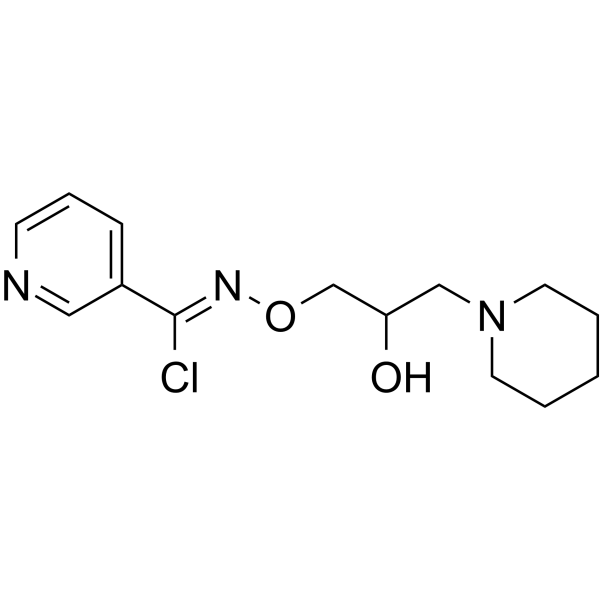
Bimoclomol

Based on 1 Customer Validation
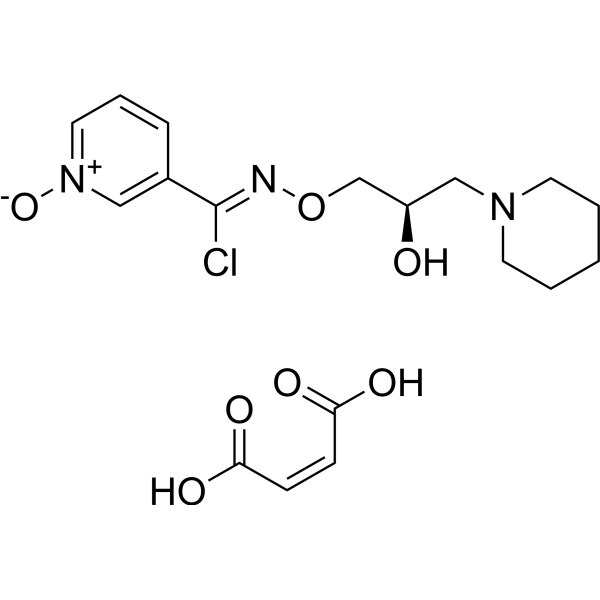
Bimoclomol is a heat shock protein (HSP) coinducer, used for treatment of cardiovascular diseases.
Nos produits utilisent uniquement pour la recherche. Nous ne vendons pas aux patients.
- Pureté: 99.29%
- CAS No.: 130493-03-7
- Formule: C14H20ClN3O2
- Masse moléculaire:297.78
-
Stockage:
4°C, sealed storage, away from moisture and light
* In solvent : -80°C, 6 months; -20°C, 1 month (sealed storage, away from moisture and light)

To place orders, for customer services and technical support, please contact: MedChemExpress USA
Tel: 609-228-6898 E-mail: [email protected] [email protected]


-
 Activité biologique
-
Chemical Information
-
Solvant et solubilité
- Protocole
- Pureté et documentation
- Références
-
 Help & FAQs




Activité biologique
|
HSP |
Bimoclomol (40 μM) significantly increases coronary flow (CF) in the period of normoxic perfusion (before ischemia). Bimoclomol significantly increases LVDP and CO, but it decreases LVEDP under ischemic conditions. Bimoclomol displays a biphasic effect on the rate of relaxation. Bimoclomol (>10 μM) causes concentration-dependent vasorelaxation, with EC50 value of 214 μM. Bimoclomol (100 μM) induces vasorelaxation also against 20 mM KCl. However, bimoclomol fails to relax preparations precontracted with serotonin, PGF2 or angiotensin II[1]. Bimoclomol does not affect the stability of Hsp70 or its mRNA. Bimoclomol coinduces Hsp expression via the prolonged activation of the heat shock transcription factor (HSF-1). The effects of bimoclomol are abolished in cells from mice lacking HSF-1. Furthermore, bimoclomol can bind to HSF-1 and induce a prolonged binding of HSF-1 to the respective DNA elements[2]. Bimoclomol (0.1, 1 and 10 μM) improves cell survival of rat neonatal cardiomyocytes compared to vehicle-treated cells. Bimoclomol (0.01 to 10 μM) significantly elevates HSP70 levels, based on the time of exposure. Pretreatment with bimoclomol for 24 h significantly increases survival of cells[3].
MedChemExpress (MCE) has not independently confirmed the accuracy of these methods. They are for reference only.
MedChemExpress (MCE) has not independently confirmed the accuracy of these methods. They are for reference only.


Chemical Information
-
CAS No. 130493-03-7
-
Appearance Oil
-
Masse moléculaire 297.78
-
Formule C14H20ClN3O2
-
Color Light yellow to brown
-
SMILES
Cl/C(C1=CC=CN=C1)=N\OCC(O)CN2CCCCC2
-
Livraison
Room temperature in continental US; may vary elsewhere.
-
Stockage
4°C, sealed storage, away from moisture and light
* In solvent : -80°C, 6 months; -20°C, 1 month (sealed storage, away from moisture and light)


Solvant et solubilité
DMSO : 100 mg/mL (335.82 mM; Need ultrasonic; Hygroscopic DMSO has a significant impact on the solubility of product, please use newly opened DMSO)
Please refer to the solubility information to select the appropriate solvent. Once prepared, please aliquot and store the solution to prevent product inactivation from repeated freeze-thaw cycles.
Storage method and period of stock solution: -80°C, 6 months; -20°C, 1 month (sealed storage, away from moisture and light). When stored at -80°C, please use it within 6 months. When stored at -20°C, please use it within 1 month.
Please refer to the solubility information to select the appropriate solvent. Once prepared, please aliquot and store the solution to prevent product inactivation from repeated freeze-thaw cycles.
Storage method and period of stock solution: -80°C, 6 months; -20°C, 1 month (sealed storage, away from moisture and light). When stored at -80°C, please use it within 6 months. When stored at -20°C, please use it within 1 month.
Concentration (start) × Volume (start) = Concentration (final) × Volume (final)
Select the appropriate dissolution method based on your experimental animal and administration route.
- For the following dissolution methods, please ensure to first prepare a clear stock solution using an In Vitro approach and then sequentially add co-solvents:
- To ensure reliable experimental results, the clarified stock solution can be appropriately stored based on storage conditions. As for the working solution for In Vivo experiments, it is recommended to prepare freshly and use it on the same day.
- The percentages shown for the solvents indicate their volumetric ratio in the final prepared solution. If precipitation or phase separation occurs during preparation, heat and/or sonication can be used to aid dissolution.
Add each solvent one by one: 10% DMSO 40% PEG300 5% Tween-80 45% Saline
Solubility: ≥ 2.5 mg/mL (8.40 mM); Clear solution
This protocol yields a clear solution of ≥ 2.5 mg/mL (saturation unknown).
Taking 1 mL working solution as an example, add 100 μL DMSO stock solution (25.0 mg/mL) to 400 μL PEG300, and mix evenly; then add 50 μL Tween-80 and mix evenly; then add 450 μL Saline to adjust the volume to 1 mL.
Preparation of Saline: Dissolve 0.9 g sodium chloride in ddH₂O and dilute to 100 mL to obtain a clear Saline solution.
Add each solvent one by one: 10% DMSO 90% (20% SBE-β-CD in Saline)
Solubility: ≥ 2.5 mg/mL (8.40 mM); Clear solution
This protocol yields a clear solution of ≥ 2.5 mg/mL (saturation unknown).
Taking 1 mL working solution as an example, add 100 μL DMSO stock solution (25.0 mg/mL) to 900 μL 20% SBE-β-CD in Saline, and mix evenly.
Preparation of 20% SBE-β-CD in Saline (4°C, storage for one week): 2 g SBE-β-CD powder is dissolved in 10 mL Saline, completely dissolve until clear.
Please enter the basic information of animal experiments:
-
-
-
-
Recommended: Prepare an additional quantity of animals to account for potential losses during experiments.
Please enter your animal formula composition:
-
%DMSO +
Recommended: Keep the proportion of DMSO in working solution below 2% if your animal is weak.
-
%+
-
+%Tween-80 + +
-
%Saline +
The co-solvents required include: DMSO, . All of co-solvents are available by MedChemExpress (MCE). , Tween 80. All of co-solvents are available by MedChemExpress (MCE).
Working solution concentration: 0.22 mg/mL
Method for preparing stock solution: mg drug dissolved in μL DMSO. Stock solution concentration: mg/mL. * In solvent : -80°C, 6 months; -20°C, 1 month (sealed storage, away from moisture and light)
1. Take μL DMSO stock solution;
2. Add μL .
μL , mix evenly;
3. Then add μL Tween 80, mix evenly;
4. Then add μL
Please ensure that the stock solution in the first step is dissolved to a clear state, and add co-solvents in sequence. You can use ultrasonic heating (ultrasonic cleaner, recommended frequency 20-40 kHz), vortexing, etc. to assist dissolution.

Protocole
Using the same cell preparation, a cytoprotection (cell survival) assay is configured to assess the ability of bimoclomol to protect cells exposed to a lethal stress. To optimize the cell survival determinations, final plating densities for this protocol are reduced to approximately 0.5 million cells/mL. Plated cardiomyocytes are placed in an incubator (37°C, 5% CO2) for 24 h. The plates are removed from the incubator and the media changed to serum free. Separate sets of cells are either heat shocked at 42°C for 1 h or treated as sham (no heat shock). Bimoclomol is then added to individual wells at 0, 0.01, 0.1, 1, 10 and 100 μM and the plates are placed back in the 37°C incubator for 24 h. The plates are removed from the incubator and after another media change, (serum free) all plates are exposed to a lethal heat stress for 2 h in a waterbath set at 47°C. The plates are then placed back in the 37°C incubator overnight (16-18 h). The following morning, cell survival is determined using trypan blue exclusion. Equal volumes of culture medium and trypan blue solution are mixed. After removing the spent media from the wells, the above mixture is added to the wells for 10 min. The cells are then washed three times with cold PBS and counted with an inverted light microscope (10×). The final survival values from this protocol are expressed as the percentage of viable cells per treatment using the formula [(stained cells−total cells)÷total cells]×100.
MedChemExpress (MCE) has not independently confirmed the accuracy of these methods. They are for reference only.


Pureté et documentation
-
Fiche technique (273 KB)
-
SDS (252 KB)
- English - EN (252 KB)
- Français - FR (252 KB)
- Deutsch - DE (252 KB)
- Norwegian - NO (252 KB)
- Español - ES (252 KB)
- Swedish - SV (252 KB)
- Italian - IT (252 KB)
- Korean - KR (252 KB)
- Portuguese - PT (252 KB)
-
Instruction de manipulation (2659 KB)
Références
[1]. Jednakovits A, et al. In vivo and in vitro acute cardiovascular effects of bimoclomol. Gen Pharmacol. 2000 May;34(5):363-9. [Content Brief]
[2]. Hargitai J, et al. Bimoclomol, a heat shock protein co-inducer, acts by the prolonged activation of heat shock factor-1. Biochem Biophys Res Commun. 2003 Aug 1;307(3):689-95. [Content Brief]
[3]. Polakowski JS, et al. Bimoclomol elevates heat shock protein 70 and cytoprotects rat neonatal cardiomyocytes. Eur J Pharmacol. 2002 Jan 18;435(1):73-7. [Content Brief]


Complete Stock Solution Preparation Table
Please refer to the solubility information to select the appropriate solvent. Once prepared, please aliquot and store the solution to prevent product inactivation from repeated freeze-thaw cycles.
Storage method and period of stock solution: -80°C, 6 months; -20°C, 1 month (sealed storage, away from moisture and light). When stored at -80°C, please use it within 6 months. When stored at -20°C, please use it within 1 month.
| Optional Solvent | Concentration Solvent Mass | 1 mg | 5 mg | 10 mg | 25 mg |
|---|---|---|---|---|---|
| DMSO | 1 mM | 3.3582 mL | 16.7909 mL | 33.5818 mL | 83.9546 mL |
| 5 mM | 0.6716 mL | 3.3582 mL | 6.7164 mL | 16.7909 mL | |
| 10 mM | 0.3358 mL | 1.6791 mL | 3.3582 mL | 8.3955 mL | |
| 15 mM | 0.2239 mL | 1.1194 mL | 2.2388 mL | 5.5970 mL | |
| 20 mM | 0.1679 mL | 0.8395 mL | 1.6791 mL | 4.1977 mL | |
| 25 mM | 0.1343 mL | 0.6716 mL | 1.3433 mL | 3.3582 mL | |
| 30 mM | 0.1119 mL | 0.5597 mL | 1.1194 mL | 2.7985 mL | |
| 40 mM | 0.0840 mL | 0.4198 mL | 0.8395 mL | 2.0989 mL | |
| 50 mM | 0.0672 mL | 0.3358 mL | 0.6716 mL | 1.6791 mL | |
| 60 mM | 0.0560 mL | 0.2798 mL | 0.5597 mL | 1.3992 mL | |
| 80 mM | 0.0420 mL | 0.2099 mL | 0.4198 mL | 1.0494 mL | |
| 100 mM | 0.0336 mL | 0.1679 mL | 0.3358 mL | 0.8395 mL |


Bimoclomol Related Classifications
HY-U00398 Related Classifications
 Powered by Bioz