



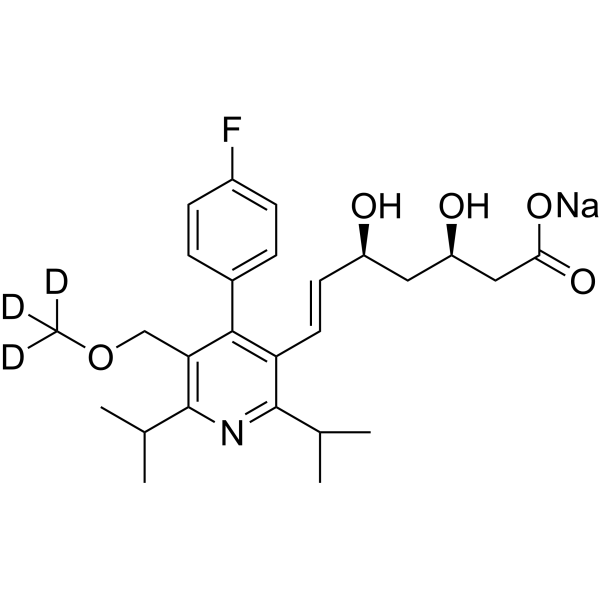
Cerivastatin-d3 sodium
Cerivastatin-d3 sodium is deuterated labeled Cerivastatin sodium (HY-109523). Cerivastatin sodium is a synthetic lipid-lowering agent and a highly potent, well-tolerated and orally active HMG-CoA reductase inhibitor, with a Ki of 1.3 nM/L. Cerivastatin sodium reduces low-density lipoprotein cholesterol levels. Cerivastatin sodium also inhibits proliferation and invasiveness of MDA-MB-231 cells, mainly by RhoA inhibition, and has anti-cancer effect.
For research use only. We do not sell to patients.
- CAS No.: 916314-45-9
- Formula: C26H30D3FNNaO5
- Molecular Weight:484.55
-
Storage:
Please store the product under the recommended conditions in the Certificate of Analysis.

To place orders, for customer services and technical support, please contact: MedChemExpress USA
Tel: 609-228-6898 E-mail: [email protected] [email protected]


-
 Biological Activity
-
Chemical Information
- Purity & Documentation
- References
-
 Help & FAQs




Biological Activity
Description
In Vitro
Stable heavy isotopes of hydrogen, carbon, and other elements have been incorporated into drug molecules, largely as tracers for quantitation during the drug development process. Deuteration has gained attention because of its potential to affect the pharmacokinetic and metabolic profiles of drugs[1].
Cerivastatin sodium (5-50 ng/mL; 3 days; MDA-MB-231 cells) treatment induces a dose-dependent decrease in cell proliferation of MDA-MB-231 cells (up to 40% inhibition at 25 ng/mL)[2].
Cerivastatin sodium (25 ng/mL; 18-36 hours; MDA-MB-231 cells) treatment induces an arrest of the cell cycle in G 1/S phase after 36 h treatment. This arrest is not observed for a shorter incubation time (18 h)[2].
Cerivastatin sodium (25 ng/mL; 18 hours; MDA-MB-231 cells) treatment induces a marked increase in the level of p21Waf1/Cip1[2].
Cerivastatin sodium (25 ng/mL; 12 hours; MDA-MB-231 cells) treatment increases the p21 transcript in MDA-MB-231 cells[2].
Cerivastatin sodium (10-25 ng/mL; 18 hours) inhibits invasion of MDA-MB-231 cells through Matrigel[2].
Cerivastatin sodium (25 ng/mL; 18-36 hours) delocalizes RhoA and Ras from the membrane to the cytosol and induces morphological changes[2].
Cerivastatin sodium (25 ng/mL; 4-36 hours) induces inactivation of NFκB, in a RhoA inhibition-dependent manner, resulting in a decrease in urokinase and metalloproteinase-9 expression, and concomitantly increases IκB[2].
MedChemExpress (MCE) has not independently confirmed the accuracy of these methods. They are for reference only.
In Vivo
MedChemExpress (MCE) has not independently confirmed the accuracy of these methods. They are for reference only.
Application
1. This compound can be used as a tracer
2. This compound can be used as an internal standard for quantitative analysis by NMR, GC-MS, or LC-MS.


Chemical Information
-
CAS No. 916314-45-9
-
Unlabeled CAS 143201-11-0
-
Molecular Weight 484.55
-
Formula C26H30D3FNNaO5
-
SMILES
FC(C=C1)=CC=C1C2=C(/C=C/[C@@H](O)C[C@@H](O)CC(O[Na])=O)C(C(C)C)=NC(C(C)C)=C2COC([2H])([2H])[2H]
-
Shipping
Room temperature in continental US; may vary elsewhere.
-
Storage
Please store the product under the recommended conditions in the Certificate of Analysis.


Purity & Documentation
References
[1]. Russak EM, et al. Impact of Deuterium Substitution on the Pharmacokinetics of Pharmaceuticals. Ann Pharmacother. 2019 Feb;53(2):211-216. [Content Brief]
[2]. Denoyelle C, et al. Cerivastatin, an inhibitor of HMG-CoA reductase, inhibits the signaling pathways involved in the invasiveness and metastatic properties of highly invasive breast cancer cell lines: an in vitro study. Carcinogenesis. 2001 Aug;22(8):1139-48. [Content Brief]
[3]. Stein E, et al. Cerivastatin, a New Potent Synthetic HMG Co-A Reductase Inhibitor: Effect of 0.2 mg Daily in Subjects With Primary Hypercholesterolemia. J Cardiovasc Pharmacol Ther. 1997 Jan;2(1):7-16. [Content Brief]
[4]. Furberg CD, et al. Withdrawal of cerivastatin from the world market. Curr Control Trials Cardiovasc Med. 2001;2(5):205-207. [Content Brief]

Calculators
Concentration (start) × Volume (start) = Concentration (final) × Volume (final)


Cerivastatin-d3 sodium Related Classifications
HY-109523S Related Classifications
 Powered by Bioz