



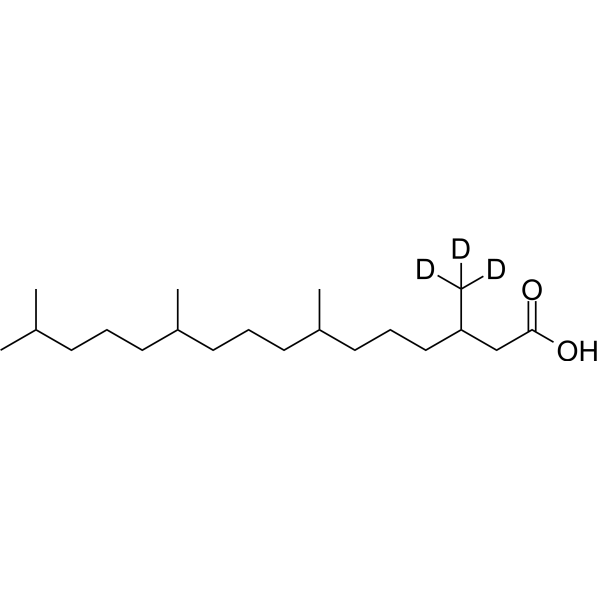
Phytanic acid-d3

Based on 1 Customer Validation
Phytanic acid-d3 is the deuterium labeled Phytanic acid. Phytanic acid is an endogenous metabolite present in Blood that can be used for the research of Zellweger Syndrome, Alpha Methylacyl CoA Racemase Deficiency, Rhizomelic Chondrodysplasia Punctata and Infantile Refsum Disease.
Nos produits utilisent uniquement pour la recherche. Nous ne vendons pas aux patients.
- Pureté: 98.95%
- CAS No.: 1383920-40-8
- Formule: C20H37D3O2
- Masse moléculaire:315.55
-
Stockage:
Solution, -20°C, 2 years

To place orders, for customer services and technical support, please contact: MedChemExpress USA
Tel: 609-228-6898 E-mail: [email protected] [email protected]


-
 Activité biologique
-
Chemical Information
- Pureté et documentation
- Références
-
 Help & FAQs


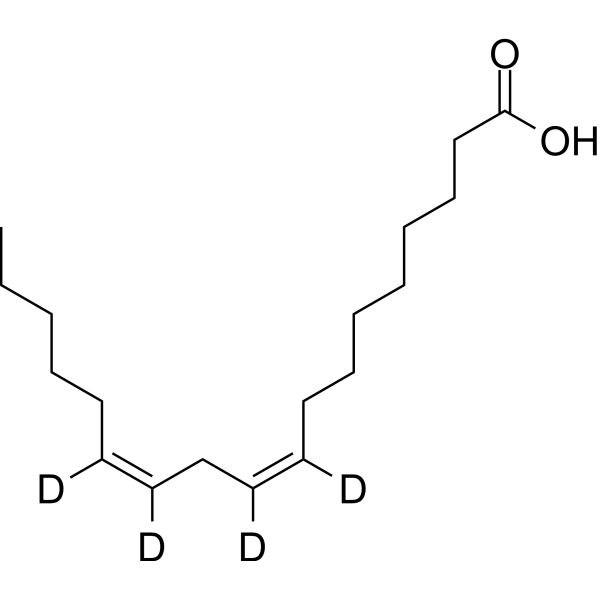
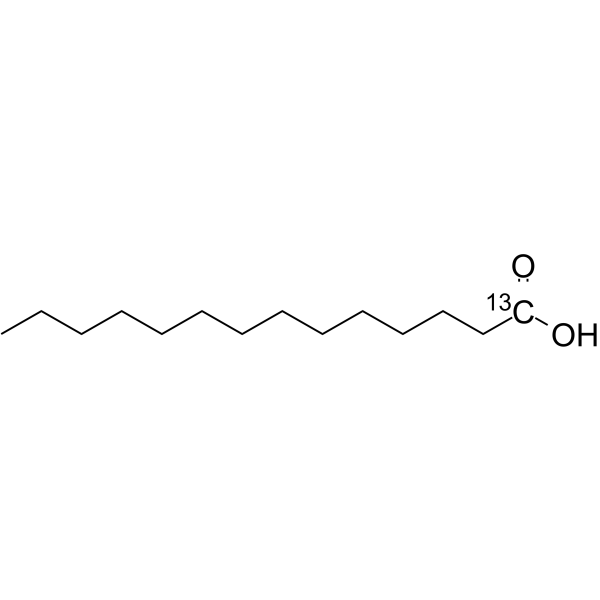
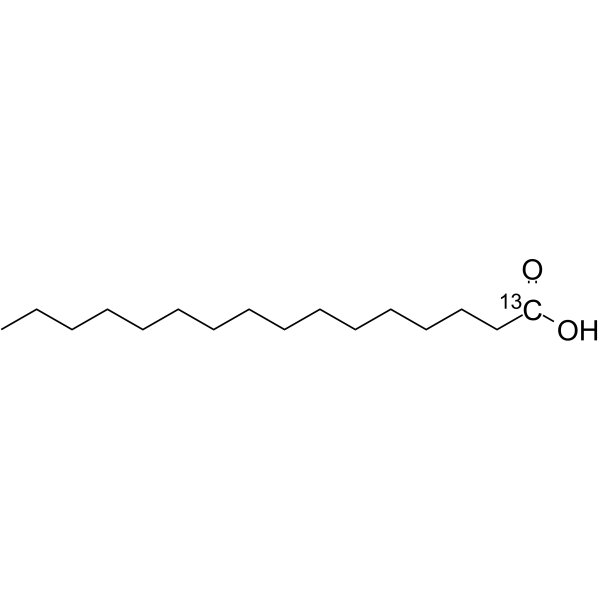
Voir tous les produits spécifiques à Isoform Endogenous Metabolite
More

Activité biologique
Description
In Vitro
Stable heavy isotopes of hydrogen, carbon, and other elements have been incorporated into drug molecules, largely as tracers for quantitation during the drug development process. Deuteration has gained attention because of its potential to affect the pharmacokinetic and metabolic profiles of drugs[1].
MedChemExpress (MCE) has not independently confirmed the accuracy of these methods. They are for reference only.
Application
1. This compound can be used as a tracer
2. This compound can be used as an internal standard for quantitative analysis by NMR, GC-MS, or LC-MS.


Chemical Information
-
CAS No. 1383920-40-8
-
Unlabeled CAS 14721-66-5
-
Appearance Liquid
-
Masse moléculaire 315.55
-
Formule C20H37D3O2
-
Color Colorless to light yellow
-
SMILES
CC(C)CCCC(C)CCCC(C)CCCC(C([2H])([2H])[2H])CC(O)=O
-
Livraison
Room temperature in continental US; may vary elsewhere.
-
Stockage
Solution, -20°C, 2 years


Pureté et documentation
-
Fiche technique (263 KB)
-
SDS (419 KB)
- English - EN (419 KB)
- Français - FR (419 KB)
- Deutsch - DE (419 KB)
- Norwegian - NO (419 KB)
- Español - ES (419 KB)
- Swedish - SV (419 KB)
- Italian - IT (419 KB)
- Korean - KR (419 KB)
- Portuguese - PT (419 KB)
-
Instruction de manipulation (2659 KB)
Références
[1]. Russak EM, et al. Impact of Deuterium Substitution on the Pharmacokinetics of Pharmaceuticals. Ann Pharmacother. 2019 Feb;53(2):211-216. [Content Brief]
[2]. Budden SS, et al. Dysmorphic syndrome with phytanic acid oxidase deficiency, abnormal very long chain fatty acids, and pipecolic acidemia: studies in four children. J Pediatr. 1986 Jan;108(1):33-9. [Content Brief]
[3]. McLean BN, et al. A new defect of peroxisomal function involving pristanic acid: a case report. J Neurol Neurosurg Psychiatry. 2002 Mar72(3):396-9. [Content Brief]
[4]. Baumgartner MR, et al. Clinical approach to inherited peroxisomal disorders: a series of 27 patients. Ann Neurol. 1998 Nov44(5):720-30. [Content Brief]
[5]. Poll-The BT, et al. Infantile Refsum's disease: biochemical findings suggesting multiple peroxisomal dysfunction. J Inherit Metab Dis. 19869(2):169-74. [Content Brief]
[6]. Lee N, et al. Endogenous toxic metabolites and implications in cancer therapy. Oncogene. 2020 Aug39(35):5709-5720. [Content Brief]

Calculators
Concentration (start) × Volume (start) = Concentration (final) × Volume (final)


Phytanic acid-d3 Related Classifications
HY-113067S Related Classifications
 Powered by Bioz