



Muscular Dystrophy
-
Muscular Dystrophy (14)

- 1
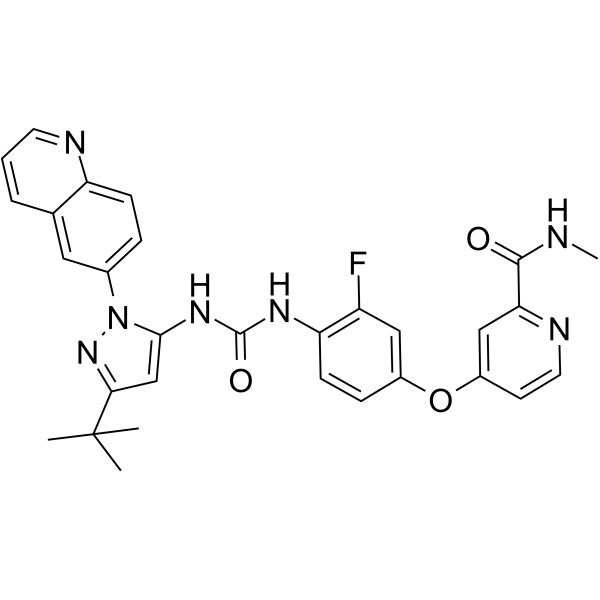
- Formula: C30H28FN7O3
- Molecular Weight: 553.59
Rebastinib (DCC-2036) is an orally active, non-ATP-competitive Bcr-Abl inhibitor, with IC50 values of 0.8 nM and 4 nM against Abl1WT and Abl1T315I, respectively. Rebastinib potently inhibits CYP2C8 (IC50 = 0.0533 μM) and CYP2C9 (IC50 = 2.54 μM). Rebastinib allosterically inhibits Tie2 with an IC50 of 0.63 nM. Rebastinib inhibits the transcriptional activity of FoxO1. Rebastinib inhibits SRC family kinases, KDR and FLT3 kinases. Rebastinib induces Apoptosis. Rebastinib exerts anti-tumor activity in breast cancer. Rebastinib exerts anti-angiogenic effects. Rebastinib increases myotube diameter and improves reduced contractility. Rebastinib can be used in research related to triple-negative breast cancer, luminal breast cancer, pancreatic neuroendocrine tumors, muscle atrophy, cancer cachexia, chronic myeloid leukemia, and B-lymphocytic leukemia.

- Formula: C6H12O6
- Molecular Weight: 180.16
Psicose (DL-Psicose) is an orally effective sugar substitute. Psicose activates the PI3K/Akt/mTOR pathway to promote muscle synthesis. Psicose upregulates IGF-1 and downregulates Myostatin. Psicose normalizes mitochondrial dysfunction by increasing G6P activity. Psicose enhances the activity of antioxidant enzymes and reduces oxidative stress markers. Psicose increases muscle mass, grip strength and muscle weight in aged mice and diet-induced obese mice. Psicose improves obesity and type 2 diabetes. Psicose can be used in the research of age-related sarcopenia.
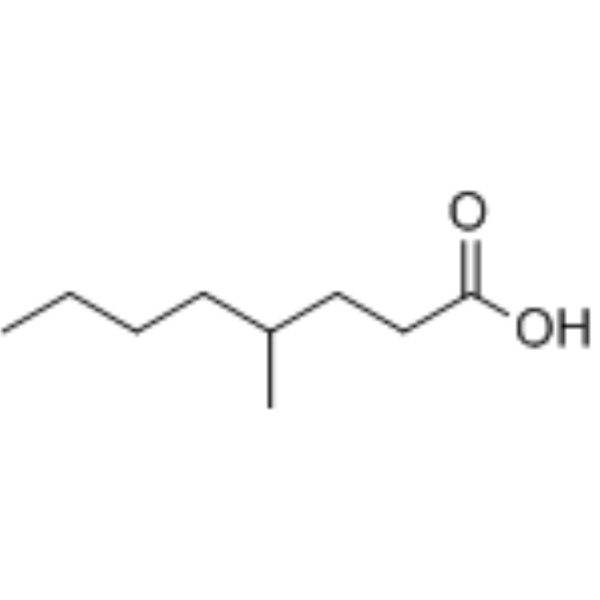
- Formula: C9H18O2
- Molecular Weight: 158.24
4-Methyloctanoic acid is an endogenous branched-chain medium-chain fatty acid and a negative regulator of the cAMP/PKA signaling pathway. 4-Methyloctanoic acid exerts antiepileptic effects by inhibiting epileptiform discharges and terminating behavioral and electroencephalographic seizures. 4-Methyloctanoic acid has neuroprotective effects; its polar metabolites can cross the blood-brain barrier, repair presynaptic release defects, improve motor function and alleviate neuromuscular degeneration in ALS models. 4-Methyloctanoic acid regulates phosphatidylinositol metabolism, reduces PIP/PIP2 levels and increases inositol levels. 4-Methyloctanoic acid can be used in studies related to epilepsy and amyotrophic lateral sclerosis.

- Formula: C9H18O2
- Molecular Weight: 158.24
4-Methyloctanoic acid (Standard) is the analytical standard of 4-Methyloctanoic acid (HY-W010178). This product is intended for research and analytical applications. 4-Methyloctanoic acid is an endogenous branched-chain medium-chain fatty acid and a negative regulator of the cAMP/PKA signaling pathway. 4-Methyloctanoic acid exerts antiepileptic effects by inhibiting epileptiform discharges and terminating behavioral and electroencephalographic seizures. 4-Methyloctanoic acid has neuroprotective effects; its polar metabolites can cross the blood-brain barrier, repair presynaptic release defects, improve motor function and alleviate neuromuscular degeneration in ALS models. 4-Methyloctanoic acid regulates phosphatidylinositol metabolism, reduces PIP/PIP2 levels and increases inositol levels. 4-Methyloctanoic acid can be used in studies related to epilepsy and amyotrophic lateral sclerosis.

- Formula: C37H36FN7O6S
- Molecular Weight: 725.79
Rebastinib tosylate (DCC-2036 tosylate) is an orally active, non-ATP-competitive Bcr-Abl inhibitor, with IC50 values of 0.8 nM and 4 nM against Abl1WT and Abl1T315I, respectively. Rebastinib tosylate potently inhibits CYP2C8 (IC50 = 0.0533 μM) and CYP2C9 (IC50 = 2.54 μM). Rebastinib tosylate allosterically inhibits Tie2 with an IC50 of 0.63 nM. Rebastinib tosylate inhibits the transcriptional activity of FoxO1. Rebastinib tosylate inhibits SRC family kinases, KDR and FLT3 kinases. Rebastinib tosylate induces Apoptosis. Rebastinib tosylate exerts anti-tumor activity in breast cancer. Rebastinib tosylate exerts anti-angiogenic effects. Rebastinib tosylate increases myotube diameter and improves reduced contractility. Rebastinib tosylate can be used in research related to triple-negative breast cancer, luminal breast cancer, pancreatic neuroendocrine tumors, muscle atrophy, cancer cachexia, chronic myeloid leukemia, and B-lymphocytic leukemia.

- Formula: C13H17FN4O2
- Molecular Weight: 280.30
Lomasemtiv (Lomasemtivum) is a Troponin activator. Lomasemtiv activates skeletal muscle myofibrils. Lomasemtiv is applicable to sarcopenia research.

- Formula: C23H21N7
- Molecular Weight: 395.46
TT-301 is a small-molecule immunomodulator capable of penetrating the blood-brain barrier. TT-301 exerts neuroprotective effects by binding to IL-1β, downregulating STAT3 expression, and modulating the JAK-STAT signaling pathway, thereby inhibiting microglial activation and the release of proinflammatory mediators, and alleviating neuroinflammation and brain edema. TT-301 is used in research on traumatic brain injury, intracerebral hemorrhage, subarachnoid hemorrhage, muscle wasting and atrophy, and periodontal disease.

- Formula: C25H34N4O3
- Molecular Weight: 438.56
GPR133 agonist 1 is an orally active GPR133/ADGRD1 agonist with an EC50 of 1.6 nM (293T cells). GPR133 agonist 1 activates GPR133, thereby regulating the downstream cAMP signaling pathway. GPR133 agonist 1 enhances muscle strength and endurance in mice. GPR133 agonist 1 can be used in research related to muscular atrophy, myasthenia, sarcopenia, erectile dysfunction, vestibular dysfunction, obesity, and non-alcoholic fatty liver disease.

- Formula: C17H15N5O
- Molecular Weight: 305.33
NAMPT activator-9 (Compound DIPM) is an allosteric, non-competitive NAMPT activator, with an EC50 of 3.366 μM against hNAMPT. NAMPT activator-9 enhances the enzymatic activity of NAMPT via an allosteric, non-competitive mechanism. NAMPT activator-9 increases intracellular NAD+ levels. NAMPT activator-9 restores myotube diameter and reduces the expression of atrophy markers Atrogin-1 and MuRF1. NAMPT activator-9 is applicable to research related to muscle atrophy.

- Formula: C57H98N18O17
- Molecular Weight: 1307.50
BV2 is a delivery peptide that binds to BVES, with a Ka of 2.03 μM for the BVES target. BV2 specifically binds to the extracellular domain of BVES, achieving muscle homing and cellular internalization via caveolae-mediated endocytosis. When BV2 is modified on the surface of exosomes by PMO, it enhances dystrophin restoration in the peripheral muscles and myocardium of dystrophin-deficient mice. BV2 is applicable to research related to Duchenne muscular dystrophy and muscle atrophy.

- Formula: C96H66O48
- Molecular Weight: 1987.52
Ishophloroglucin A is an orally active phlorotannin compound found in Ishige okamurae. Ishophloroglucin A can alleviate Dexamethasone (HY-14648)-induced muscle atrophy through muscle protein metabolism. Ishophloroglucin A can improve impaired protein synthesis (PI3K and Akt) or degradation (muscle-specific ubiquitin ligase muscle RING finger and atrogin-1). Ishophloroglucin A can be used for research of muscle atrophy-related diseases.

- Formula: C23H22ClN7
- Molecular Weight: 431.93
TT-301 hydrochloride is a small-molecule immunomodulator capable of penetrating the blood-brain barrier. TT-301 hydrochloride exerts neuroprotective effects by binding to IL-1β, downregulating STAT3 expression, and modulating the JAK-STAT signaling pathway, thereby inhibiting microglial activation and the release of proinflammatory mediators, and alleviating neuroinflammation and brain edema. TT-301 hydrochloride is used in research on traumatic brain injury, intracerebral hemorrhage, subarachnoid hemorrhage, muscle wasting and atrophy, and periodontal disease.

- Formula: C5H8F3NO2
- Molecular Weight: 171.12
(S)-2-Amino-5,5,5-trifluoropentanoic acid ((S)-5,5,5-Trifluoronorvaline; H-Nva (5,5,5-triF)-OH) is a selective Sestrin-GATOR2 modulator that indirectly inhibits mTORC1 activity via a competitive binding mechanism. (S)-2-Amino-5,5,5-trifluoropentanoic acid can be used in research on cancer, metabolic diseases, neurodegenerative diseases, and muscle atrophy.\n

- Formula: C24H20ClN5O2
- Molecular Weight: 445.90
TAO Kinase-IN-3 is a potent pan-TAOK (Thousand-And-One Kinase) inhibitor that specifically binds to and inhibits the kinase activities of TAOK1, TAOK2 and TAOK3 with Kd values of <0.17 nM, 0.34 nM, and 0.17 nM, respectively. TAO Kinase-IN-3 can be used to study Alzheimer's disease, primary tauopathies and related syndromes. In addition, TAO Kinase-IN-3 is also widely used in research on the mechanisms of cancer cachexia and the muscle atrophy it induces.
- 1



