



Rhodiolin
Based on 1 publication(s) in Google Scholar
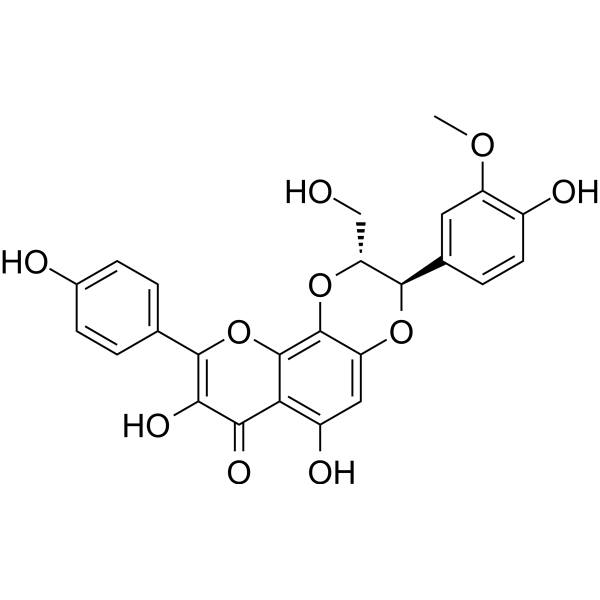
Rhodiolin, a flavonoid, is an orally active glucose 6-phosphate isomerase (GPI) inhibitor. Rhodiolin inhibits papillary thyroid cancer (PTC) by targeting glycolysis enzyme glucose 6-phosphate isomerase GPI and suppressing PI3K/AKT/mTOR phosphorylation and induce apoptosis. Rhodiolin as a NS2B-NS3 protease inhibitor can disrupt dengue viral replication. Rhodiolin is also a potential candidate for developing anticancer strategies inhibiting CK1ε kinase. Rhodiolin can be used for the study of anti-tumor and anti-viral .
For research use only. We do not sell to patients.
- Purity: 98%
- CAS No.: 86831-53-0
- Formula: C25H20O10
- Molecular Weight:480.42
-
Storage:
4°C, protect from light
* In solvent : -80°C, 6 months; -20°C, 1 month (protect from light)

To place orders, for customer services and technical support, please contact: MedChemExpress USA
Tel: 609-228-6898 E-mail: [email protected] [email protected]


-
 Biological Activity
-
Chemical Information
- Purity & Documentation
- References
-
 Help & FAQs


Publications Citing Use of MedChemExpress (MCE) Rhodiolin
More

Biological Activity
|
CK1ε |
PI3K |
Akt |
mTOR |
|
Cell Line

|
Type | Value | Description | References |
|---|---|---|---|---|
| MDCK | CC50 |
>300 μM
Compound: 9
|
Cytotoxicity against MDCK cells after 48 hrs by MTT assay
Cytotoxicity against MDCK cells after 48 hrs by MTT assay
|
[PMID: 19729316] |
| MDCK | EC50 |
29.3 μM
Compound: 9
|
Antiviral activity against influenza A virus H9N2 A/Chicken/Korea/MS96/96 infected in MDCK cells assessed as reduction in virus-induced cytopathic effect
Antiviral activity against influenza A virus H9N2 A/Chicken/Korea/MS96/96 infected in MDCK cells assessed as reduction in virus-induced cytopathic effect
|
[PMID: 19729316] |
| MDCK | EC50 |
41.7 μM
Compound: 9
|
Antiviral activity against influenza A virus H1N1 A/PR/8/34 infected in MDCK cells assessed as reduction in virus-induced cytopathic effect
Antiviral activity against influenza A virus H1N1 A/PR/8/34 infected in MDCK cells assessed as reduction in virus-induced cytopathic effect
|
[PMID: 19729316] |
Rhodiolin (0-40 μM, 24 h) induces cell cycle arrest at G1/S phase in PTC cells[1].
Rhodiolin (0-40 μM, 12-24 h) blocks glycolysis by downregulating GPI expression and then inhibited the PI3K/Akt/mTOR signaling pathway which, in turn, inhibits the proliferation and induces the apoptosis of PTC cells[1].
MedChemExpress (MCE) has not independently confirmed the accuracy of these methods. They are for reference only.
-
Cell Line:PTC cells
-
Concentration:10, 20 and 40 μM
-
Incubation Time:24 h
-
Result:Showed a dose-dependent reduction in S-phase cells.
-
Cell Line:PTC cells
-
Concentration:10, 20 and 40 μM
-
Incubation Time:12 h
-
Result:Observed A dose-dependent increase in the percentage of cells undergoing early apoptosis and late apoptosis.
Caused dose-dependent reduction in MMP.
Reduced the number of mitochondria in tumor cells significantly while increasing the intracellular oxidation level.
-
Cell Line:PTC cells
-
Concentration:10, 20 and 40 μM
-
Incubation Time:24 h
-
Result:Decreased the expression of cyclin E, CDK4, and CDK2 .
Increased the expression of the expression of p21 and p27.
Reduced phosphorylation of the PI3K/Akt/mTOR signaling pathway significantly.
MedChemExpress (MCE) has not independently confirmed the accuracy of these methods. They are for reference only.
-
Animal Model:MH-134 hepatoma xenograft model established in 6 weeks old female C57BL/6 mice[1]
-
Dosage:10 and 25 mg/kg
-
Administration:Intragastric administration (i.g.), every two days for 10 days
-
Result:Reduced the tumor-cell density significantly.
Showed a dose-dependent reduction in the number of Ki-67-positive cells and GPI expression.
Induced significant apoptosis in tumor tissue.
No signs of hepatotoxicity were evident.
No morphological abnormalities or signs of inflammation were detected in the heart, liver, spleen, lungs, or kidneys of mice.


Chemical Information
-
CAS No. 86831-53-0
-
Appearance Solid
-
Molecular Weight 480.42
-
Formula C25H20O10
-
Color Light yellow to yellow
-
SMILES
O=C1C2=C(O)C=C(O[C@H](C3=CC(OC)=C(O)C=C3)[C@@H](CO)O4)C4=C2OC(C5=CC=C(O)C=C5)=C1O
-
Structure Classification
-
Initial Source
-
Shipping
Room temperature in continental US; may vary elsewhere.
-
Storage
4°C, protect from light
* In solvent : -80°C, 6 months; -20°C, 1 month (protect from light)


Publications (1)
-
Journal Impact Factor
-
Most Recent
-
Phytomedicine
Rhodiolin inhibits the PI3K/AKT/mTOR signaling pathway via the glycolytic enzyme GPI in human papillary thyroid cancer. [Abstract]2024 Jun 25:132:155804. PMID: 38943696


Purity & Documentation
-
Data Sheet (278 KB)
-
SDS (252 KB)
- English - EN (252 KB)
- Français - FR (252 KB)
- Deutsch - DE (252 KB)
- Norwegian - NO (252 KB)
- Español - ES (252 KB)
- Swedish - SV (252 KB)
- Italian - IT (252 KB)
- Korean - KR (252 KB)
- Portuguese - PT (252 KB)
-
Handling Instructions (2659 KB)
References
[1]. Bo J, et al. Rhodiolin inhibits the PI3K/AKT/mTOR signaling pathway via the glycolytic enzyme GPI in human papillary thyroid cancer. Phytomedicine. 2024 Sep;132:155804. [Content Brief]
[2]. Hakami MA, et al. Identification of potential casein kinase I isoform epsilon inhibitors from phytoconstituents: implications for targeted anticancer therapeutics. J Biomol Struct Dyn. 2025 Apr 29:1-13. [Content Brief]
[3]. Purohit P, et al. Targeting the DENV NS2B-NS3 protease with active antiviral phytocompounds: structure-based virtual screening, molecular docking and molecular dynamics simulation studies. J Mol Model. 2022 Oct 24;28(11):365. [Content Brief]

Calculators
Concentration (start) × Volume (start) = Concentration (final) × Volume (final)


Rhodiolin Related Classifications
HY-N6841 Related Classifications
 Powered by Bioz