



EDTA tetrasodium tetrahydrate

Based on 1 Customer Validation
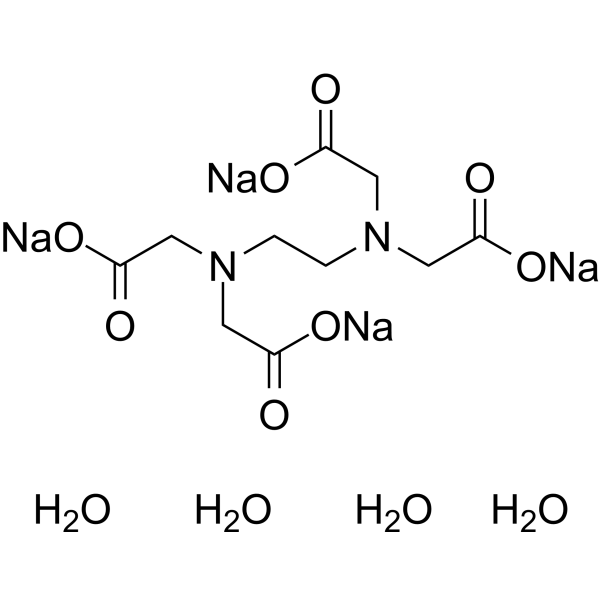
EDTA tetrasodium tetrahydrate is a metal chelator (binds to metal divalent and trivalent cations including calcium), which shows activities of anticoagulant and anti-hypercalcemic. EDTA tetrasodium tetrahydrate decreases the metal ion-catalyzed oxidative damage to proteins, and allows maintenance of reducing environment during protein purification. EDTA tetrasodium tetrahydrate can also decrease the formation of disulfide bonds.
For research use only. We do not sell to patients.
- Purity : 97.0%
- CAS No.: 13235-36-4
- Formula: C10H20N2Na4O12
- Molecular Weight:452.23
-
Storage:Powder -20°C, 3 years , 4°C, 2 years ; In solvent -80°C, 6 months , -20°C, 1 month

To place orders, for customer services and technical support, please contact: MedChemExpress USA
Tel: 609-228-6898 E-mail: [email protected] [email protected]


-
 Biological Activity
-
Chemical Information
- Purity & Documentation
- References
-
 Help & FAQs




Biological Activity
Description


Chemical Information
-
CAS No. 13235-36-4
-
Appearance Solid
-
Molecular Weight 452.23
-
Formula C10H20N2Na4O12
-
Color White to off-white
-
SMILES
O=C(O[Na])CN(CC(O[Na])=O)CCN(CC(O[Na])=O)CC(O[Na])=O.O.O.O.O
-
Synonyms
Ethylenediaminetetraacetic acid tetrasodium tetrahydrate
-
Shipping
Room temperature in continental US; may vary elsewhere.
-
Storage
Powder -20°C 3 years 4°C 2 years In solvent -80°C 6 months -20°C 1 month


Purity & Documentation
-
Data Sheet (271 KB)
-
SDS (778 KB)
- English - EN (778 KB)
- Français - FR (778 KB)
- Deutsch - DE (778 KB)
- Norwegian - NO (778 KB)
- Español - ES (778 KB)
- Swedish - SV (778 KB)
- Italian - IT (778 KB)
- Korean - KR (778 KB)
- Portuguese - PT (778 KB)
-
Handling Instructions (2659 KB)
References
[1]. Chumanov RS, et al. Artifact-inducing enrichment of ethylenediaminetetraacetic acid and ethyleneglycoltetraacetic acid on anion exchange resins. Anal Biochem. 2011 May 1;412(1):34-9. [Content Brief]
[2]. Banfi G, et al. The role of ethylenediamine tetraacetic acid (EDTA) as in vitro anticoagulant for diagnostic purposes. Clin Chem Lab Med. 2007;45(5):565-76. [Content Brief]
[3]. Ibad A, et al. Chelation therapy in the treatment of cardiovascular diseases. J Clin Lipidol. 2016 Jan-Feb;10(1):58-62. [Content Brief]

Calculators
Concentration (start) × Volume (start) = Concentration (final) × Volume (final)


EDTA tetrasodium tetrahydrate Related Classifications
HY-W105699 Related Classifications
 Powered by Bioz