



Imipramine pamoate
Based on 3 publication(s) in Google Scholar
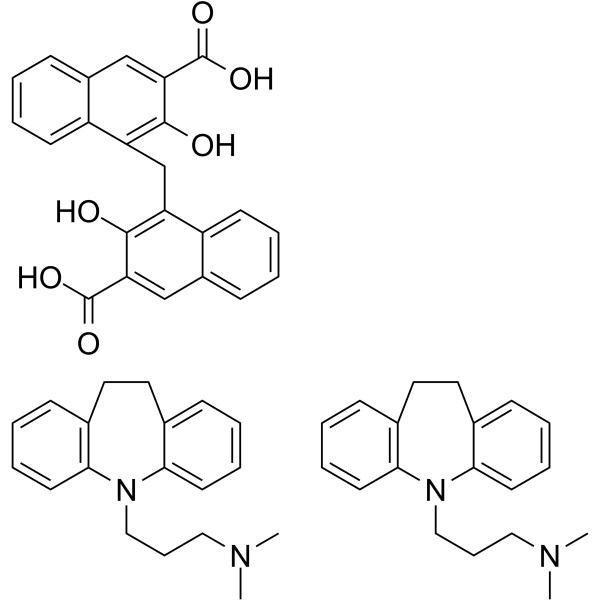
Imipramine pamoate is a potent anti-depressant compound.
For research use only. We do not sell to patients.
- CAS No.: 10075-24-8
- Formula: C61H64N4O6
- Molecular Weight:949.18
-
Storage:
Please store the product under the recommended conditions in the Certificate of Analysis.

To place orders, for customer services and technical support, please contact: MedChemExpress USA
Tel: 609-228-6898 E-mail: [email protected] [email protected]


-
 Biological Activity
-
Chemical Information
- Purity & Documentation
- References
-
 Help & FAQs


Publications Citing Use of MedChemExpress (MCE) Imipramine pamoate
More Customer Validation & Images

-
Cell Proliferation/Viability Assay
-
Cell Proliferation/Viability Assay
-
Cell Imaging/Staining
-
Cell Migration/Invasion Assay
-
Flow Cytometry


Biological Activity
Description
Clinical Trial
| NCT Number | Sponsor | Condition | Start Date |
Phase

|
|---|---|---|---|---|
| NCT01329991 | Plexxikon| | 2011-05 | PHASE1 |


Chemical Information
-
CAS No. 10075-24-8
-
Molecular Weight 949.18
-
Formula C61H64N4O6
-
SMILES
OC1=C(C2=CC=CC=C2C=C1C(O)=O)CC3=C(O)C(C(O)=O)=CC4=CC=CC=C34.CN(C)CCCN5C6=CC=CC=C6CCC7=C5C=CC=C7.CN(C)CCCN8C9=CC=CC=C9CCC%10=C8C=CC=C%10
-
Shipping
Room temperature in continental US; may vary elsewhere.
-
Storage
Please store the product under the recommended conditions in the Certificate of Analysis.


Publications (3)
-
Journal Impact Factor
-
Most Recent
-
Nat Chem Biol
2024 Jul;20(7):857-866. PMID: 38355723 -
-
Int Immunopharmacol
Innovative role of the antidepressant imipramine in esophageal squamous cell carcinoma treatment: Promoting apoptosis and protective autophagy. [Abstract]2025 Feb 6:147:113969. PMID: 39764996
Imipramine pamoate purchased from MedChemExpress. Usage Cited in: Int Immunopharmacol. 2025 Feb 6:147:113969. [Abstract]
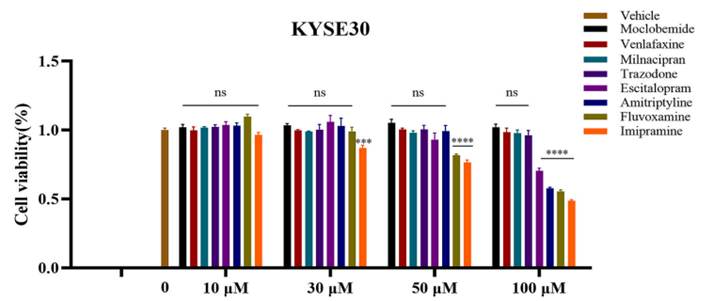
Cells were exposed to moclobemide, milnacipran, venlafaxine, escitalopram, amitriptyline, trazodone, fluvoxamine, or Imipramine (0–100 μM concentration) for 24 h. Cell viability was assessed with CCK-8 assays.
Imipramine pamoate purchased from MedChemExpress. Usage Cited in: Int Immunopharmacol. 2025 Feb 6:147:113969. [Abstract]
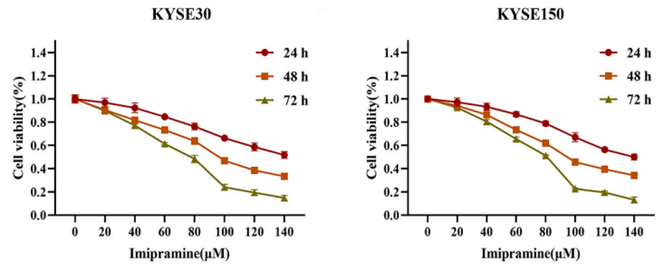
CCK-8 assays for 24 h, 48 h and 72 h in KYSE30 and KYSE150 cells treated with various concentrations of Imipramine.
Imipramine pamoate purchased from MedChemExpress. Usage Cited in: Int Immunopharmacol. 2025 Feb 6:147:113969. [Abstract]
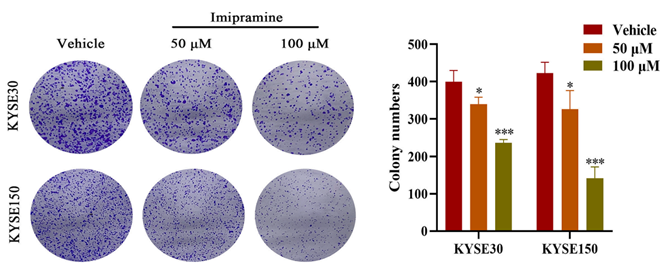
Colony formation assays in KYSE30 and KYSE150 cells treated with Imipramine (0, 50, or 100 μM, 14 days) . Histograms represent the number of colonies per set of replicates, according to colony formation measurements (n = 3).
Imipramine pamoate purchased from MedChemExpress. Usage Cited in: Int Immunopharmacol. 2025 Feb 6:147:113969. [Abstract]
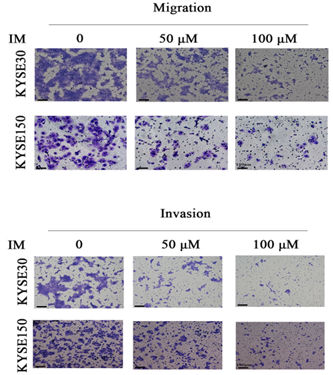
Imipramine (0, 50, or 100 μM, 48 h). KYSE30 and KYSE150 cells showing migration or invasion in Transwell assays were fixed and stained. Cells that crossed the membranes were counted under a light microscope (10 × ) in three random fields of view.
Imipramine pamoate purchased from MedChemExpress. Usage Cited in: Int Immunopharmacol. 2025 Feb 6:147:113969. [Abstract]
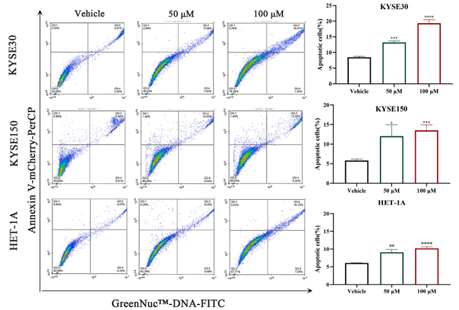
Imipramine (0, 50, or 100 μM, 48 h) induces apoptosis in ESCC cells. ESCC or HET-1A cells were treated with various concentrations of Imipramine for 48 h. Cell apoptosis was detected by flow cytometry with annexin V-FITC/Caspase-3 double staining.
Imipramine pamoate purchased from MedChemExpress. Usage Cited in: Int Immunopharmacol. 2025 Feb 6:147:113969. [Abstract]
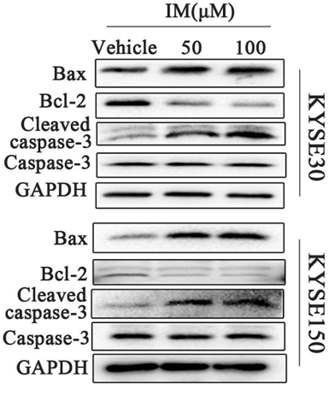
ESCC cells were treated with various concentrations of Imipramine (50, 100 μM) for 48 h. Western blotting was performed to assess Bax, Bcl-2, and cleaved-caspase-3 expression.
Imipramine pamoate purchased from MedChemExpress. Usage Cited in: Int Immunopharmacol. 2025 Feb 6:147:113969. [Abstract]
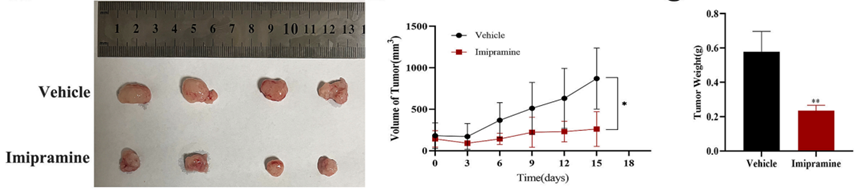
Anti-tumor effect of Imipramine (receiving intraperitoneal injections of 20 mg/kg/day, 15 days) in a xenograft model.Representative images depicting the appearance of tumors at the conclusion of treatment. Tumor volumes were measured every 3 days. Final tumor weights.
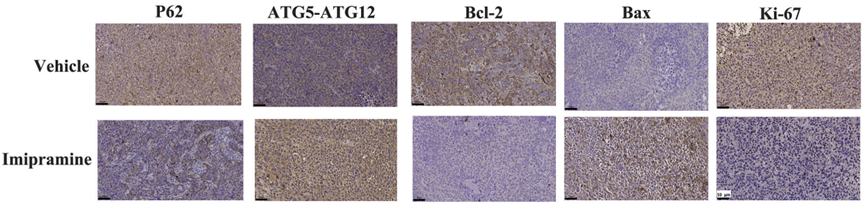
Imipramine pamoate purchased from MedChemExpress. Usage Cited in: Int Immunopharmacol. 2025 Feb 6:147:113969. [Abstract]
Imipramine (receiving intraperitoneal injections of 20 mg/kg/day, 15 days). Expression of P62, ATG5-ATG12 complex, Bcl-2, Bax, and Ki-67 was detected by IHC staining in tumor tissues.


Purity & Documentation
References

Calculators
Concentration (start) × Volume (start) = Concentration (final) × Volume (final)


Imipramine pamoate Related Classifications
HY-107956 Related Classifications
 Powered by Bioz