



Dihydrokavain

Based on 1 Customer Validation
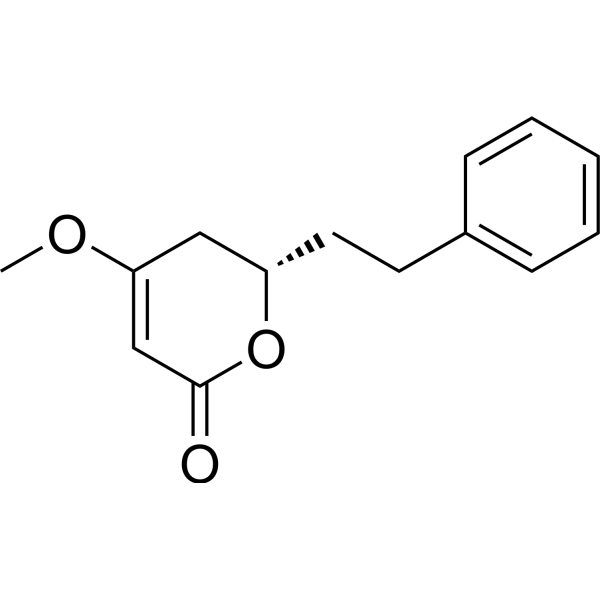
Dihydrokavain (7,8-Dihydrokawain) is a natural kavalactone compound. Dihydrokavain inhibits COX-1, COX-2, CYP2C9 (IC50 = 130.95 μM), CYP2C19 (IC50 = 10.05 μM) and CYP3A4 (IC50 = 78.59 μM). Dihydrokavain reduces TNFα secretion. Dihydrokavain shows analgesic and anxiolytic effects.
연구목적의 판매만을 진행합니다. 환자를 대상으로 한 판매는 하지 않습니다.
- Purity: 99.94%
- CAS No.: 587-63-3
- 화학식: C14H16O3
- 분자량:232.28
-
보관:
4°C, protect from light
* In solvent : -80°C, 6 months; -20°C, 1 month (protect from light)

To place orders, for customer services and technical support, please contact: MedChemExpress USA
Tel: 609-228-6898 E-mail: [email protected] [email protected]


-
 Biological Activity
-
Chemical Information
-
용액&용해도
- 순도&문서
- References
-
 Help & FAQs
-

Immunology/Inflammation Compound Library
HY-L007
-
Metabolism/Protease Compound Library
HY-L012
-
Natural Product Library
HY-L021
-
Anti-Aging Compound Library
HY-L034
-
Antioxidant Compound Library
HY-L037
-
Oxygen Sensing Compound Library
HY-L045
-
Medicine Food Homology Compound Library
HY-L055
-
Pyroptosis Compound Library
HY-L059
-
Traditional Chinese Medicine Active Compound Library
HY-L065
-
Anti-Pancreatic Cancer Compound Library
HY-L077
-
Mitochondria-Targeted Compound Library
HY-L089
-
Anti-Colorectal Cancer Compound Library
HY-L103
-
Antidepressant Compound Library
HY-L108
-
Anti-inflammatory Traditional Chinese Medicine Active Compound Library
HY-L114
-
Plant-Sourced Natural Product Library
HY-L115
-
Human Metabolite Library
HY-L123
-
Anti-Prostate Cancer Compound Library
HY-L124
-
Cancer Stem Cells Compound Library
HY-L135
-
Metabolic Enzyme Compound Library
HY-L146
-
Multi-Target Compound Library
HY-L176
-
Radioprotector Library
HY-L178
-
Bioactive Compound Library Max
HY-L181
-
MCE Bioactive Compound Library
HY-L001V
-
Natural Product Library Plus
HY-L021P
-
Natural Product and Natural Product-Like Compound Library
HY-L021M
-
Bioactive Compound Library
HY-L001
-
RO5 Drug-like Natural Product Library
HY-L200
-
High-Throughput Bioactive Compound Library
HY-L205
-
High-Throughput Natural Product Library
HY-L206
-
Anti-Rheumatic Arthritis Compound Library
HY-L210
-
Mass Spectrometry Human Metabolite Library
HY-L215
-
Diarrhea-Related Traditional Chinese Medicine Active Compound Library
HY-L224
-
Mongolian Medicine Compound Library
HY-L238
-
Natural Product Diversity Scaffold Library
HY-L245
-
Mass Spectrometry Natural Product Library
HY-L262
-
3D Diverse Fragment Library
HY-L903




Biological Activity
|
COX-2 |
COX-1 |
CYP2C9 130.95 μM (IC50) |
CYP2C19 10.05 μM (IC50) |
CYP3A4 78.59 μM (IC50) |
|
Cell Line

|
Type | Value | Description | References |
|---|---|---|---|---|
| A549 | IC50 |
60 μg/mL
Compound: (+)-Dihydrokavain
|
Inhibition of TNF-alpha-induced NF-kappaB expressed in human A549 cells treated 1 hr after TNFalpha challenge measured after 6 hrs by luciferase reporter gene assay
Inhibition of TNF-alpha-induced NF-kappaB expressed in human A549 cells treated 1 hr after TNFalpha challenge measured after 6 hrs by luciferase reporter gene assay
|
[PMID: 19716299] |
Dihydrokavain inhibits COX-1 and COX-2 by approximately 58% and 28%, respectively[1].
Dihydrokavain (50 μg/mL) reduces TNFα secretion in a lipopolysaccharide-stimulated human acute monocytic leukaemia derived cell line (THP-1)[3].
Dihydrokavain inhibits CYP2C9 (IC50 = 130.95 μM), CYP2C19 (IC50 = 10.05 μM) and CYP3A4 (IC50 = 78.59 μM)[4].
MedChemExpress (MCE) has not independently confirmed the accuracy of these methods. They are for reference only.
MedChemExpress (MCE) has not independently confirmed the accuracy of these methods. They are for reference only.
-
Animal Model:Male Balb-c mice (20-25 g bodyweight)[6]
-
Dosage:150 mg/kg
-
Administration:Intraperitoneal injection
-
Result:Significantly prolonged the tail-flick reaction time, indicating a potent analgesic property.
Showed a short-lived analgesic effect, lasting approximately 20-30 min.


Chemical Information
-
CAS No. 587-63-3
-
Appearance Solid
-
분자량 232.28
-
화학식 C14H16O3
-
Color White to off-white
-
SMILES
O=C1C=C(OC)C[C@H](CCC2=CC=CC=C2)O1
-
Synonyms
7,8-Dihydrokawain; 7,8-Dihydrokavain; Marindinin
-
Structure Classification
-
Initial Source
-
선적
Room temperature in continental US; may vary elsewhere.
-
보관
4°C, protect from light
* In solvent : -80°C, 6 months; -20°C, 1 month (protect from light)


용액&용해도
DMSO : 100 mg/mL (430.51 mM; Need ultrasonic; Hygroscopic DMSO has a significant impact on the solubility of product, please use newly opened DMSO)
Please refer to the solubility information to select the appropriate solvent. Once prepared, please aliquot and store the solution to prevent product inactivation from repeated freeze-thaw cycles.
Storage method and period of stock solution: -80°C, 6 months; -20°C, 1 month (protect from light). When stored at -80°C, please use it within 6 months. When stored at -20°C, please use it within 1 month.
Please refer to the solubility information to select the appropriate solvent. Once prepared, please aliquot and store the solution to prevent product inactivation from repeated freeze-thaw cycles.
Storage method and period of stock solution: -80°C, 6 months; -20°C, 1 month (protect from light). When stored at -80°C, please use it within 6 months. When stored at -20°C, please use it within 1 month.
Concentration (start) × Volume (start) = Concentration (final) × Volume (final)
Select the appropriate dissolution method based on your experimental animal and administration route.
- For the following dissolution methods, please ensure to first prepare a clear stock solution using an In Vitro approach and then sequentially add co-solvents:
- To ensure reliable experimental results, the clarified stock solution can be appropriately stored based on storage conditions. As for the working solution for In Vivo experiments, it is recommended to prepare freshly and use it on the same day.
- The percentages shown for the solvents indicate their volumetric ratio in the final prepared solution. If precipitation or phase separation occurs during preparation, heat and/or sonication can be used to aid dissolution.
Add each solvent one by one: 10% DMSO 40% PEG300 5% Tween-80 45% Saline
Solubility: ≥ 2.5 mg/mL (10.76 mM); Clear solution
This protocol yields a clear solution of ≥ 2.5 mg/mL (saturation unknown).
Taking 1 mL working solution as an example, add 100 μL DMSO stock solution (25.0 mg/mL) to 400 μL PEG300, and mix evenly; then add 50 μL Tween-80 and mix evenly; then add 450 μL Saline to adjust the volume to 1 mL.
Preparation of Saline: Dissolve 0.9 g sodium chloride in ddH₂O and dilute to 100 mL to obtain a clear Saline solution.
Add each solvent one by one: 10% DMSO 90% (20% SBE-β-CD in Saline)
Solubility: 2.5 mg/mL (10.76 mM); Suspended solution; Need ultrasonic
This protocol yields a suspended solution of 2.5 mg/mL. Suspended solution can be used for oral and intraperitoneal injection.
Taking 1 mL working solution as an example, add 100 μL DMSO stock solution (25.0 mg/mL) to 900 μL 20% SBE-β-CD in Saline, and mix evenly.
Preparation of 20% SBE-β-CD in Saline (4°C, storage for one week): 2 g SBE-β-CD powder is dissolved in 10 mL Saline, completely dissolve until clear.
Please enter the basic information of animal experiments:
-
-
-
-
Recommended: Prepare an additional quantity of animals to account for potential losses during experiments.
Please enter your animal formula composition:
-
%DMSO +
Recommended: Keep the proportion of DMSO in working solution below 2% if your animal is weak.
-
%+
-
+%Tween-80 + +
-
%Saline +
The co-solvents required include: DMSO, . All of co-solvents are available by MedChemExpress (MCE). , Tween 80. All of co-solvents are available by MedChemExpress (MCE).
Working solution concentration: 0.22 mg/mL
Method for preparing stock solution: mg drug dissolved in μL DMSO. Stock solution concentration: mg/mL. * In solvent : -80°C, 6 months; -20°C, 1 month (protect from light)
1. Take μL DMSO stock solution;
2. Add μL .
μL , mix evenly;
3. Then add μL Tween 80, mix evenly;
4. Then add μL
Please ensure that the stock solution in the first step is dissolved to a clear state, and add co-solvents in sequence. You can use ultrasonic heating (ultrasonic cleaner, recommended frequency 20-40 kHz), vortexing, etc. to assist dissolution.


순도&문서
-
Data Sheet (274 KB)
-
SDS (393 KB)
- English - EN (393 KB)
- Français - FR (393 KB)
- Deutsch - DE (393 KB)
- Norwegian - NO (393 KB)
- Español - ES (393 KB)
- Swedish - SV (393 KB)
- Italian - IT (393 KB)
- Korean - KR (393 KB)
- Portuguese - PT (393 KB)
-
Handling Instructions (2659 KB)
References
[1]. Rowe A, et al. Kavalactone pharmacophores for major cellular drug targets. Mini Rev Med Chem. 2011 Jan;11(1):79-83. [Content Brief]
[2]. Xia Q, et al. Phototoxicity of kava - formation of reactive oxygen species leading to lipid peroxidation and DNA damage. Am J Chin Med. 2012;40(6):1271-88. [Content Brief]
[3]. Bian T, et al. Kava as a Clinical Nutrient: Promises and Challenges. Nutrients. 2020 Oct 5;12(10):3044. [Content Brief]
[4]. Anke J, et al. Pharmacokinetic and pharmacodynamic drug interactions with Kava (Piper methysticum Forst. f.). J Ethnopharmacol. 2004 Aug;93(2-3):153-60. [Content Brief]
[5]. Feltenstein MW, et al. Anxiolytic properties of Piper methysticum extract samples and fractions in the chick social-separation-stress procedure. Phytother Res. 2003 Mar;17(3):210-6. [Content Brief]
[6]. Jamieson DD, et al. The antinociceptive actions of kava components in mice. Clin Exp Pharmacol Physiol. 1990 Jul;17(7):495-507. [Content Brief]


Complete Stock Solution Preparation Table
Please refer to the solubility information to select the appropriate solvent. Once prepared, please aliquot and store the solution to prevent product inactivation from repeated freeze-thaw cycles.
Storage method and period of stock solution: -80°C, 6 months; -20°C, 1 month (protect from light). When stored at -80°C, please use it within 6 months. When stored at -20°C, please use it within 1 month.
| Optional Solvent | Concentration Solvent Mass | 1 mg | 5 mg | 10 mg | 25 mg |
|---|---|---|---|---|---|
| DMSO | 1 mM | 4.3051 mL | 21.5257 mL | 43.0515 mL | 107.6287 mL |
| 5 mM | 0.8610 mL | 4.3051 mL | 8.6103 mL | 21.5257 mL | |
| 10 mM | 0.4305 mL | 2.1526 mL | 4.3051 mL | 10.7629 mL | |
| 15 mM | 0.2870 mL | 1.4350 mL | 2.8701 mL | 7.1752 mL | |
| 20 mM | 0.2153 mL | 1.0763 mL | 2.1526 mL | 5.3814 mL | |
| 25 mM | 0.1722 mL | 0.8610 mL | 1.7221 mL | 4.3051 mL | |
| 30 mM | 0.1435 mL | 0.7175 mL | 1.4350 mL | 3.5876 mL | |
| 40 mM | 0.1076 mL | 0.5381 mL | 1.0763 mL | 2.6907 mL | |
| 50 mM | 0.0861 mL | 0.4305 mL | 0.8610 mL | 2.1526 mL | |
| 60 mM | 0.0718 mL | 0.3588 mL | 0.7175 mL | 1.7938 mL | |
| 80 mM | 0.0538 mL | 0.2691 mL | 0.5381 mL | 1.3454 mL | |
| 100 mM | 0.0431 mL | 0.2153 mL | 0.4305 mL | 1.0763 mL |


Dihydrokavain Related Classifications
HY-N0920 Related Classifications
 Powered by Bioz