



XST-14
Based on 4 publication(s) in Google Scholar
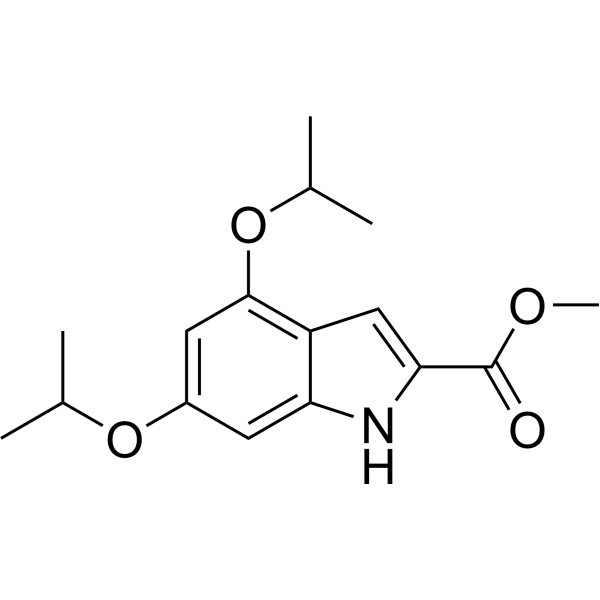
XST-14 is a potent, competitive and highly selective ULK1 inhibitor with an IC50 of 26.6 nM. XST-14 induces autophagy inhibition by reducing the phosphorylation of the ULK1 downstream substrate. XST-14 induces apoptosis in hepatocellular carcinoma (HCC) cells and has antitumor effects.
연구목적의 판매만을 진행합니다. 환자를 대상으로 한 판매는 하지 않습니다.
- Purity: 99.26%
- CAS No.: 2607143-50-8
- 화학식: C16H21NO4
- 분자량:291.34
-
보관:Powder -20°C, 3 years , 4°C, 2 years ; In solvent -80°C, 6 months , -20°C, 1 month

To place orders, for customer services and technical support, please contact: MedChemExpress USA
Tel: 609-228-6898 E-mail: [email protected] [email protected]


-
 Biological Activity
-
Chemical Information
-
용액&용해도
- 순도&문서
- References
-
 Help & FAQs
-

Apoptosis Compound Library
HY-L003
-
Immunology/Inflammation Compound Library
HY-L007
-
Kinase Inhibitor Library
HY-L009
-
MAPK Compound Library
HY-L010
-
Neuronal Signaling Compound Library
HY-L013
-
Protein Tyrosine Kinase Compound Library
HY-L016
-
TGF-beta/Smad Compound Library
HY-L018
-
Anti-Cancer Compound Library
HY-L025
-
Autophagy Compound Library
HY-L029
-
Reprogramming Compound Library
HY-L039
-
Oxygen Sensing Compound Library
HY-L045
-
Pyroptosis Compound Library
HY-L059
-
Anti-Lung Cancer Compound Library
HY-L075
-
Anti-Pancreatic Cancer Compound Library
HY-L077
-
Anti-Cancer Metabolism Compound Library
HY-L083
-
Neurodegenerative Disease-related Compound Library
HY-L086
-
Anti-Obesity Compound Library
HY-L087
-
Angiogenesis-Related Compound Library
HY-L088
-
Targeted Diversity Library
HY-L099
-
Anti-Liver Cancer Compound Library
HY-L101
-
Anti-Colorectal Cancer Compound Library
HY-L103
-
Antidepressant Compound Library
HY-L108
-
Anti-Prostate Cancer Compound Library
HY-L124
-
Anti-Pulmonary Fibrosis Compound Library
HY-L125
-
Osteogenesis Compound Library
HY-L131
-
Cancer Stem Cells Compound Library
HY-L135
-
Pain-Related Compound Library
HY-L139
-
Membrane Protein-targeted Compound Library
HY-L149
-
Membrane Receptor-targeted Compound Library
HY-L150
-
Highly Selective Inhibitors Library
HY-L158
-
Highly Selective Activators Library
HY-L159
-
Cytokine Inhibitors Library
HY-L161
-
Cell Death Library
HY-L162
-
Serine/Threonine Kinase Inhibitor Library
HY-L164
-
Anti-Ovarian Cancer Compound Library
HY-L173
-
Multi-Target Compound Library
HY-L176
-
Mitophagy Compound Library
HY-L180
-
Bioactive Compound Library Max
HY-L181
-
MCE Bioactive Compound Library
HY-L001V
-
Bioactive Compound Library
HY-L001
-
Anti-Gastric Cancer Compound Library
HY-L184
-
Anti-Fibrosis Compound Library
HY-L185
-
Anti-Brain Cancer Compound Library
HY-L188
-
Protein Kinase Compound Library
HY-L196
-
Non-Alcoholic Fatty Liver Disease (NAFLD) Compound Library
HY-L199
-
Cell Proliferation Compound Library
HY-L201
-
High-Throughput Bioactive Compound Library
HY-L205
-
Anti-Rheumatic Arthritis Compound Library
HY-L210
-
Posttranslational Modification Library
HY-L226
-
Lactylation Compound Library
HY-L249


Publications Citing Use of MedChemExpress (MCE) XST-14
More

Biological Activity
|
CaMK II |
ULK1 26.6 nM (IC50) |
XST-14 inhibits ULK1 (IC50=13.6 nM), MAP2K1/MEK1 (IC50=721.8 nM), MAPK14/p38 alpha (IC50=283.9 nM), TGFBR2 (IC50=809.3 nM), ACVR1/ALK2 (IC50=183.8 nM), ULK2 (IC50=70.9 nM) and CAMK2A (IC50=66.3 nM) by the 10-point titration results from SelectScreen Kinase Profiling Services[1].
XST-14 (20-80 μM; for 24 h) leads a decrease in cell proliferation activity[1].
XST-14 (5 μM; for 24 h) induces apoptosis in HepG2 and human primary HCC cells[1].
XST-14 (5 μM; for 12 h) strongly inhibits the conversion of LC3-I to LC3-II in CHO cells stably expressing GFP-LC3[1].
XST-14 (5 μM; for 12 h) inhibits the Ser249 phosphorylation of PIK3C3 and Ser15 phosphorylation of BECN1[1].
MedChemExpress (MCE) has not independently confirmed the accuracy of these methods. They are for reference only.
-
Cell Line:HepG2 cells
-
Concentration:20, 40, 60, 80 μM
-
Incubation Time:24 hours
-
Result:Led a decrease in cell proliferation activity.
-
Cell Line:HepG2 and human primary cells
-
Concentration:5 μM
-
Incubation Time:24 hours
-
Result:Induced apoptosis in HepG2 and human primary HCC cells.
-
Cell Line:CHO, HepG2 cells stably expressing GFP-LC3
-
Concentration:5 μM
-
Incubation Time:12 hours
-
Result:Strongly inhibited the conversion of LC3-I to LC3-II in CHO cells.
Dramatically decreased the number of GFP-LC3 puncta in HepG2 cells.
Decreased autophagosome formation and blocked autophagosome/lysosome fusion in HepG2 cells.
-
Cell Line:HepG2 cells
-
Concentration:5 μM
-
Incubation Time:12 hours
-
Result:Inhibited the Ser249 phosphorylation of PIK3C3 and Ser15 phosphorylation of BECN1.
XST-14 (2 mg/kg for IV; 10 mg/kg for IP) has a T1/2 of 2.31 hours for IV and a T1/2 of 2.69 hours for IP[1].
MedChemExpress (MCE) has not independently confirmed the accuracy of these methods. They are for reference only.
-
Animal Model:Nude mice bearing HepG2 tumor xenografts[1]
-
Dosage:15, 30 mg/kg
-
Administration:IP; daily; for 4 consecutive weeks
-
Result:Displayed anti-HCC efficacies, resulting in decreased tumor weights and suppressed tumor growth of HCC cells in nude mice.
-
Animal Model:Sprague-Dawley rat[1]
-
Dosage:2 mg/kg for IV; 10 mg/kg for IP (Pharmacokinetic Analysis)
-
Administration:IV or IP
-
Result:Had a T1/2 of 2.31 hours, a CL of 26.28 mL/min•kg, and and an AUC of 1269 hr•ng/mL for IV.
Had a T1/2 of 2.69 hours, a Cmax of 2033 ng/mL, and an AUC of 5979 hr•ng/mL for IP.


Chemical Information
-
CAS No. 2607143-50-8
-
Appearance Solid
-
분자량 291.34
-
화학식 C16H21NO4
-
Color White to off-white
-
SMILES
O=C(OC)C1=CC2=C(OC(C)C)C=C(OC(C)C)C=C2N1
-
선적
Room temperature in continental US; may vary elsewhere.
-
보관
Powder -20°C 3 years 4°C 2 years In solvent -80°C 6 months -20°C 1 month


Publications (4)
-
Journal Impact Factor
-
Most Recent
-
Nat Aging
2026 May 14. PMID: 42135576 -
Cancer Res
Inhibiting Fatty Acid Oxidation Reverses Autophagy-Mediated Acquired Chemotherapy Resistance in Pancreatic Ductal Adenocarcinoma. [Abstract]2026 Jul 2;86(13):3194-3212. PMID: 42008004 -
Toxins
The Mycotoxin De-Epoxy-Deoxynivalenol (DOM-1) Increases Endoplasmic Reticulum Stress in Ovarian Theca Cells. [Abstract]2023 Mar 17;15(3):228. PMID: 36977119 -


용액&용해도
DMSO : 250 mg/mL (858.10 mM; Need ultrasonic; Hygroscopic DMSO has a significant impact on the solubility of product, please use newly opened DMSO)
Please refer to the solubility information to select the appropriate solvent. Once prepared, please aliquot and store the solution to prevent product inactivation from repeated freeze-thaw cycles.
Storage method and period of stock solution: -80°C, 6 months; -20°C, 1 month. When stored at -80°C, please use it within 6 months. When stored at -20°C, please use it within 1 month.
Please refer to the solubility information to select the appropriate solvent. Once prepared, please aliquot and store the solution to prevent product inactivation from repeated freeze-thaw cycles.
Storage method and period of stock solution: -80°C, 6 months; -20°C, 1 month. When stored at -80°C, please use it within 6 months. When stored at -20°C, please use it within 1 month.
Concentration (start) × Volume (start) = Concentration (final) × Volume (final)
Select the appropriate dissolution method based on your experimental animal and administration route.
- For the following dissolution methods, please ensure to first prepare a clear stock solution using an In Vitro approach and then sequentially add co-solvents:
- To ensure reliable experimental results, the clarified stock solution can be appropriately stored based on storage conditions. As for the working solution for In Vivo experiments, it is recommended to prepare freshly and use it on the same day.
- The percentages shown for the solvents indicate their volumetric ratio in the final prepared solution. If precipitation or phase separation occurs during preparation, heat and/or sonication can be used to aid dissolution.
Add each solvent one by one: 10% DMSO 90% (20% SBE-β-CD in Saline)
Solubility: ≥ 2.08 mg/mL (7.14 mM); Clear solution
This protocol yields a clear solution of ≥ 2.08 mg/mL (saturation unknown).
Taking 1 mL working solution as an example, add 100 μL DMSO stock solution (20.8 mg/mL) to 900 μL 20% SBE-β-CD in Saline, and mix evenly.
Preparation of 20% SBE-β-CD in Saline (4°C, storage for one week): 2 g SBE-β-CD powder is dissolved in 10 mL Saline, completely dissolve until clear.
Please enter the basic information of animal experiments:
-
-
-
-
Recommended: Prepare an additional quantity of animals to account for potential losses during experiments.
Please enter your animal formula composition:
-
%DMSO +
Recommended: Keep the proportion of DMSO in working solution below 2% if your animal is weak.
-
%+
-
+%Tween-80 + +
-
%Saline +
The co-solvents required include: DMSO, . All of co-solvents are available by MedChemExpress (MCE). , Tween 80. All of co-solvents are available by MedChemExpress (MCE).
Working solution concentration: 0.22 mg/mL
Method for preparing stock solution: mg drug dissolved in μL DMSO. Stock solution concentration: mg/mL.
1. Take μL DMSO stock solution;
2. Add μL .
μL , mix evenly;
3. Then add μL Tween 80, mix evenly;
4. Then add μL
Please ensure that the stock solution in the first step is dissolved to a clear state, and add co-solvents in sequence. You can use ultrasonic heating (ultrasonic cleaner, recommended frequency 20-40 kHz), vortexing, etc. to assist dissolution.


순도&문서
-
Data Sheet (279 KB)
-
SDS (251 KB)
- English - EN (251 KB)
- Français - FR (251 KB)
- Deutsch - DE (251 KB)
- Norwegian - NO (251 KB)
- Español - ES (251 KB)
- Swedish - SV (251 KB)
- Italian - IT (251 KB)
- Korean - KR (251 KB)
- Portuguese - PT (251 KB)
-
Handling Instructions (2659 KB)
References


Complete Stock Solution Preparation Table
Please refer to the solubility information to select the appropriate solvent. Once prepared, please aliquot and store the solution to prevent product inactivation from repeated freeze-thaw cycles.
Storage method and period of stock solution: -80°C, 6 months; -20°C, 1 month. When stored at -80°C, please use it within 6 months. When stored at -20°C, please use it within 1 month.
| Optional Solvent | Concentration Solvent Mass | 1 mg | 5 mg | 10 mg | 25 mg |
|---|---|---|---|---|---|
| DMSO | 1 mM | 3.4324 mL | 17.1621 mL | 34.3242 mL | 85.8104 mL |
| 5 mM | 0.6865 mL | 3.4324 mL | 6.8648 mL | 17.1621 mL | |
| 10 mM | 0.3432 mL | 1.7162 mL | 3.4324 mL | 8.5810 mL | |
| 15 mM | 0.2288 mL | 1.1441 mL | 2.2883 mL | 5.7207 mL | |
| 20 mM | 0.1716 mL | 0.8581 mL | 1.7162 mL | 4.2905 mL | |
| 25 mM | 0.1373 mL | 0.6865 mL | 1.3730 mL | 3.4324 mL | |
| 30 mM | 0.1144 mL | 0.5721 mL | 1.1441 mL | 2.8603 mL | |
| 40 mM | 0.0858 mL | 0.4291 mL | 0.8581 mL | 2.1453 mL | |
| 50 mM | 0.0686 mL | 0.3432 mL | 0.6865 mL | 1.7162 mL | |
| 60 mM | 0.0572 mL | 0.2860 mL | 0.5721 mL | 1.4302 mL | |
| 80 mM | 0.0429 mL | 0.2145 mL | 0.4291 mL | 1.0726 mL | |
| 100 mM | 0.0343 mL | 0.1716 mL | 0.3432 mL | 0.8581 mL |


XST-14 Related Classifications
HY-137506 Related Classifications
 Powered by Bioz