



Stem cell classification and its application
2023-05-18
As the smallest unit of structure and function of the human body, stem cells have the ability to further differentiate into cells of various functions. So, what is the classification and application of stem cells? Let's have a comprehensive understanding of these amazing stem cells!

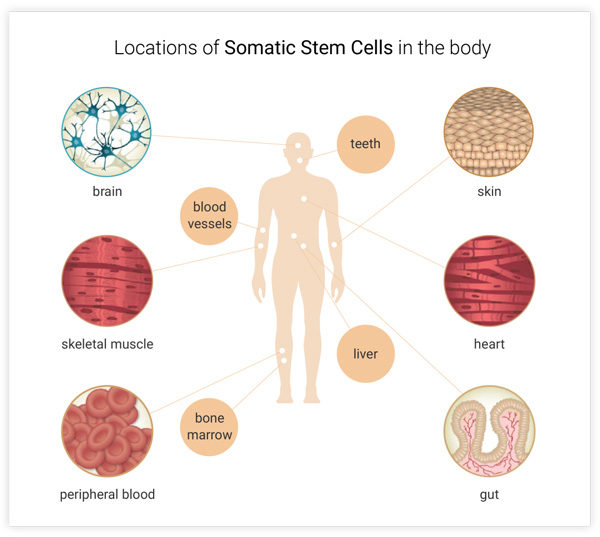
According to the differentiation potential, stem cells can be divided into totipotent stem cells (TSCs), multipotent stem cells, adult multipotent stem cells, monopotent stem cells, and oligopotent stem cells[3].
Totipotent stem cells have the potential to generate all the cells and tissues that make up the embryo and support its growth and development in the uterus and can continue to differentiate and grow into a mature individual. TSCs (e.g., fertilized eggs) can differentiate not only into all types of cells of the three embryonic layers during development but also into extra-embryonic tissues necessary for embryonic development, such as the placenta and umbilical cord formed by the trophectoderm[4].
Perinatal stem cells can differentiate into ESCs of all three germ layers, but do not have the ability to differentiate into extra-embryonic tissue cells (e.g. placenta and umbilical cord tissue formed by the trophectoderm) as do TSCs.
Induced pluripotent stem cells (iPSCs), also known as artificially induced pluripotent stem cells, are a type of mammalian adult cells transduced with transcription factors, first discovered in 2006 by the research group of Japanese scholar Shinya Yamanaka[5,6].
The classifications of (adult) multipotent stem cells and oligopotent stem cells, which have a slightly lower differentiation potential than multipotent stem cells. Adult multipotent stem cells: for example, HSCs can further differentiate to form platelets and red blood cells in vivo (Figure 3). Unipotent stem cells can only differentiate into one type of cell and have the lowest developmental potential.
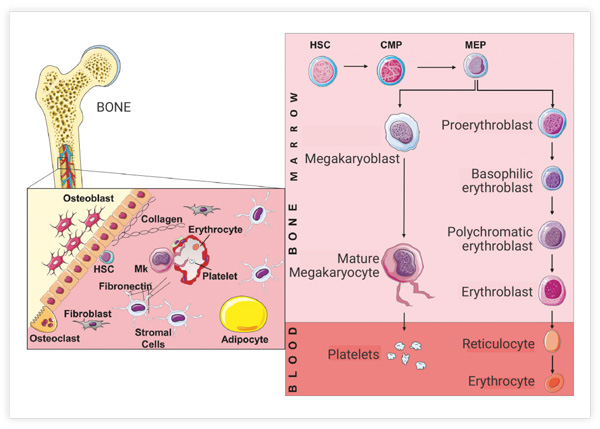
The differentiation pathways of megakaryopoiesis and erythropoiesis are mainly depicted. Megakaryopoiesis is typically characterized by an exponential increase in cell size, leading to the final extension of the cytosol, the growth of "prostheses" (platelets), and the subsequent release of platelets into the bloodstream. The process of erythropoiesis undergoes several morphological and structural changes, culminating in the production of basophilic, polychromatic and acidophilic erythrocytes. Maturation of mature erythrocytes is not completed until the terminal maturation phase is over and reticulocytes are released into the bloodstream. MK: megakaryocytes; HSC: hematopoietic stem cells; CMP: common myeloid progenitor cells; MEP: megakaryocyte-erythroid progenitor cells.
The cytokines required for stem cell culture mainly belong to two categories: transforming growth factor-β superfamily and colony-stimulating factor.
Transforming growth factor-β superfamily (TGF-βs): This family consists of nearly 30 members, including TGFβ (TGF-β1, TGF-β2 and TGF-β3), bone morphogenetic protein (BMP), activin A and inhibin. Activation of type I receptors leads to phosphorylation of various Smad proteins that translocate to the nucleus and activate transcription of target genes. Activation of type II receptors mainly promotes signaling pathways such as ERK, JNK and p38 MAPK kinases[8-10].
Mature BMP-4 is a disulfide-linked homodimeric protein consisting of two subunits of 116 amino acid residues, which are involved in the regulation of cell proliferation, differentiation and apoptosis, and thus play an important role in embryonic development and the growth and differentiation of various cell types. Commonly used culture factors such as BMP-4 and activin A play important roles in cell growth and differentiation[9,10].
Colony-stimulating factors (CSFs): These include macrophage colony-stimulating factor (M-CSF), granulocyte-macrophage colony-stimulating factor (GM-CSF), granulocyte colony-stimulating factor (G-CSF), and multipotent colony-stimulating factor (multi-CSF/IL-3), which are widely used to promote blood cell development and differentiation. Broadly speaking, all cytokines that stimulate the hematopoietic process can be collectively referred to as CSFs, such as erythropoietin (EPO), which stimulates erythropoiesis; stem cell factor (SCF), and leukemia inhibitory factor (LIF), which stimulates the production of ESCs.
Stem cells require a combination of growth factors and nutrients to maintain differentiation and development. For example, scientists have been able to use recombinant proteins to achieve in vitro induction of differentiation of HSCs, for production of erythrocytes and platelets, to investigate optimal culture conditions to maximize platelet production per megakaryocyte and to increase the number of nucleated erythrocytes obtained in vitro (Figure 4).
Recombinant human TPO is commonly used to generate megakaryocytes. Platelet-forming elements and their analogs bind to a variety of cytokines, including stem cell factors and interleukins (e.g. IL-3, IL-6, IL-11) that subsequently promote the production of mature megakaryocyte populations from HSCs, which in turn form platelets, without the need of serum supplementation or co-culture with feeder cells[11-12].

Professor Yuan's team at Tongji Medical College of Huazhong University of Science and Technology demonstrated the synergistic effect of the combination of Pyrotinib and Apatinib in the treatment of HER2-positive Gastric Cancer (GC) using both in vitro and in vivo models followed by RNAseq, KEGG database and Western-blot analysis. We found that stem cell factor (SCF) is a potential target to generate acquired pyrrolizidine resistance through the activation of PI3K/AKT and MAPK signaling pathways (Figure 5), thus providing a foundation for clinical studies in HER2-positive Advanced Gastric Cancer (AGC) patients.

MedChemExpress (MCE) offers a wide range of high purity and bioactive recombinant proteins, cytokines, and small molecule compounds for advanced stem cell research.
| Protein/Cytokines | Hematopoietic stem cells(HSCs) | Embryonic stem cells(ESCs) | Neural stem cells(NSCs) | Induced Pluripotent Stem Cells(iPSCs) | Mesenchymal stem cells(MSCs) |
|---|---|---|---|---|---|
| FGF-2 | √ | √ | √ | √ | √ |
| EGF | √ | √ | √ | √ | √ |
| TGF-β1 | √ | √ | √ | ||
| TGF-β3 | √ | ||||
| BMP-4 | √ | √ | √ | ||
| Activin A | √ | ||||
| IL-3 | √ | √ | |||
| SCF | √ | ||||
| Flt3-ligand | √ | ||||
| GM-CSF | √ | ||||
| G-CSF | √ | ||||
| M-CSF | √ | ||||
| LIF | √ | √ | |||
| TPO | √ | ||||
| VEGF165 | √ | ||||
| FGF-8b | √ | ||||
| IL-6 | √ | ||||
| SHH | √ | ||||
| CNTF | √ | √ | |||
| Noggin | √ | ||||
| PDGF-BB | √ | ||||
| R-spondin 1 | √ | ||||
| HGF | √ | ||||
| Vitronectin | √ | √ |
[2] Rathnam, Christopher, et al. Science Advances 7.40 (2021): eabj2281.
[3] Shah, A.A., Khan, F.A. (2021). Stem Cell Biology and Regenerative Medicine, vol 69. Humana, Cham.
[4] Chan, A W et al. Science (New York, N.Y.) vol. 287,5451 (2000): 317-9.
[5] Takahashi, Kazutoshi, and Shinya Yamanaka. Cell vol. 126,4 (2006): 663-76.
[6] Sobhani, Aligholi et al. Acta Medica Iranica vol. 55,1 (2017): 6-23.
[7] Di Buduo, Christian A., et al. Haematologica 106.4 (2021): 947.
[8] Derynck, Rik, and Ying E. Zhang. Nature 425.6958 (2003): 577-584.
[9] Zhang, Jiwang, and Linheng Li. "BMP signaling and stem cell regulation." Developmental Biology 284.1 (2005): 1-11.
[10] Bloise, Enrrico, et al. Physiological Reviews 99.1 (2019): 739-780.
[11] Metcalf, D et al. Blood vol. 76,1 (1990): 50-6.
[12] Kuter, David J., and C. Glenn Begley. Blood, The Journal of the American Society of Hematology 100.10 (2002): 3457-3469.
[13] Su, Beibei, et al. Gastric Cancer 24 (2021): 352-367.
 LinkedIn
 Researchgate
 Instagram
 X
X Facebook
 WhatsApp
 Reddit
 Mail
Mail