



SHH Protein, Human
Based on 2 publication(s) in Google Scholar
Sonic Hedgehog (SHH) Protein is a secretory glycoprotein of the Hedgehog family that can self-cleave to form N-SHH. SHH Protein activates Smo by binding to Frizzled and LRP6, inhibits GSK-3β to stabilize β-catenin, and activates FOXM1. SHH Protein also promotes NO release and shortens myocardial APD by phosphorylating eNOS through PI3K/Akt. SHH Protein can promote the maturation of sweat gland cells in three-dimensional culture and play a cardioprotective role in the pig ischemia-reperfusion model. SHH Protein, Human is a recombinant human SHH protein expressed in E. coli with tag-free.
- Species: Human
- Source: E. coli
-
Storage:Stored at -20°C for 2 years from date of receipt. After reconstitution, it is stable at 4°C for 1 week or -20°C for longer (with carrier protein). It is recommended to freeze aliquots at -20°C or -80°C for extended storage.


To place orders, for customer services and technical support, please contact: MedChemExpress USA
Tel: 609-228-6898 E-mail: [email protected] [email protected]


-
 Biological Activity
-
Technical Parameters
-
Product Properties
- Documentation
- References
- Help & FAQs


-
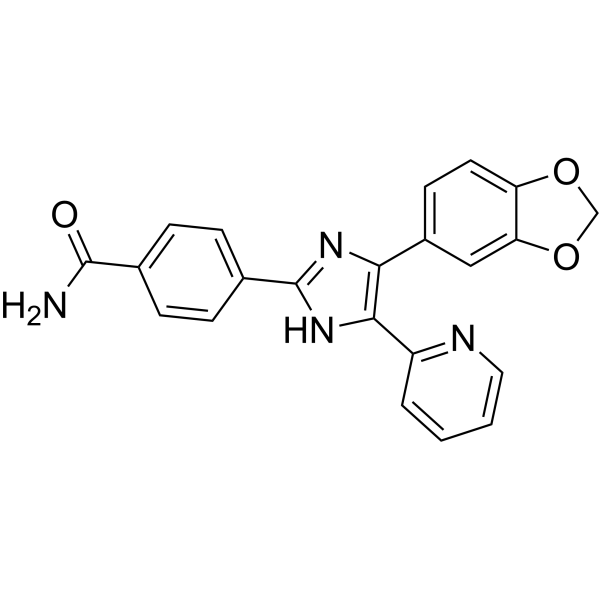
HY-10431
SB-431542 -
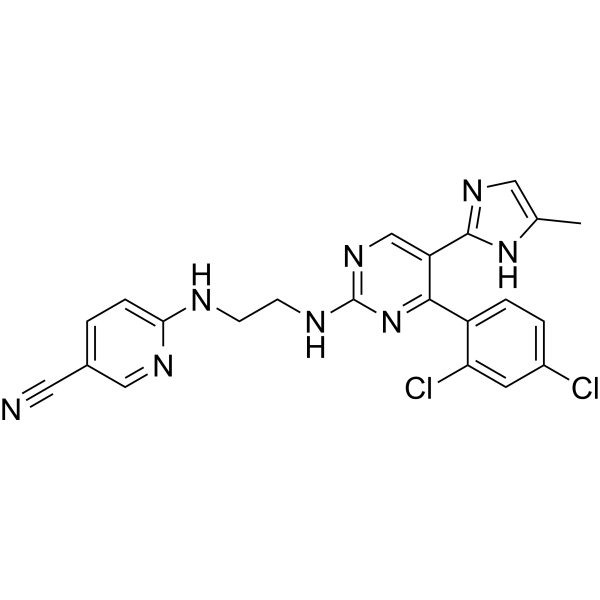
HY-10182
Laduviglusib -

HY-P7116A
BDNF Protein, Human/Mouse/Rat -
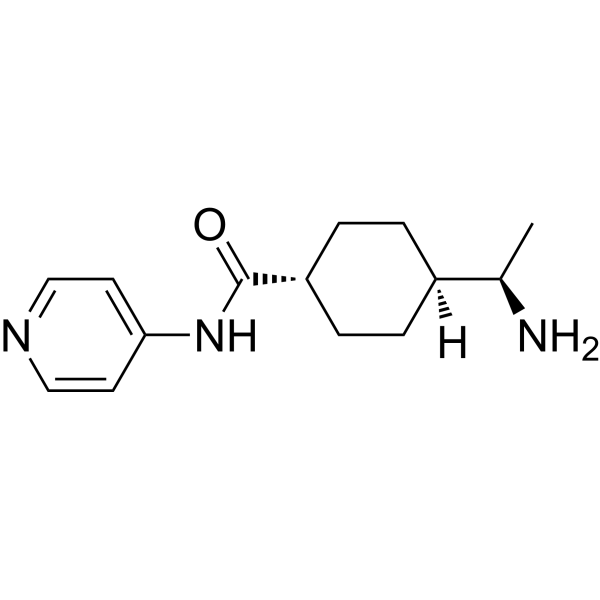
HY-10071
Y-27632 -
HY-P70533
FGF-8b Protein, Human/Mouse -
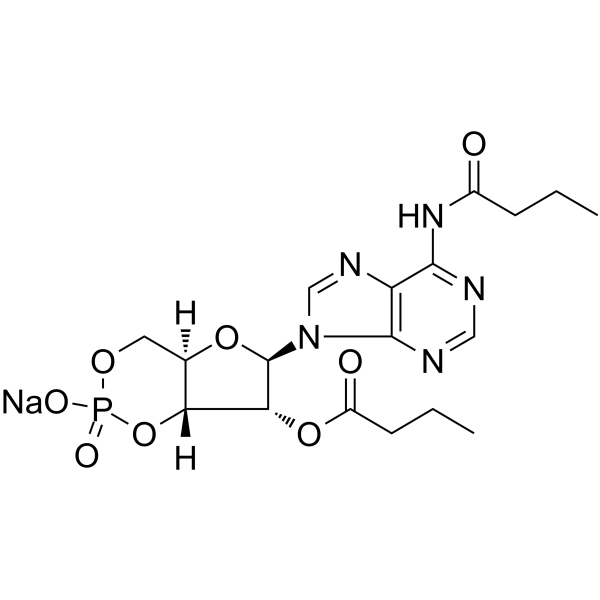
HY-B0764
Bucladesine sodium -
HY-P7182
GDNF Protein, Human -
HY-15371
Forskolin -
HY-P70311
Activin A Protein, Human/Mouse/Rat (HEK293) -
HY-13027
DAPT -
HY-17024
Cyclopamine -
HY-12071
LDN193189


Biological Activity
Description
Sonic Hedgehog (SHH) Protein is a secretory glycoprotein of the Hedgehog family that can self-cleave to form N-SHH. SHH Protein activates Smo by binding to Frizzled and LRP6, inhibits GSK-3β to stabilize β-catenin, and activates FOXM1. SHH Protein also promotes NO release and shortens myocardial APD by phosphorylating eNOS through PI3K/Akt. SHH Protein can promote the maturation of sweat gland cells in three-dimensional culture and play a cardioprotective role in the pig ischemia-reperfusion model[1][2]. SHH Protein, Human is a recombinant human SHH protein expressed in E. coli with tag-free.
Background
Sonic Hedgehog (SHH) Protein is a secreted glycoprotein of the Hedgehog family whose transcription is regulated by a long-range regulatory mechanism involving multiple enhancers. The N-terminus of SHH Protein contains a cysteine-rich domain with glycosylation sites and a cholesterol-binding domain at the C-terminus, which can form an N-terminal active fragment (N-SHH) by self-cleavage. In the endoplasmic reticulum, ShhC is degraded, leaving behind the lipidated ShhNp that is essential for developmental patterning. SHH Protein is extensively modified by cleavage and post-translational modifications, and its release from producer cells can also be regulated by interactions with Dispatched, Scube2, and heparan sulfate proteoglycans.
SHH signaling is involved in embryonic development (including lung) and patterning during development. As a ligand of the classic Hedgehog signaling pathway, SHH Protein binds to the transmembrane receptor Frizzled (such as Frizzled-1) and the co-receptor LRP6, activates Smoothened (Smo) and inhibits GSK-3β, relieves β-catenin degradation and causes its nuclear translocation, and activates anti-apoptotic genes such as FOXM1. At the same time, SHH Protein can promote NO release by phosphorylating eNOS through the PI3K/Akt pathway and shorten the action potential duration (APD) of cardiomyocytes. The biological activities of SHH Protein include promoting the maturation of sweat gland cells in three-dimensional culture (upregulating markers such as CK19) and myocardial protection in the pig ischemia-reperfusion model (reducing infarct volume and inhibiting arrhythmias). It is mainly used in the research of tissue engineering (sweat gland regeneration), ischemic diseases (such as myocardial infarction), prostate cancer and other diseases[1][2][3][4][5].
Verified Bioactivity
Measured by its ability to induce alkaline phosphatase production by C3H10T1/2 mouse embryonic fibroblast cells. The ED50 for this effect is ≤ 0.3049 µg/mL, corresponding to a specific activity is ≥3.279×10³ units/mg.


Publications (2)
-
Journal Impact Factor
-
Most Recent
-
NPJ Precis Oncol
Prognostic biomarkers and Hedgehog pathway activation in early prostate cancer neuroendocrine differentiation via spatial profiling. [Abstract]2026 May 6;10(1):271. PMID: 42092131 -
PLoS Biol
Gas1-high quiescent neural stem cells are multipotent and produce oligodendrocytes during aging and after demyelinating injury. [Abstract]2025 Apr 3;23(4):e3003100. PMID: 40179071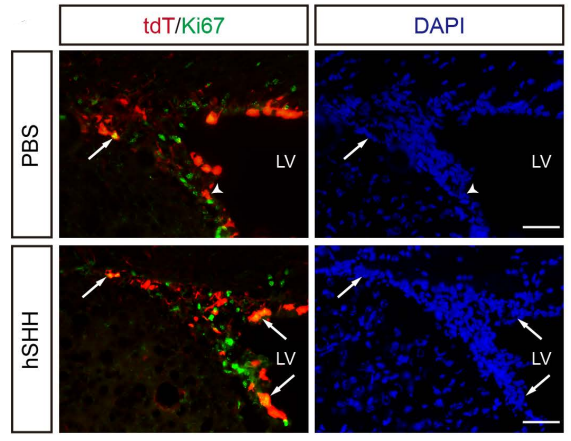
SHH Protein, Human purchased from MedChemExpress. Usage Cited in: PLoS Biol. 2025 Apr 3;23(4):e3003100. [Abstract]
Representative IF co-labeling of Ki67 and tdT in the SVZ. Arrows highlight examples of Ki67+ tdT+ NSCs. The Ki67−tdT+ NSCs are indicated by an arrowhead. The results showed that Intraventricular SHH Protein, Human (375 μg/mL; 8 μL; mice) injection promotes proliferation of tdT+
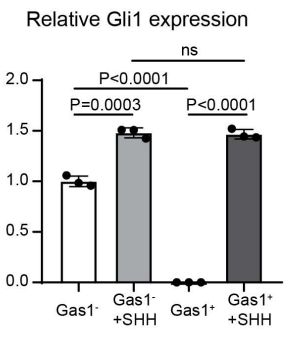
SHH Protein, Human purchased from MedChemExpress. Usage Cited in: PLoS Biol. 2025 Apr 3;23(4):e3003100. [Abstract]
The relative expression level of Gli1 in different groups. The results showed that intraventricular SHH protein (Human, 375 μg/mL; 8 μL; mice) injection upregulated Gli1 expression in tdT⁺ Gas1high SVZ NSCs.


Technical Parameters
-
Species Human
-
Source E. coli
-
Tag Tag Free
-
Accession
Q15465 (C24-G197)
-
Molecular Construction
-
N-term
-
SHH (C24-G197)
Accession # Q15465 -
C-term
-
-
Protein Length
Full Length of Sonic hedgehog protein N-product Chain
-
Synonyms
SHH; Shh Unprocessed N-Terminal Signaling And C-Terminal Autoprocessing Domains; Prev. HLP3; Sonic Hedgehog Protein; Prev. HPE3; ShhNC; MCOPCB5; Sonic Hedgehog (Drosophila) Homolog; SMMCI; Sonic Hedgehog Homolog; TPTPS; Hedgehog Protein; HHG1; HHG-1; TPT;
-
AA Sequence
CGPGRGFGKRRHPKKLTPLAYKQFIPNVAEKTLGASGRYEGKISRNSERFKELTPNYNPDIIFKDEENTGADRLMTQRCKDKLNALAISVMNQWPGVKLRVTEGWDEDGHHSEESLHYEGRAVDITTSDRDRSKYGMLARLAVEAGFDWVYYESKAHIHCSVKAENSVAAKSGG
-
Predicted Molecular Mass
17.8 kDa
-
Molecular Weight
Approximately 19-25 kDa, based on SDS-PAGE under reducing conditions, due to the glycosylation.
-
Purity
≥ 95%, as determined by reducing SDS-PAGE.


Product Properties
Lyophilized powder.
1.Lyophilized from a 0.22 μm filtered solution of 20 mM PB, 100 mM NaCl, 1 mM DTT, pH 7.5.
2.Lyophilized from a 0.22 μm filtered solution of PBS, pH 7.4, 5% trehalose, 5% mannitol and 0.01% Tween80.
3.Lyophilized from a 0.22 μm filtered solution of PBS, pH 7.4, 5% trehalose, 5% mannitol, 0.01% Tween 80.
4.Lyophilized from a 0.22 μm filtered solution of PBS, pH 7.4, 8% trehalose.
Please refer to the lot-specific COA for specific buffer information.
<1 EU/μg, determined by LAL method.
It is not recommended to reconstitute to a concentration less than 100 μg/mL in ddH2O.
Stored at -20°C for 2 years from date of receipt. After reconstitution, it is stable at 4°C for 1 week or -20°C for longer (with carrier protein). It is recommended to freeze aliquots at -20°C or -80°C for extended storage.
Room temperature in continental US; may vary elsewhere.


Documentation
-
Data Sheet (264 KB)
-
SDS (251 KB)
- English - EN (251 KB)
- Français - FR (251 KB)
- Deutsch - DE (251 KB)
- Norwegian - NO (251 KB)
- Español - ES (251 KB)
- Swedish - SV (251 KB)
- Italian - IT (251 KB)
- Korean - KR (251 KB)
- Portuguese - PT (251 KB)
-
Handling Instructions (2659 KB)


References
[1]. Wang XZ, et al. Sonic hedgehog (Shh) and CC chemokine ligand 2 signaling pathways in asthma. J Chin Med Assoc. 2019;82(5):343-350. [Content Brief]
[2]. Seo H, et al. Upstream Enhancer Elements of Shh Regulate Oral and Dental Patterning. J Dent Res. 2018;97(9):1055-1063. [Content Brief]
[3]. Huang Z, et al. Shh promotes sweat gland cell maturation in three-dimensional culture. Cell Tissue Bank. 2016 Jun;17(2):317-25. [Content Brief]
[4]. Ghaleh B, et al. Cardioprotective effect of sonic hedgehog ligand in pig models of ischemia reperfusion. Theranostics. 2020 Mar 4;10(9):4006-4016. [Content Brief]
[5]. Spinella-Jaegle S, et al. Sonic hedgehog increases the commitment of pluripotent mesenchymal cells into the osteoblastic lineage and abolishes adipocytic differentiation. J Cell Sci. 2001 Jun;114(Pt 11):2085-94. [Content Brief]

Calculators
Concentration (start) × Volume (start) = Concentration (final) × Volume (final)


 Powered by Bioz

