



FGF-8b Protein, Human/Mouse
Based on 3 publication(s) in Google Scholar
FGF-8b Protein, Human/Mouse is the recombinant mouse, human-derived FGF-8b protein, expressed by E. coli, with tag free.
- Species: Human; Mouse
- Source: E. coli
-
Storage:Stored at -20°C for 2 years from date of receipt. After reconstitution, it is stable at 4°C for 1 week or -20°C for longer (with carrier protein). It is recommended to freeze aliquots at -20°C or -80°C for extended storage.


To place orders, for customer services and technical support, please contact: MedChemExpress USA
Tel: 609-228-6898 E-mail: [email protected] [email protected]


-
 Biological Activity
-
Technical Parameters
-
Product Properties
- Documentation
- Help & FAQs


-
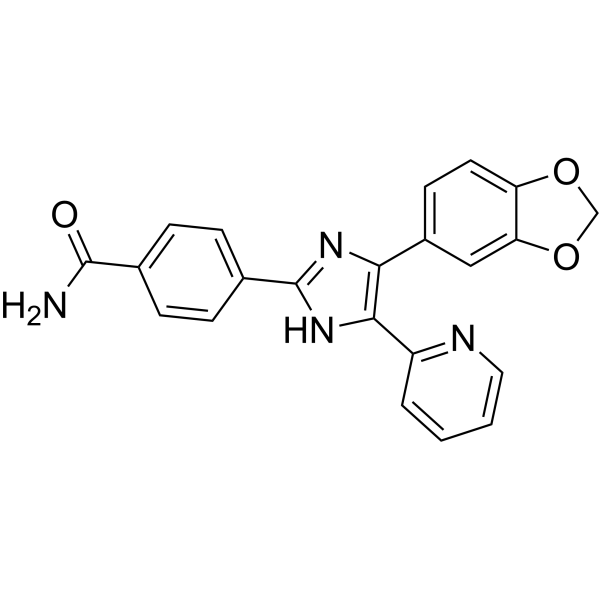
HY-10431
SB-431542TGF-β Receptor Kinase Inhibitor -
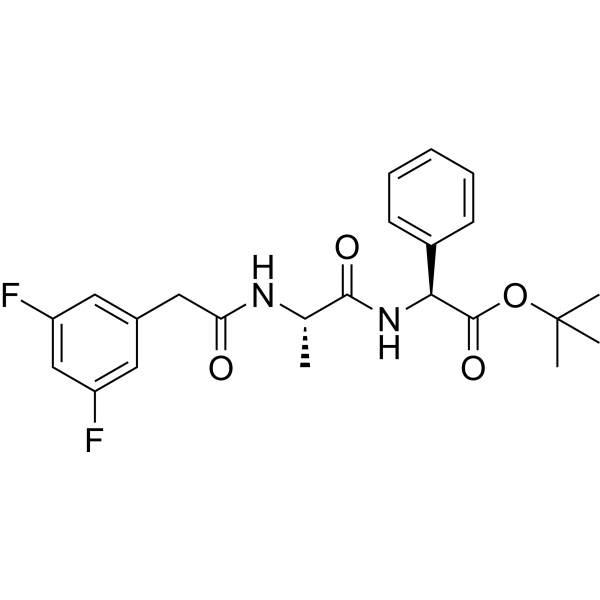
HY-13027
DAPTγ-secretase Inhibitor -
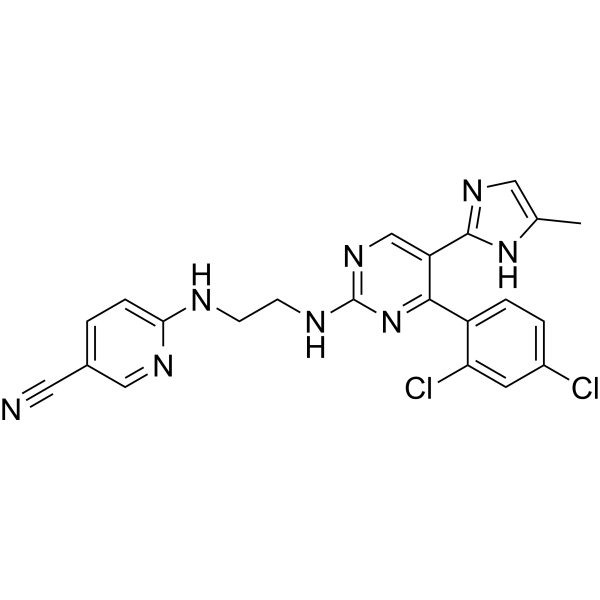
HY-10182
LaduviglusibGSK-3 Inhibitor -
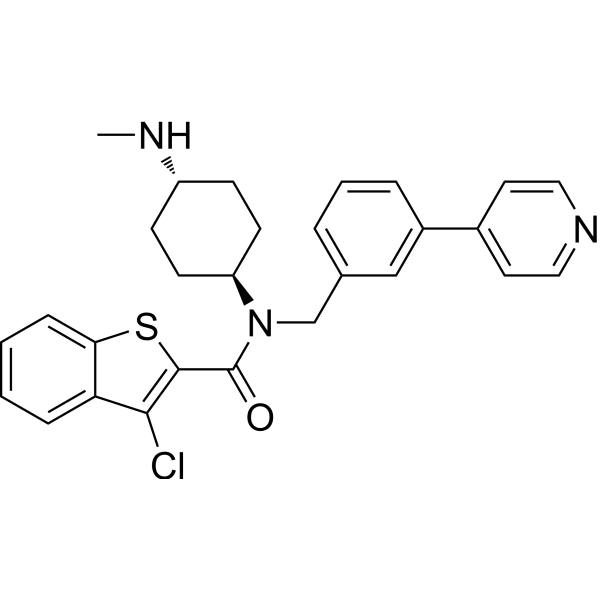
HY-12848
SAGSmoothened Agonist -
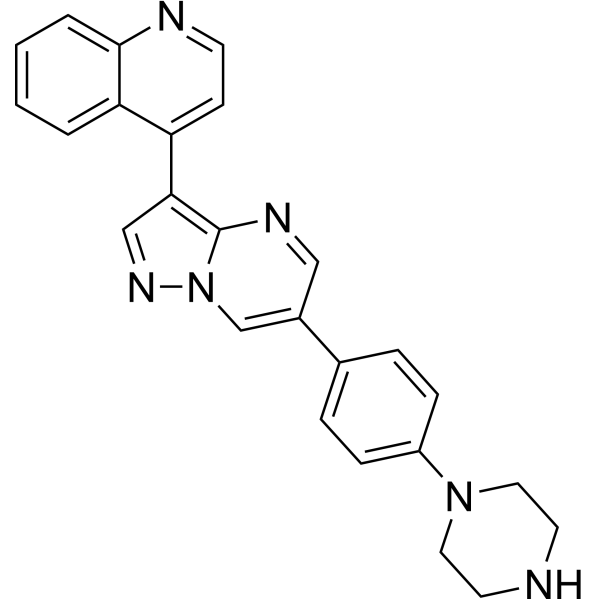
HY-12071
LDN193189ALK2/3 Inhibitor -
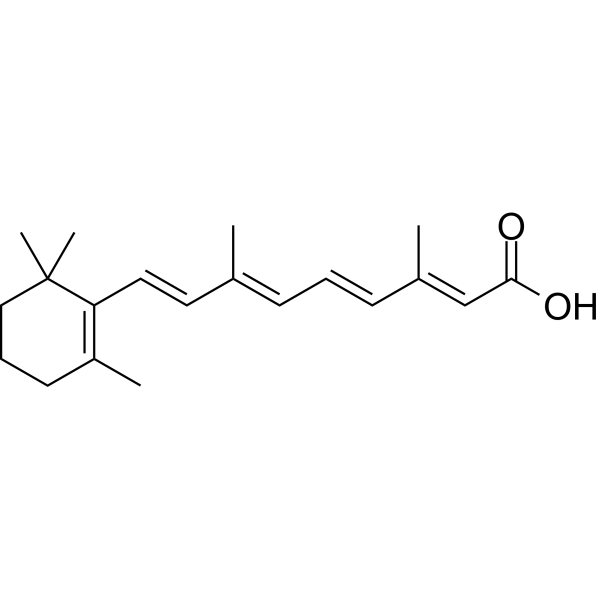
HY-14649
Retinoic acidRAR Agonist -
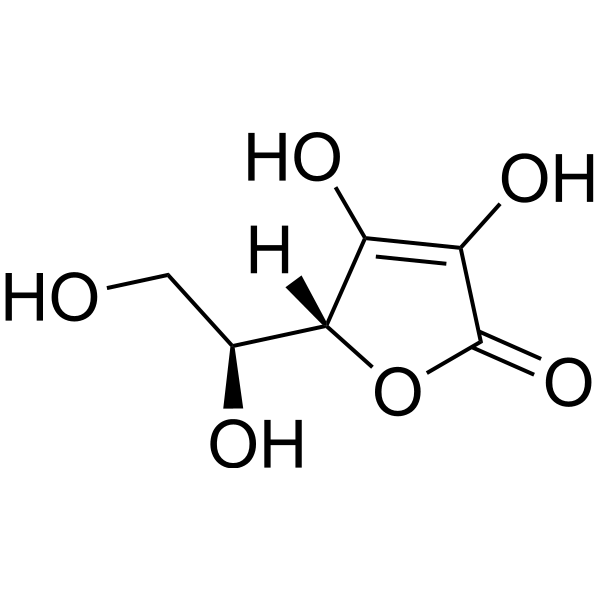
HY-B0166
L-Ascorbic acidAntioxidant -
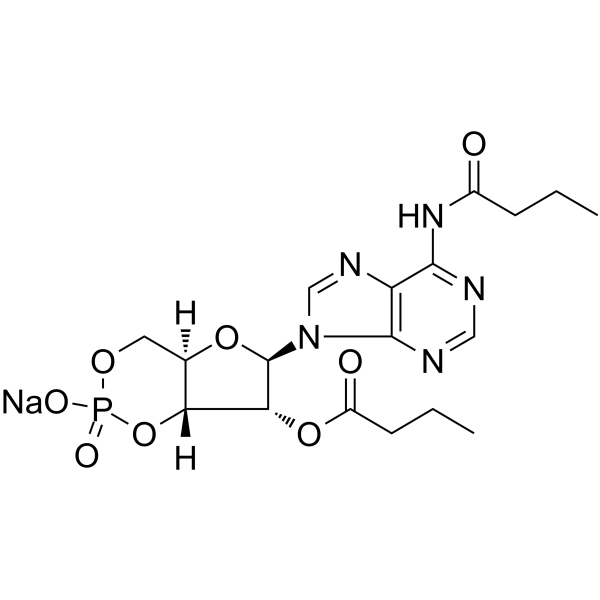
HY-B0764
Bucladesine sodiumcAMP Analog -

HY-P7116A
BDNF Protein, Human/Mouse/Rat -
HY-P7007
BMP-4 Protein, Human -
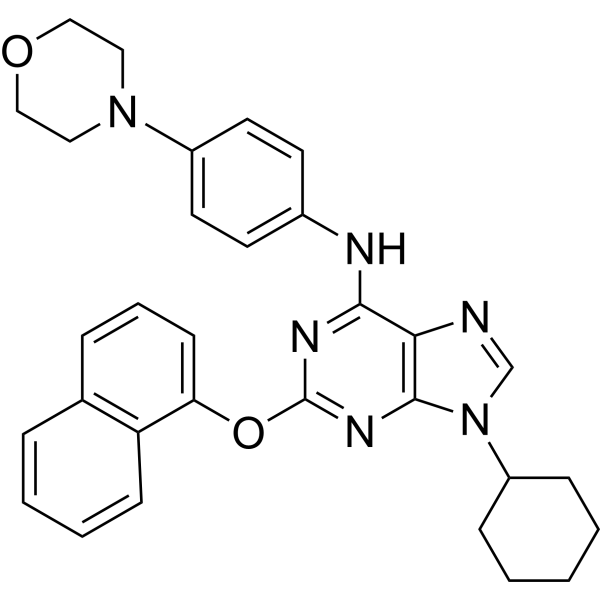
HY-15108
PurmorphamineSmoothened Receptor Agonist -
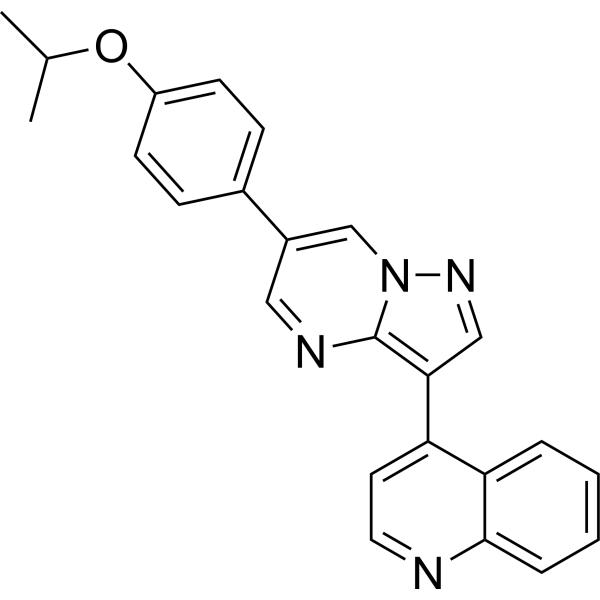
HY-12273
DMH-1BMP Inhibitor


Biological Activity
Description
FGF-8b Protein, Human/Mouse is the recombinant mouse, human-derived FGF-8b protein, expressed by E. coli, with tag free.
Background
FGF-8b plays an important role in the regulation of embryonic development, cell proliferation, cell differentiation, and cell migration. It is required for normal brain, eye, ear, and limb development during embryogenesis. Additionally, FGF-8b is essential for the normal development of the gonadotropin-releasing hormone (GnRH) neuronal system (by similar: PubMed:16384934, PubMed:16597617, PubMed:8663044). It also functions in neurite outgrowth in hippocampal cells (by similar: PubMed:21576111).
Verified Bioactivity
1.Measured in a cell proliferation assay using BALB/c 3T3 cells and the special bioactivity is ≤40.58 ng/mL.
2.Measured in a cell proliferation assay using NIH/3T3 mouse fibroblast cells. The ED50 for this effect is typically 10-60 ng/mL in the presence of 1 µg/mL heparin.
MCE Validation Data
-
Purity - SDS-PAGE
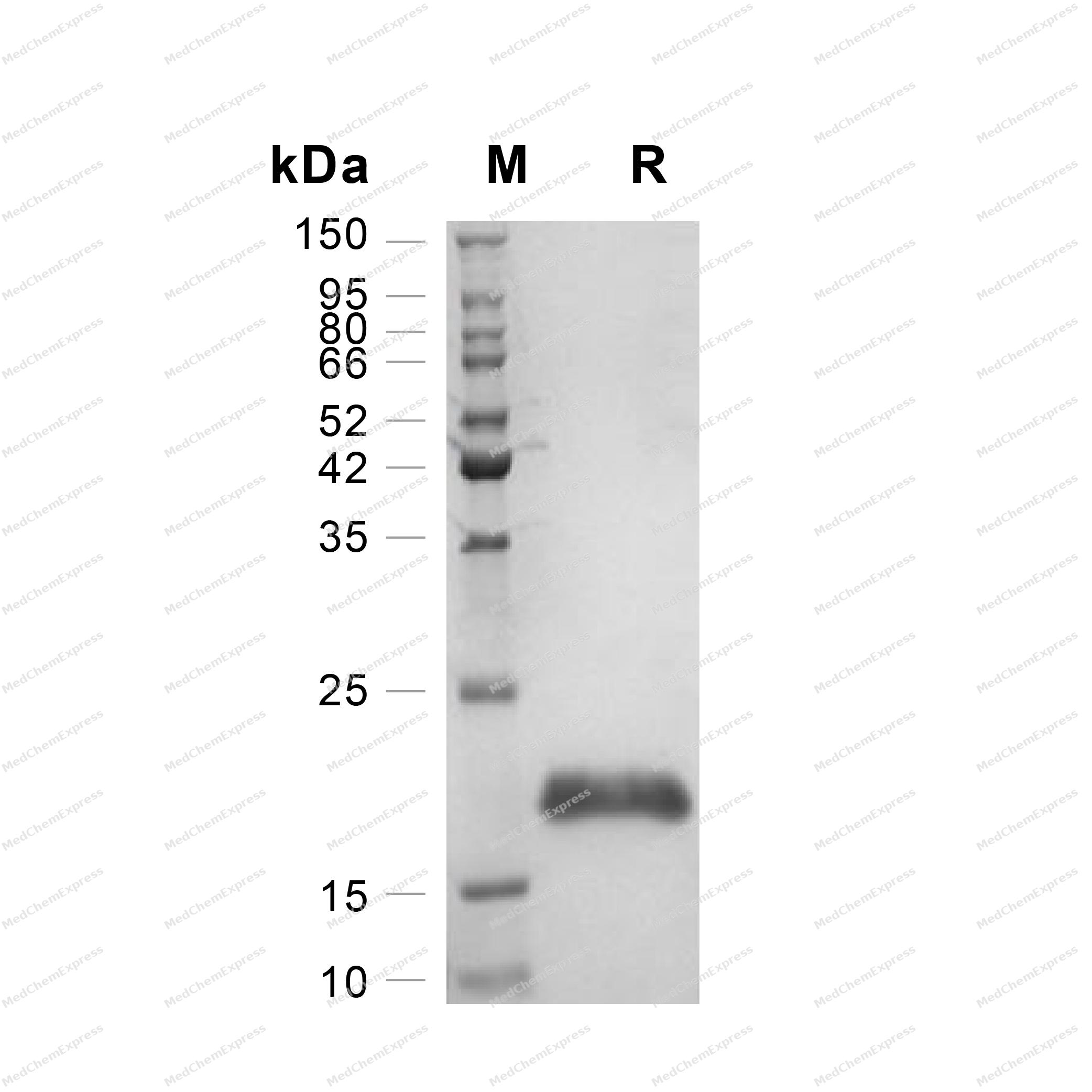
Purity - SDS-PAGE
-
Bioactivity - Cell-Based Assay
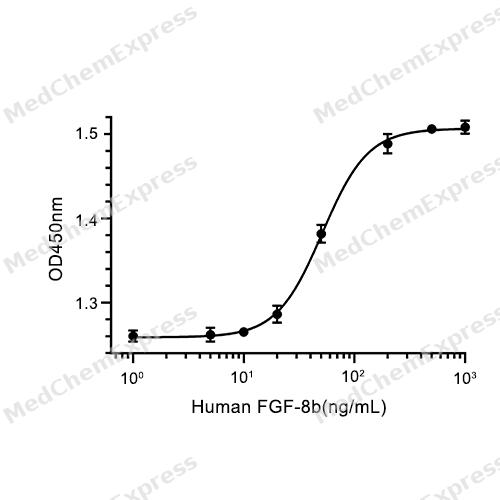
Bioactivity - Cell-Based Assay


Publications (3)
-
Journal Impact Factor
-
Most Recent
-
Adv Sci (Weinh)
SIRT3-Mediated Deacetylation of DRP1K711 Prevents Mitochondrial Dysfunction in Parkinson's Disease. [Abstract]2025 May;12(17):e2411235. PMID: 39976201 -
-


Technical Parameters
-
Species Human; Mouse
-
Source E. coli
-
Tag Tag Free
-
Molecular Construction
-
N-term
-
FGF-8b (Q23-R215)
Accession # P55075-3 -
C-term
-
-
Protein Length
Partial
-
Synonyms
FGF8; HBGF-8; Fibroblast Growth Factor 8; FGF-8; AIGF; Fibroblast Growth Factor; Androgen-Induced Growth Factor; KAL6; Fibroblast Growth Factor 8 (Androgen-Induced); HH6; Heparin-Binding Growth Factor 8; FGF
-
AA Sequence
QVTVQSSPNFTQHVREQSLVTDQLSRRLIRTYQLYSRTSGKHVQVLANKRINAMAEDGDPFAKLIVETDTFGSRVRVRGAETGLYICMNKKGKLIAKSNGKGKDCVFTEIVLENNYTALQNAKYEGWYMAFTRKGRPRKGSKTRQHQREVHFMKRLPRGHHTTEQSLRFEFLNYPPFTRSLRGSQRTWAPEPR
-
Predicted Molecular Mass
22.5 kDa
-
Molecular Weight
Approximately 22-28 kDa, based on SDS-PAGE under reducing conditions, due to the glycosylation.
-
Purity
≥ 95%, as determined by reducing SDS-PAGE.


Product Properties
Lyophilized powder
1.Lyophilized from a 0.22 μm filtered solution of PBS, pH 7.4.
2.Lyophilized from a 0.22 μm filtered solution of 20 mM PB, 300 mM NaCl, 2% sucrose, 0.02% Tween 80, pH 7.4.
3.Lyophilized from a 0.22 μm filtered solution of PBS.
4.Lyophilized from a 0.22 μm filtered solution of PBS, pH 7.4, 8% trehalose.
Please refer to the lot-specific COA for specific buffer information.
<1 EU/μg, determined by LAL method.
It is not recommended to reconstitute to a concentration less than 100 μg/mL in ddH2O. For long term storage it is recommended to add a carrier protein (0.1% BSA, 5% HSA, 10% FBS or 5% Trehalose).
Stored at -20°C for 2 years from date of receipt. After reconstitution, it is stable at 4°C for 1 week or -20°C for longer (with carrier protein). It is recommended to freeze aliquots at -20°C or -80°C for extended storage.
Room temperature in continental US; may vary elsewhere.


Documentation
-
Data Sheet (236 KB)
-
SDS (252 KB)
- English - EN (252 KB)
- Français - FR (252 KB)
- Deutsch - DE (252 KB)
- Norwegian - NO (252 KB)
- Español - ES (252 KB)
- Swedish - SV (252 KB)
- Italian - IT (252 KB)
- Korean - KR (252 KB)
- Portuguese - PT (252 KB)
-
Handling Instructions (2659 KB)

Calculators
Concentration (start) × Volume (start) = Concentration (final) × Volume (final)


 Powered by Bioz

