



IL-3 Protein, Human
Based on 1 Customer Validation
IL-3 Protein, Human is a multilineage hematopoietic cytokine with promising effects on platelet and neutrophil counts and special usefulness in patients with secondary hematopoietic failure. IL-3 Protein, Human plays a role in neural cell proliferation and survival. IL-3 Protein, Human inhibits NF-κB nuclear translocation and activation, and inhibits osteoclast differentiation. IL-3 Protein, Human is the recombinant human-derived IL-2 Protein, expressed by E. coli.
- Species: Human
- Source: E. coli
-
Storage:Stored at -20°C for 2 years from date of receipt. After reconstitution, it is stable at 4°C for 1 week or -20°C for longer (with carrier protein). It is recommended to freeze aliquots at -20°C or -80°C for extended storage.


To place orders, for customer services and technical support, please contact: MedChemExpress USA
Tel: 609-228-6898 E-mail: [email protected] [email protected]


-
 Biological Activity
-
Technical Parameters
-
Product Properties
- Documentation
- References
- Help & FAQs


-

HY-P70781
SCF Protein, Human -
HY-P7044
IL-6 Protein, Human -
HY-P7050
M-CSF Protein, Human -
HY-P7110A
VEGF165 Protein, Human (HEK293) -
HY-P7016A
GM-CSF Protein, Human -
HY-P70445
IL-4 Protein, Human -
HY-P7007
BMP-4 Protein, Human -
HY-P7111
FLT3LG Protein, Human (CHO) -
HY-P7115
TPO/Thrombopoietin Protein, Human (CHO, His, solution) -
HY-18739
Phorbol 12-myristate 13-acetate -
HY-90006
5-Fluorouracil -
HY-10182
Laduviglusib


Biological Activity
Description
IL-3 Protein, Human is a multilineage hematopoietic cytokine with promising effects on platelet and neutrophil counts and special usefulness in patients with secondary hematopoietic failure. IL-3 Protein, Human plays a role in neural cell proliferation and survival. IL-3 Protein, Human inhibits NF-κB nuclear translocation and activation, and inhibits osteoclast differentiation. IL-3 Protein, Human is the recombinant human-derived IL-2 Protein, expressed by E. coli.
Background
Interleukin-3 (IL-3) is aglycoprotein belonging to the hematopoietic growth factor family that in preclinical in vitro and in vivo studies has exhibited a multilineage activity. Recombinant human interleukin-3 (rhIL-3) enhances the mobilization of peripheral blood progenitor cells by recombinant human granulocyte colony-stimulating factor (rhG-CSF)[1]. Human interleukin-3 (hIL-3) is a multipotent hematopoietic cytokine produced by mitogen and antigen-activated keratinocytes, T-lymphocytes, mast cells, NK cells, monocytes and endothelial cells. The hematopoietic progenitor cells are proliferated and differentiated with the help of hIL-3 protein into mature erythrocytes, mast cells, megakaryocytes and granulocytes. The potential use of hIL-3 protein has been extensively tested in various clinical applications such as bone marrow transplantation, hematological malignancies, cytopenias, aplastic anemia and various types of cancer[2].
In Vitro
IL-3 Protein (Human, 1-50 U/mL, 6 days) induces short-term proliferation of human peripheral blood lymphocytes and T cells[3].
IL-3 Protein (Human, 1-100 U/mL, 14 days) promotes the differentiation of basophils and eosinophils, enhances the production of histamine in rhesus monkey bone marrow cells[4].
In Vivo
IL-3 Protein (Human, 100 µg/kg/day, sc, three times daily for 14 days) increases the number of leukocytes, increases the level of total histamine and plasma histamine in rhesus monkeys[4].
Verified Bioactivity
The ED50 is <0.5 ng/mL as measured by TF-1 cells, corresponding to a specific activity of >1 × 10⁷ units/mg.
MCE Validation Data
-
Purity - SDS-PAGE
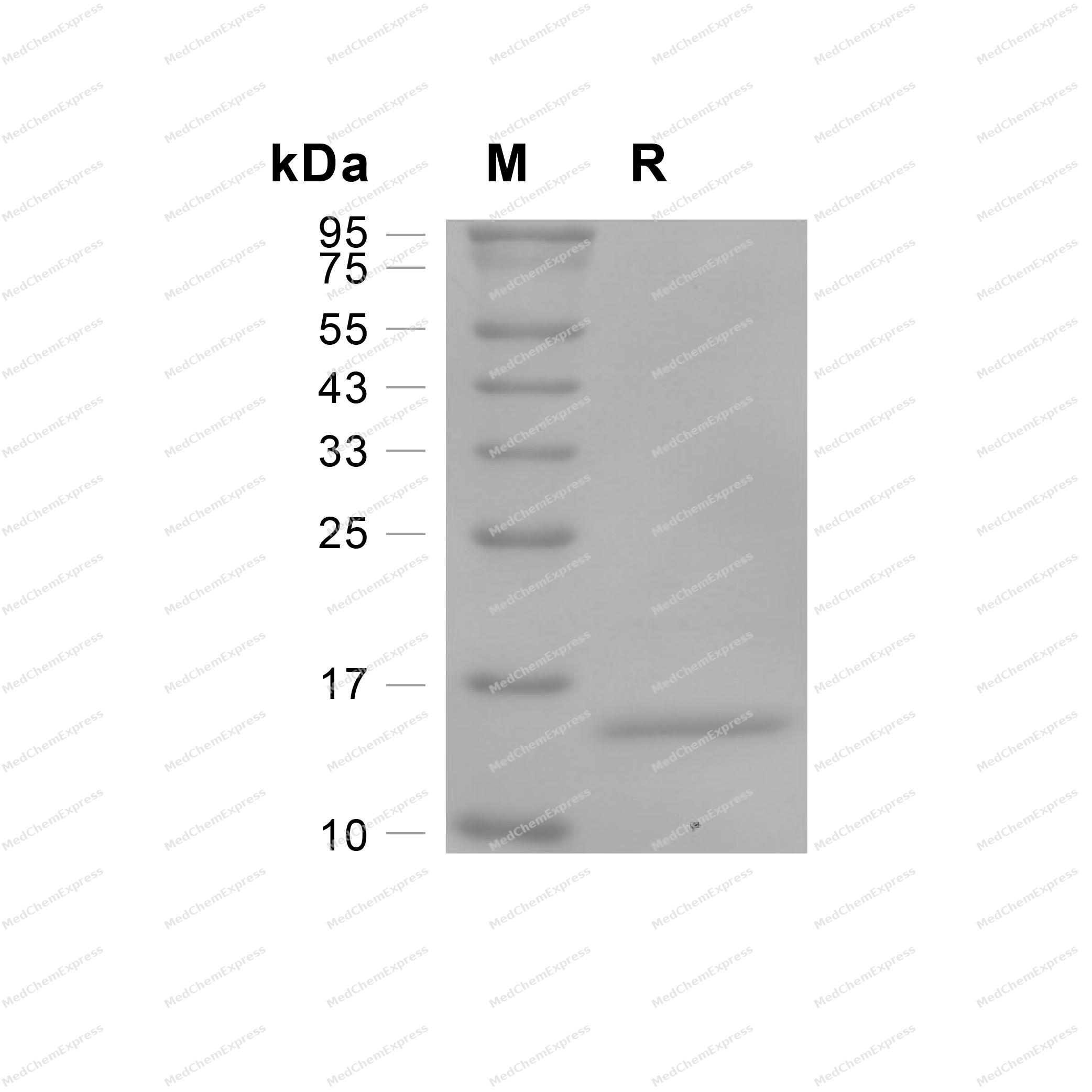
Purity - SDS-PAGE
-
Bioactivity - Cell-Based Assay
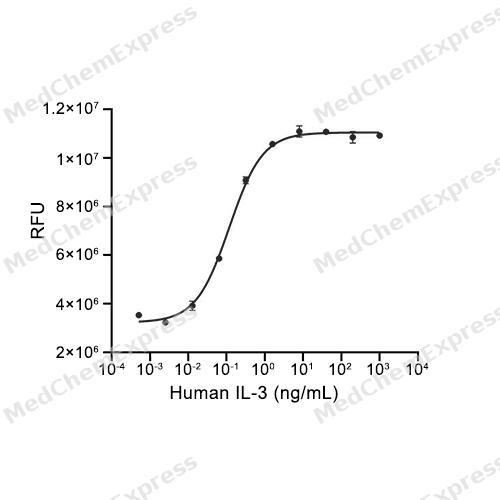
Bioactivity - Cell-Based Assay


Technical Parameters
-
Species Human
-
Source E. coli
-
Tag Tag Free
-
Accession
P08700 (A20-F152)
-
Molecular Construction
-
N-term
-
IL-3 (A20-F152)
Accession # P08700 -
C-term
-
-
Protein Length
Full Length of Mature Protein
-
Synonyms
IL3; Colony-Stimulating Factor, Multiple; Interleukin 3; P-Cell Stimulating Factor; IL-3; P-Cell-Stimulating Factor; Hematopoietic Growth Factor; Mast-Cell Growth Factor; MCGF; Mast Cell Growth Factor; Multipotential Colony-Stimulating Factor; MGC79398; I
-
AA Sequence
APMTQTTPLKTSWVNCSNMIDEIITHLKQPPLPLLDFNNLNGEDQDILMENNLRRPNLEAFNRAVKSLQNASAIESILKNLLPCLPLATAAPTRHPIHIKDGDWNEFRRKLTFYLKTLENAQAQQTTLSLAIF
-
Molecular Weight
Approximately 11-17 kDa, based on SDS-PAGE under reducing conditions, due to the glycosylation.
-
Purity
≥ 95%, as determined by reducing SDS-PAGE.


Product Properties
Lyophilized powder
1.Lyophilized from a 0.22 μm filtered solution of PBS.
2.Lyophilized from a 0.22 μm filtered solution of PBS, pH 8.0, 8% trehalose.
3.Lyophilized from a 0.22 μm filtered solution of 50 mM Tris-HCl, 300 mM NaCl, 200 mM arginine, pH 8.0.
Please refer to the lot-specific COA for specific buffer information.
Note: For SPR assay, please replace the buffer. Primary amine components (e.g., Tris, imidazole) can affect protein-coupled chips.
<1 EU/μg, determined by LAL method.
It is not recommended to reconstitute to a concentration less than 100 μg/mL in ddH2O. For long term storage it is recommended to add a carrier protein (0.1% BSA, 5% HSA, 10% FBS or 5% Trehalose).
Stored at -20°C for 2 years from date of receipt. After reconstitution, it is stable at 4°C for 1 week or -20°C for longer (with carrier protein). It is recommended to freeze aliquots at -20°C or -80°C for extended storage.
Room temperature in continental US; may vary elsewhere.


Documentation
-
Data Sheet (263 KB)
-
SDS (252 KB)
- English - EN (252 KB)
- Français - FR (252 KB)
- Deutsch - DE (252 KB)
- Norwegian - NO (252 KB)
- Español - ES (252 KB)
- Swedish - SV (252 KB)
- Italian - IT (252 KB)
- Korean - KR (252 KB)
- Portuguese - PT (252 KB)
-
Handling Instructions (2659 KB)


References
[1]. Huhn RD, et al. Recombinant human interleukin-3 (rhIL-3) enhances the mobilization of peripheral blood progenitor cells by recombinant human granulocyte colony-stimulating factor (rhG-CSF) in normal volunteers. Exp Hematol. 1996 Jun;24(7):839-47. [Content Brief]
[2]. Dagar VK, et al. Combined effect of gene dosage and process optimization strategies on high-level production of recombinant human interleukin-3 (hIL-3) in Pichia pastoris fed-batch culture. Int J Biol Macromol. 2018 Mar;108:999-1009. [Content Brief]
[3]. Santoli D, et al., Amplification of IL-2-driven T cell proliferation by recombinant human IL-3 and granulocyte-macrophage colony-stimulating factor. J Immunol. [Content Brief]

Calculators
Concentration (start) × Volume (start) = Concentration (final) × Volume (final)


 Powered by Bioz

