



GM-CSF R alpha Protein, Human (HEK293, His)

Based on 1 Customer Validation
GM-CSF R alpha is the alpha subunit of the heterodimeric receptor for colony stimulating factor 2. GM-CSF R alpha binds to the cytokine with high specificity and low affinity. GM-CSF R alpha binds to GM-CSF and induces cell differentiation. GM-CSF R alpha monoclonal antibody decreases GM-CSFRα expression on GM-CSF-responsive cells and shows anti-inflammatory activity in rheumatoid arthritis (RA). GM-CSF R alpha Protein, Human (HEK293, His) is a recombinant protein with a C-Terminal His label, It consists of 298 amino acids (E23-G320) and is produced in HEK293 cells.
- Species: Human
- Source: HEK293
-
Storage:Stored at -20°C for 2 years from date of receipt. After reconstitution, it is stable at 4°C for 1 week or -20°C for longer (with carrier protein). It is recommended to freeze aliquots at -20°C or -80°C for extended storage.


To place orders, for customer services and technical support, please contact: MedChemExpress USA
Tel: 609-228-6898 E-mail: [email protected] [email protected]


-
 Biological Activity
-
Technical Parameters
-
Product Properties
- Documentation
- References
- Help & FAQs




Biological Activity
Description
GM-CSF R alpha is the alpha subunit of the heterodimeric receptor for colony stimulating factor 2. GM-CSF R alpha binds to the cytokine with high specificity and low affinity[1]. GM-CSF R alpha binds to GM-CSF and induces cell differentiation[2]. GM-CSF R alpha monoclonal antibody decreases GM-CSFRα expression on GM-CSF-responsive cells and shows anti-inflammatory activity in rheumatoid arthritis (RA)[3]. GM-CSF R alpha Protein, Human (HEK293, His) is a recombinant protein with a C-Terminal His label, It consists of 298 amino acids (E23-G320) and is produced in HEK293 cells.
Background
GM-CSF R alpha is expressed on myeloid cells and on some non-hemopoietic cells, such as endothelial cells, not on T cells[2].
The amino acid sequence of human GM-CSF R alpha protein has low homology for mouse GM-CSF R alpha protein.
GM-CSF receptor (GM-CSFR) consists of two subunits, an α-subunit, which binds the cytokine with low affinity, and a larger β-subunit (beta common; βc), responsible for signaling, forming a ternary receptor complex. Signal transduction in response to the cytokines interleukin (IL)-3 and IL-5 is also mediated by βc; therefore, receptor specificity is due to GM-CSFRα[1]. After binding GM-CSF to its receptor, Janus-kinase-2 (JAK-2) is recruited to the cytoplasmic domain of the β chain, and activation of JAK-2 occurs, which subsequently induces STAT-5 phosphorylation. This signaling pathway induces migration of STAT-5 dimers to the nucleus and promotes the transcription of various genes such as pim-1 and CIS to induce cell differentiation[2].
GM-CSFR α-subunit significantly increases positive synovial macrophages in the RA synovium. GM-CSFR α monoclonal antibody suppresses disease activity in the murine collagen-induced arthritis model[3].
Verified Bioactivity
1. Measured by its ability to inhibit GM-CSF-dependent proliferation of TF-1 human erythroleukemic cells.The ED50 for this effect is 0.5-2.509 μg/mL.
2. Loaded Mavrilimumab (HY-P99031) on AHC2 biosensor, can bind GM-CSF R alpha Protein, Human (HEK293, His) with an affinity constant of 7.867E-10 M as determined in BLI assay.
MCE Validation Data
-
Purity - SDS-PAGE
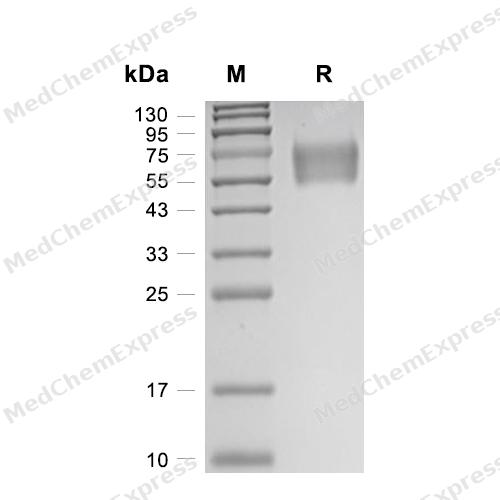
Purity - SDS-PAGE
-
Bioactivity - Cell-Based Assay
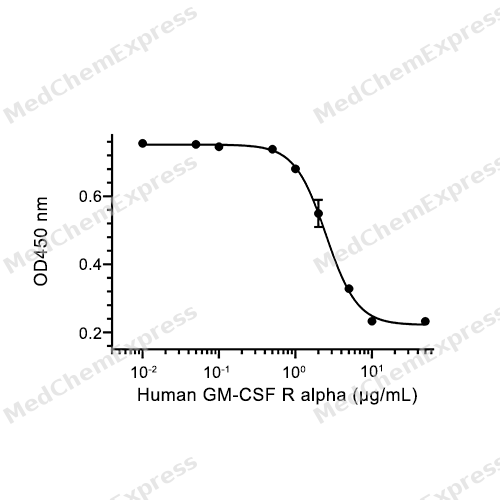
Bioactivity - Cell-Based Assay
-
Bioactivity - BLI
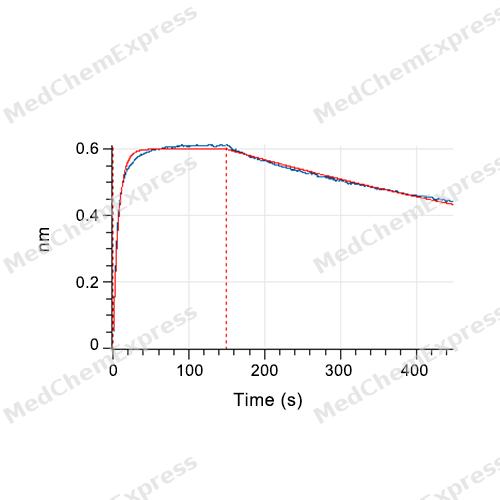
Bioactivity - BLI


Technical Parameters
-
Species Human
-
Source HEK293
-
Tag C-6*His
-
Accession
P15509 (E23-G320)
-
Molecular Construction
-
N-term
-
GM-CSF R alpha (E23-G320)
Accession # P15509 -
6*His
-
C-term
-
-
Protein Length
Extracellular Domain
-
Synonyms
CSF2RA; GMCSFR-Alpha; Prev. CSF2R; CDw116; AlphaGMR; CSF2RY; CD116; Granulocyte-Macrophage Colony-Stimulating Factor Receptor Alpha Chain; Colony Stimulating Factor 2 Receptor, Alpha, Low-Affinity (Granulocyte-Macrophage); CSF2RAX; Granulocyte-Macrophage
-
AA Sequence
EKSDLRTVAPASSLNVRFDSRTMNLSWDCQENTTFSKCFLTDKKNRVVEPRLSNNECSCTFREICLHEGVTFEVHVNTSQRGFQQKLLYPNSGREGTAAQNFSCFIYNADLMNCTWARGPTAPRDVQYFLYIRNSKRRREIRCPYYIQDSGTHVGCHLDNLSGLTSRNYFLVNGTSREIGIQFFDSLLDTKKIERFNPPSNVTVRCNTTHCLVRWKQPRTYQKLSYLDFQYQLDVHRKNTQPGTENLLINVSGDLENRYNFPSSEPRAKHSVKIRAADVRILNWSSWSEAIEFGSDDG
-
Molecular Weight
Approximately 60-65 kDa, based on SDS-PAGE under reducing conditions, due to the glycosylation.
-
Glycosylation
Yes
-
Purity
≥ 95%, as determined by reducing SDS-PAGE.


Product Properties
Lyophilized powder.
1.Lyophilized from a 0.22 μm filtered solution of 20 mM PB, 150 mM NaCl, pH 7.4.
2.Lyophilized from a 0.22 μm filtered solution of PBS, pH 7.4, 8% trehalose.
Please refer to the lot-specific COA for specific buffer information.
<1 EU/μg, determined by LAL method.
It is not recommended to reconstitute to a concentration less than 100 μg/mL in ddH2O. For long term storage it is recommended to add a carrier protein (0.1% BSA, 5% HSA, 10% FBS or 5% Trehalose).
Stored at -20°C for 2 years from date of receipt. After reconstitution, it is stable at 4°C for 1 week or -20°C for longer (with carrier protein). It is recommended to freeze aliquots at -20°C or -80°C for extended storage.
Room temperature in continental US; may vary elsewhere.


Documentation
-
Data Sheet (266 KB)
-
SDS (252 KB)
- English - EN (252 KB)
- Français - FR (252 KB)
- Deutsch - DE (252 KB)
- Norwegian - NO (252 KB)
- Español - ES (252 KB)
- Swedish - SV (252 KB)
- Italian - IT (252 KB)
- Korean - KR (252 KB)
- Portuguese - PT (252 KB)
-
Handling Instructions (2659 KB)


References
[1]. Hansen G, et al. The structure of the GM-CSF receptor complex reveals a distinct mode of cytokine receptor activation. Cell. 2008 Aug 8;134(3):496-507. [Content Brief]
[2]. Martinez-Moczygemba M, et, al. Biology of common beta receptor-signaling cytokines: IL-3, IL-5, and GM-CSF. J Allergy Clin Immunol. 2003 Oct;112(4):653-65; quiz 666. [Content Brief]
[3]. Lotfi N, et al. Roles of GM-CSF in the Pathogenesis of Autoimmune Diseases: An Update. Front Immunol. 2019 Jun 4;10:1265. [Content Brief]
[4]. Goldstein JI, et, al. Defective leukocyte GM-CSF receptor (CD116) expression and function in inflammatory bowel disease. Gastroenterology. 2011 Jul;141(1):208-16. [Content Brief]
[5]. Cook AD, et al. Granulocyte macrophage colony-stimulating factor receptor α expression and its targeting in antigen-induced arthritis and inflammation. Arthritis Res Ther. 2016 Dec 1;18(1):287. [Content Brief]

Calculators
Concentration (start) × Volume (start) = Concentration (final) × Volume (final)


 Powered by Bioz

