



Lomefloxacin

Based on 1 Customer Validation
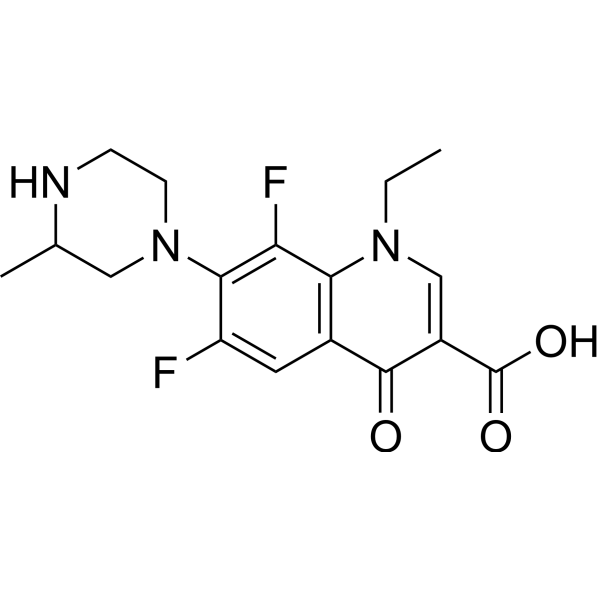
Lomefloxacin (SC47111A) is an orally active difluoroquinolone antibiotic. Lomefloxacin prevents DNA supercoiling and replication by inhibiting bacterial topoisomerase II. Lomefloxacin induces ROS production and Apoptosis. Lomefloxacin has broad-spectrum bactericidal activity against Gram-positive and Gram-negative bacteria. Lomefloxacin has anticancer effects against melanoma. Lomefloxacin can be used in the study of systemic bacterial infections (such as Salmonella typhimurium infections), skin and melanoma .
For research use only. We do not sell to patients.
- Purity : 99.99%
- CAS No.: 98079-51-7
- Formula: C17H19F2N3O3
- Molecular Weight:351.35
-
Storage:Powder -20°C, 3 years , 4°C, 2 years ; In solvent -80°C, 6 months , -20°C, 1 month

To place orders, for customer services and technical support, please contact: MedChemExpress USA
Tel: 609-228-6898 E-mail: [email protected] [email protected]


-
 Biological Activity
-
Chemical Information
-
Solvent & Solubility
- Protocols
- Purity & Documentation
- References
-
 Help & FAQs




Biological Activity
Description
IC50 & Target
|
Quinolone |
Cellular Effect
|
Cell Line

|
Type | Value | Description | References |
|---|---|---|---|---|
| HeLa | IC50 |
410 μM
Compound: Lomefloxacin
|
Inhibition of human HeLa cell proliferation
Inhibition of human HeLa cell proliferation
|
[PMID: 19595598] |
| NIH3T3 | IC50 |
483 μM
Compound: Lomefloxacin
|
Inhibition of mouse NIH/3T3 cell proliferation by MTT assay
Inhibition of mouse NIH/3T3 cell proliferation by MTT assay
|
[PMID: 19595598] |
In Vitro
Lomefloxacin (1/4 to 2×MIC concentrations) rapidly reduces viable cell counts of Staphylococcus aureus, Escherichia coli, and Pseudomonas aeruginosa, with no regrowth observed in all strains except P. aeruginosa[1].
Lomefloxacin exhibits MIC values ranging from 0.06-4 μg/mL in susceptibility determination experiments with strains such as Escherichia coli and Staphylococcus aureus[2].
Lomefloxacin (0.1-1.0 mM; 24-72 h) decreases viability of COLO829 cells and induces ROS production in COLO829 cells[3].
Lomefloxacin (50-100 μM) induces apoptosis in keratinocyte[4].
MedChemExpress (MCE) has not independently confirmed the accuracy of these methods. They are for reference only.
-
Cell Line:COLO829 melanoma cells
-
Concentration:0.0001, 0.001, 0.01, 0.05, 0.1, 0.5, 1.0 mM
-
Incubation Time:24, 48, 72 h
-
Result:Decreased cell viability by 12-68% at 0.1-1.0 mM for 24 h, with IC50 values of 0.51, 0.33, and 0.25 mM at 24, 48, 72 h, respectively.
In Vivo
Lomefloxacin (-80 mg/kg; orogastric administration) reduces mortality, significantly decreases splenic bacterial counts, and inhibits inflammatory response in mice infected with Salmonella typhimurium[5].
Lomefloxacin (16-32 mg/kg; i.p.; 5 days) only at the highest dose slightly reduces the number of implants and live fetuses in the third week of mating in mice, without significant dominant lethal mutation induction[6].
MedChemExpress (MCE) has not independently confirmed the accuracy of these methods. They are for reference only.


Chemical Information
-
CAS No. 98079-51-7
-
Appearance Solid
-
Molecular Weight 351.35
-
Formula C17H19F2N3O3
-
Color White to off-white
-
SMILES
O=C(C1=CN(CC)C2=C(C=C(F)C(N3CC(C)NCC3)=C2F)C1=O)O
-
Synonyms
SC47111A; NY-198
-
Shipping
Room temperature in continental US; may vary elsewhere.
-
Storage
Powder -20°C 3 years 4°C 2 years In solvent -80°C 6 months -20°C 1 month


Solvent & Solubility
In Vitro:
DMSO : 4 mg/mL (11.38 mM; ultrasonic and warming and heat to 60°C; Hygroscopic DMSO has a significant impact on the solubility of product, please use newly opened DMSO)
Please refer to the solubility information to select the appropriate solvent. Once prepared, please aliquot and store the solution to prevent product inactivation from repeated freeze-thaw cycles.
Storage method and period of stock solution: -80°C, 6 months; -20°C, 1 month. When stored at -80°C, please use it within 6 months. When stored at -20°C, please use it within 1 month.
Please refer to the solubility information to select the appropriate solvent. Once prepared, please aliquot and store the solution to prevent product inactivation from repeated freeze-thaw cycles.
Storage method and period of stock solution: -80°C, 6 months; -20°C, 1 month. When stored at -80°C, please use it within 6 months. When stored at -20°C, please use it within 1 month.
Concentration (start) × Volume (start) = Concentration (final) × Volume (final)


Purity & Documentation
-
Data Sheet (275 KB)
-
SDS (393 KB)
- English - EN (393 KB)
- Français - FR (393 KB)
- Deutsch - DE (393 KB)
- Norwegian - NO (393 KB)
- Español - ES (393 KB)
- Swedish - SV (393 KB)
- Italian - IT (393 KB)
- Korean - KR (393 KB)
- Portuguese - PT (393 KB)
-
Handling Instructions (2659 KB)
References
[1]. Hirose T, et al. In vitro and in vivo activity of NY-198, a new difluorinated quinolone. Antimicrob Agents Chemother. 1987 Jun;31(6):854-9. [Content Brief]
[2]. Piddock LJ, et al. Mechanism of action of lomefloxacin. Antimicrob Agents Chemother. 1990 Jun;34(6):1088-93. [Content Brief]
[3]. Beberok A, et al. Lomefloxacin Induces Oxidative Stress and Apoptosis in COLO829 Melanoma Cells. Int J Mol Sci. 2017 Oct 20;18(10):2194. [Content Brief]
[4]. Marrot L, et al. Molecular responses to photogenotoxic stress induced by the antibiotic lomefloxacin in human skin cells: from DNA damage to apoptosis. J Invest Dermatol. 2003 Sep;121(3):596-606. [Content Brief]
[5]. Butler T, et al. Treatment of experimental Salmonella typhimurium infection in mice with lomefloxacin. J Antimicrob Chemother. 1990 Apr;25(4):629-34. [Content Brief]
[6]. Singh AC, et al. Genotoxicity of lomefloxacin--an antibacterial drug in somatic and germ cells of Swiss albino mice in vivo. Mutat Res. 2003 Feb 5;535(1):35-42. [Content Brief]


Complete Stock Solution Preparation Table
Please refer to the solubility information to select the appropriate solvent. Once prepared, please aliquot and store the solution to prevent product inactivation from repeated freeze-thaw cycles.
Storage method and period of stock solution: -80°C, 6 months; -20°C, 1 month. When stored at -80°C, please use it within 6 months. When stored at -20°C, please use it within 1 month.
| Optional Solvent | Concentration Solvent Mass | 1 mg | 5 mg | 10 mg | 25 mg |
|---|---|---|---|---|---|
| DMSO | 1 mM | 2.8462 mL | 14.2308 mL | 28.4616 mL | 71.1541 mL |
| 5 mM | 0.5692 mL | 2.8462 mL | 5.6923 mL | 14.2308 mL | |
| 10 mM | 0.2846 mL | 1.4231 mL | 2.8462 mL | 7.1154 mL |


Lomefloxacin Related Classifications
HY-B0455A Related Classifications
 Powered by Bioz