



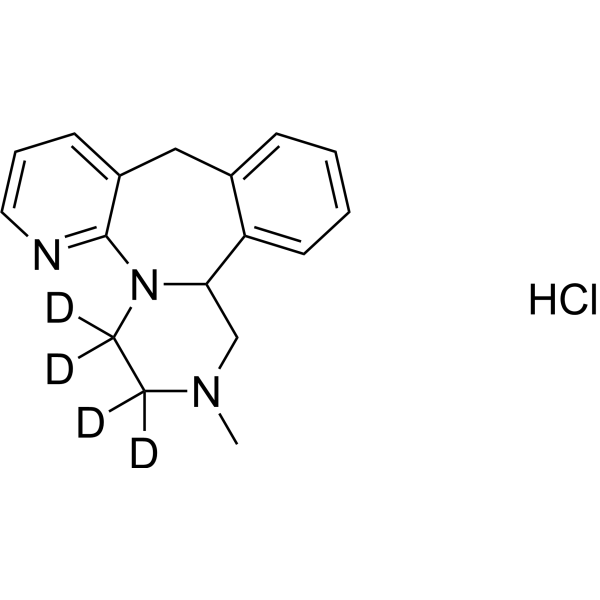
Mirtazapine-d4 hydrochloride
Mirtazapine-d4 hydrochloride is deuterated labeled Mirtazapine (HY-B0352). Mirtazapine (Org3770) is a potent and orally active noradrenergic and specific serotonergic antidepressant (NaSSA) agent. Mirtazapine is also a 5-HT2, 5-HT3, histamine H1 receptor and α2-adrenoceptor antagonist with pKi values of 8.05, 8.1, 9.3 and 6.95, respectively.
For research use only. We do not sell to patients.
- CAS No.: 1215587-73-7
- Formula: C17H16D4ClN3
- Molecular Weight:305.84
-
Storage:
Please store the product under the recommended conditions in the Certificate of Analysis.

To place orders, for customer services and technical support, please contact: MedChemExpress USA
Tel: 609-228-6898 E-mail: [email protected] [email protected]


-
 Biological Activity
-
Chemical Information
- Purity & Documentation
- References
-
 Help & FAQs


All 5-HT Receptor Isoforms
MoreAll Adrenergic Receptor Isoforms
MoreAll Histamine Receptor Isoforms
More

Biological Activity
Description
In Vitro
Stable heavy isotopes of hydrogen, carbon, and other elements have been incorporated into drug molecules, largely as tracers for quantitation during the drug development process. Deuteration has gained attention because of its potential to affect the pharmacokinetic and metabolic profiles of drugs[1].
Mirtazapine can antagonize the adrenergic α2-autoreceptors and α2-heteroreceptors as well as block 5-HT2 and 5-HT3 receptors. Mirtazapine enhances the release of norepinephrine and 5-HT1A-mediated serotonergic transmission[2].
The cytochrome (CYP) P450 isoenzymes CYP1A2, CYP2D6, and CYP3A4 are mainly responsible for Mirtazapine's metabolism[2].
Mirtazapine (10 μM) significantly reduces activation-induced release of cytokine/chemokine mediators from human CD14+ monocytes in vitro[4].
MedChemExpress (MCE) has not independently confirmed the accuracy of these methods. They are for reference only.
In Vivo
Mirtazapine treatment inhibits hepatic macrophage/monocyte activation, decreases hepatic macrophage/monocyte-derived pro-inflammatory cytokine (e.g., TNFα) and chemokine (e.g., CXCL1 and CXCL2) production, suppression of Con A-induced increases in the hepatic expression of the neutrophil relevant endothelial cell adhesion molecule ICAM-1, with the resultant significant reduction in neutrophil recruitment into the liver[4].
MedChemExpress (MCE) has not independently confirmed the accuracy of these methods. They are for reference only.
Application
1. This compound can be used as a tracer
2. This compound can be used as an internal standard for quantitative analysis by NMR, GC-MS, or LC-MS.


Chemical Information
-
CAS No. 1215587-73-7
-
Unlabeled CAS 85650-52-8
-
Molecular Weight 305.84
-
Formula C17H16D4ClN3
-
SMILES
CN1CC2C3=CC=CC=C3CC4=CC=CN=C4N2C([2H])([2H])C1([2H])[2H].Cl
-
Shipping
Room temperature in continental US; may vary elsewhere.
-
Storage
Please store the product under the recommended conditions in the Certificate of Analysis.


Purity & Documentation
References
[1]. Russak EM, et al. Impact of Deuterium Substitution on the Pharmacokinetics of Pharmaceuticals. Ann Pharmacother. 2019 Feb;53(2):211-216. [Content Brief]
[2]. S A Anttila, et al. A review of the pharmacological and clinical profile of mirtazapine. CNS Drug Rev. Fall 2001;7(3):249-64. [Content Brief]
[3]. T H de Boer, et al. Neurochemical and autonomic pharmacological profiles of the 6-aza-analogue of mianserin, Org 3770 and its enantiomers. Neuropharmacology. 1988 Apr;27(4):399-408. [Content Brief]
[4]. Wagdi Almishri, et al. The Antidepressant Mirtazapine Inhibits Hepatic Innate Immune Networks to Attenuate Immune-Mediated Liver Injury in Mice. Front Immunol. 2019 Apr 12;10:803. [Content Brief]

Calculators
Concentration (start) × Volume (start) = Concentration (final) × Volume (final)


Mirtazapine-d4 hydrochloride Related Classifications
HY-B0352S3 Related Classifications
 Powered by Bioz