



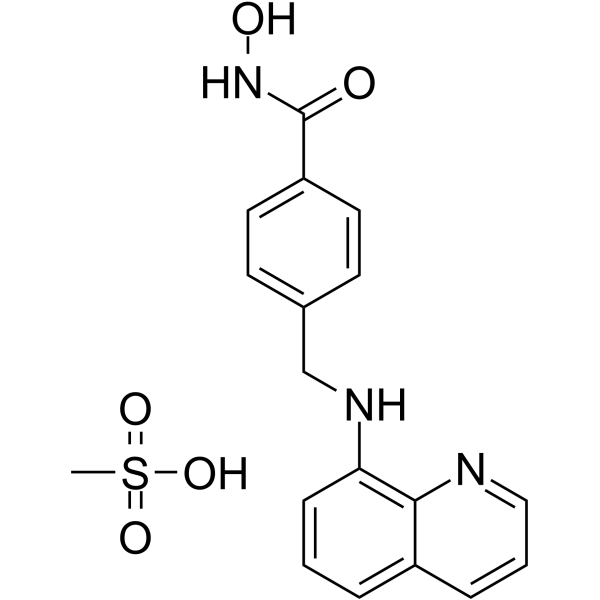
MPT0G211 mesylate
Based on 1 publication(s) in Google Scholar
MPT0G211 mesylate is a potent, orally active and selective HDAC6 inhibitor (IC50=0.291 nM). MPT0G211 mesylate displays >1000-fold selective for HDAC6 over other HDAC isoforms. MPT0G211 mesylate can penetrate the blood-brain barrier. MPT0G211 mesylate ameliorates tau phosphorylation and cognitive deficits in an Alzheimer’s disease model. MPT0G211 mesylate has anti-metastatic and neuroprotective effects. Anticancer activities.
For research use only. We do not sell to patients.
- CAS No.: 2151854-33-8
- Formula: C18H19N3O5S
- Molecular Weight:389.43
-
Storage:
Please store the product under the recommended conditions in the Certificate of Analysis.

To place orders, for customer services and technical support, please contact: MedChemExpress USA
Tel: 609-228-6898 E-mail: [email protected] [email protected]


-
 Biological Activity
-
Chemical Information
- Protocols
- Purity & Documentation
- References
-
 Help & FAQs


Publications Citing Use of MedChemExpress (MCE) MPT0G211 mesylate
More

Biological Activity
Description
IC50 & Target
[1]|
HDAC6 0.291 μM (IC50) |
In Vitro
MPT0G211 mesylate (0.1 μM; Cells were transfected with pCAX APP 695 and pRK5-EGFP-Tau P301L for 24 h) significantly inhibited the phosphorylation of tau Ser396[1].
MPT0G211 mesylate inhibits HDAC6/Hsp90 binding and causes subsequent proteasomal degradation of polyubiquitinated proteins[1].
MPT0G211 mesylate significantly decreases the phosphorylation of tau by GSK3β inactivation[1].
MPT0G211 mesylate (0.1 μM; 24 hours) significantly attenuates the phosphorylation of tau Ser396 and Ser404 in both cell lines (SH-SY5Y and Neuro-2a cells were transfected for 24 h with pCAX APP 695 and pRK5-EGFP-Tau P301L)[1].
MPT0G211 mesylate inhibits MDA-MB-231 and MCF-7 cells growth (GI50=16.19 and 5.6 μM, respectively)[2].
In AML cells, MPT0G211 mesylate potentiates the cytotoxic effects of DOXO by impairing DNA repair machinery and activating Bcl-2-associated X protein (BCL-XL)-dependent cell apoptosis[3].
MedChemExpress (MCE) has not independently confirmed the accuracy of these methods. They are for reference only. Further protocols information, click here.
In Vivo
MPT0G211 mesylate (25 mg/kg; i.p.; qd; day 73 post-tumor injection) reduces numbers of nodules and lung weights[2].
MPT0G211 mesylate treatment not only diminishes tau phosphorylation by inhibition GSK3β activity but also enhances the acetylation of Hsp90, which causes the downregulation of HDAC6/Hsp90 binding and facilitates proteasomal degradation of polyubiquitinated p-tau[1].
MedChemExpress (MCE) has not independently confirmed the accuracy of these methods. They are for reference only.
-
Animal Model:Triple transgenic (3×Tg-AD) mice (harboring APPSwe and tauP301L mutant transgenes[1]
-
Dosage:50 mg/kg
-
Administration:P.o.; daily for 3 months
-
Result:Significantly ameliorated the spatial memory impairment.
-
Animal Model:Female SCID mice (bearing MDA-MB-231 cells)[2]
-
Dosage:25 mg/kg
-
Administration:I.p.; qd; day 73 post-tumor injection
-
Result:Significantly reduced numbers of nodules and lung weights.


Chemical Information
-
CAS No. 2151854-33-8
-
Molecular Weight 389.43
-
Formula C18H19N3O5S
-
SMILES
CS(=O)(O)=O.O=C(NO)C1=CC=C(CNC2=C3N=CC=CC3=CC=C2)C=C1
-
Shipping
Room temperature in continental US; may vary elsewhere.
-
Storage
Please store the product under the recommended conditions in the Certificate of Analysis.


Publications (1)
-
Journal Impact Factor
-
Most Recent

Protocols
-
Kinase activity and phosphorylation assays
Kinase activity assays measure the ability of kinases to transfer phosphate groups from ATP to specific substrates, while phosphorylation assays detect the presence and levels of phosphorylated proteins. Common methods include radiolabeled ATP incorporation (e. g. ,), ADP release detection via bioluminescence (e. g. ,[3]), enzyme-linked immunosorbent assays (ELISA) for phospho-specific epitopes (e. g. ,[6]), and microtiter-based formats for high-throughput screening (e. g. ,[8]). The ADP-Glo assay quantifies kinase activity by measuring ADP produced during phosphorylation using a luciferase-based system. Radiometric assays involve autoradiography or scintillation counting after incorporation of 32P-labeled ATP into substrate proteins. ELISA-based approaches rely on phospho-specific antibodies to detect activated kinases in cell lysates or purified samples.
-
Western Blot
Western blotting (WB) is a commonly used experimental method in molecular biology, biochemistry, and immunogenetics for identifying and quantifying target proteins. It combines gel electrophoresis with immunoassay, enabling researchers to analyze protein expression, post-translational modifications, and molecular weight.
-
Cell Cytotoxicity Assay
Cytotoxicity assays are usually based on the assessment of cell membrane damage, which can also be indirectly detected by measuring cell viability. Detection methods include MTT assay, CKK-8 assay, LDH assay and ATP assay, etc.
-
Protocol for Kinase activity and phosphorylation assays
Kinase activity assays measure transfer of phosphate from ATP to a protein or peptide substrate, generating phosphorylated substrate, ADP, or incorporated radiolabeled phosphate as the readout; phosphorylation assays measure site-specific phosphorylation in cells or tissues as a proxy for kinase-pathway activation, inhibition, or substrate regulation. Phosphorylation can be detected by phospho-specific Western blot, immunoprecipitation kinase assay, phospho-immunofluorescence, phospho-flow cytometry, luminescent ADP detection, radiolabeled ATP incorporation, or reporter-based pathway assays, and these readouts can be applied to cancer cells, primary neurons, mouse tumors, organoids, inflammatory macrophages, ferroptosis studies, and mitophagy studies when the kinase target is biologically relevant.
-
Alzheimer’s Disease Modeling
Alzheimer’s Disease (AD) is a neurodegenerative disorder characterized by a progressive decline in cognitive functions and loss of specific types of neurons and synapses. Alzheimer's symptoms can be simulated in mice by injecting drugs (such as Aβ) or genetically modified.
-
How to Choose the Right Model Animal
Choosing the right model animal is a validity-driven decision in which the species, strain, sex, age, genetic background, disease-induction method, outcome measures, and welfare burden must match the scientific question rather than laboratory tradition or convenience. A model should be selected by judging face validity, construct validity, and predictive validity: whether it resembles the human phenotype, whether it reproduces relevant mechanisms, and whether results are likely to predict human biology or treatment response. Animal studies often fail to translate because of species differences, weak disease resemblance, poor experimental design, inadequate reporting, publication bias, and underuse of randomization, blinding, and sample-size justification. Unresolved questions include how to rank competing models objectively, how much human-disease complexity must be reproduced for a given objective, and when non-animal systems such as organoids, ex vivo tissue, or computational models


Purity & Documentation
References
[1]. Fan SJ, et al. The novel histone de acetylase 6 inhibitor, MPT0G211, ameliorates tau phosphorylation and cognitive deficits in an Alzheimer's disease model. Cell Death Dis. 2018;9(6):655. Published 2018 May 29. [Content Brief]
[2]. Hsieh YL, et al. Anti-metastatic activity of MPT0G211, a novel HDAC6 inhibitor, in human breast cancer cells in vitro and in vivo. Biochim Biophys Acta Mol Cell Res. 2019;1866(6):992-1003. [Content Brief]
[3]. Tu HJ, et al. The anticancer effects of MPT0G211, a novel HDAC6 inhibitor, combined with chemotherapeutic agents in human acute leukemia cells. Clin Epigenetics. 2018;10(1):162. Published 2018 Dec 29. [Content Brief]

Calculators
Concentration (start) × Volume (start) = Concentration (final) × Volume (final)


MPT0G211 mesylate Related Classifications
HY-123976A Related Classifications
 Powered by Bioz