



PhIP
Based on 1 publication(s) in Google Scholar
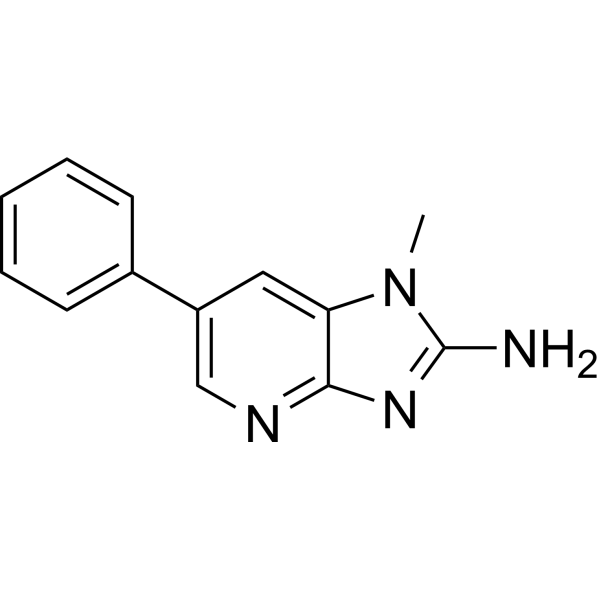
PhIP (2-Amino-1-methyl-6-phenylimidazo[4,5-b]pyridine) is the most abundant of generation of heterocyclic amines (HCA), resulted in the cooking of meat. DNA damaging and mutagenic activities. PhIP also has oestrogenic activity that could contribute to its tissue specific carcinogenicity.
Nur für Forschungszwecke. Wir verkaufen nicht an Patienten.
- Reinheit : 99.93%
- CAS. Nr.: 105650-23-5
- Formel: C13H12N4
- Molecular Weight:224.26
-
Speicherung:Powder -20°C, 3 years , 4°C, 2 years ; In solvent -80°C, 6 months , -20°C, 1 month

To place orders, for customer services and technical support, please contact: MedChemExpress USA
Tel: 609-228-6898 E-mail: [email protected] [email protected]


-
 Biologische Aktivität
-
Chemical Information
-
Lösungsmittel & Löslichkeit
- Protokoll
- Reinheit & Dokumentation
- Verweise
-
 Help & FAQs



Publications Citing Use of MedChemExpress (MCE) PhIP
More

Biologische Aktivität
Beschreibung
In Vitro
PhIP causes widespread and largely over-lapping effects on miRNA expression. PhIP induces widespread effects via activation of oestrogen receptor alpha (ERα). Deregulation of miRNA by PhIP could potentially be an important non-DNA-damaging carcinogenic mechanism in breast cancer[2].
MedChemExpress (MCE) has not independently confirmed the accuracy of these methods. They are for reference only. Further protocols information, click here.
Induced Disease Models
Please do not refer to only one article to determine the experimental conditions. It is recommended to determine the optimal experimental conditions (animal strain, age, dosage, frequency and cycle, detection time and indicators, etc.) through preliminary experiments before the formal experiment.
PhIP (400 p.p.m. in diet) induces colon carcinogenesis in male F344 rats, progressing through defined phases: PhIP-DNA adduct formation (peaking at 1-8 weeks), subsequent crypt cell hyperproliferation (4-12 weeks), and the emergence of preneoplastic aberrant crypt foci (ACF) by 14 weeks. This sequence, upon continuous exposure for 52 weeks, results in colon carcinomas at an incidence of about 50%[3][4]
PhIP (400 p.p.m. in diet), employing an intermittent high-fat regimen, efficiently induces colon carcinogenesis in male F344 rats, with an incidence of ~45% within 60 weeks[5].
PhIP (total dose 200 mg/kg, i.g.) induces the formation of small intestinal tumors at the ages of weeks 28-40 in obese hCYP1A-db/db mice[6].
Administration: 400 p.p.m. in diet • p.o. • daily for 52 weeks;
2. Rats: F344 rats • male • maintained on a high-fat diet throughout • 6-week-old
Administration: 400 p.p.m. in diet • p.o. • 2 weeks, followed by 4 weeks of high-fat diet alone, the cycle repeated 3 times, followed by the high-fat diet for 42 weeks
Administration: 100 mg/kg • i.g. • total 2 doses, 4 days apart, starting at 6 weeks of age.
In hCYP1A-mice, PhIP induces inflammation, epithelial cell damage, and prostatic intraepithelial neoplasia in the dorsolateral prostate lobe compared to the ventral lobe. PhIP forms DNA adducts in the prostate, PhIP also induces oxidative stress, atrophy of the acini, and inflammation of the prostate of rodents[1].
MedChemExpress (MCE) has not independently confirmed the accuracy of these methods. They are for reference only.
Clinical Trial
| NCT Number | Sponsor | Condition | Start Date |
Phase

|
|---|---|---|---|---|
| NCT01329991 | Plexxikon| | 2011-05 | PHASE1 |


Chemical Information
-
CAS. Nr. 105650-23-5
-
Appearance Solid
-
Molecular Weight 224.26
-
Formel C13H12N4
-
Color White to light yellow
-
SMILES
NC1=NC2=NC=C(C=C2N1C)C3=CC=CC=C3
-
Synonyms
2-Amino-1-methyl-6-phenylimidazo[4,5-b]pyridine
-
Initial Source
-
Versand
Room temperature in continental US; may vary elsewhere.
-
Speicherung
Powder -20°C 3 years 4°C 2 years In solvent -80°C 6 months -20°C 1 month


Publications (1)
-
Journal Impact Factor
-
Most Recent
-
J Agric Food Chem
Potential of Fiber and Probiotics to Fight Against the Effects of PhIP + DSS-Induced Carcinogenic Process of the Large Intestine. [Abstract]2024 Nov 13;72(45):25161-25172. PMID: 39470985


Lösungsmittel & Löslichkeit
In Vitro:
DMSO : 25 mg/mL (111.48 mM; ultrasonic and warming and heat to 60°C; Hygroscopic DMSO has a significant impact on the solubility of product, please use newly opened DMSO)
Please refer to the solubility information to select the appropriate solvent. Once prepared, please aliquot and store the solution to prevent product inactivation from repeated freeze-thaw cycles.
Storage method and period of stock solution: -80°C, 6 months; -20°C, 1 month. When stored at -80°C, please use it within 6 months. When stored at -20°C, please use it within 1 month.
Please refer to the solubility information to select the appropriate solvent. Once prepared, please aliquot and store the solution to prevent product inactivation from repeated freeze-thaw cycles.
Storage method and period of stock solution: -80°C, 6 months; -20°C, 1 month. When stored at -80°C, please use it within 6 months. When stored at -20°C, please use it within 1 month.
Konzentration (Stammlösung) × Volumen (Stammlösung) = Konzentration (Ziellösung) × Volumen (Ziellösung)
In Vivo:
Select the appropriate dissolution method based on your experimental animal and administration route.
- For the following dissolution methods, please ensure to first prepare a clear stock solution using an In Vitro approach and then sequentially add co-solvents:
- To ensure reliable experimental results, the clarified stock solution can be appropriately stored based on storage conditions. As for the working solution for In Vivo experiments, it is recommended to prepare freshly and use it on the same day.
- The percentages shown for the solvents indicate their volumetric ratio in the final prepared solution. If precipitation or phase separation occurs during preparation, heat and/or sonication can be used to aid dissolution.
Add each solvent one by one: 10% DMSO 90% (20% SBE-β-CD in Saline)
Solubility: ≥ 0.56 mg/mL (2.50 mM); Clear solution
This protocol yields a clear solution of ≥ 0.56 mg/mL (saturation unknown).
Taking 1 mL working solution as an example, add 100 μL DMSO stock solution (5.6 mg/mL) to 900 μL 20% SBE-β-CD in Saline, and mix evenly.
Preparation of 20% SBE-β-CD in Saline (4°C, storage for one week): 2 g SBE-β-CD powder is dissolved in 10 mL Saline, completely dissolve until clear.
In Vivo Dissolution Calculator
Please enter the basic information of animal experiments:
-
-
-
-
Recommended: Prepare an additional quantity of animals to account for potential losses during experiments.
Please enter your animal formula composition:
-
%DMSO +
Recommended: Keep the proportion of DMSO in working solution below 2% if your animal is weak.
-
%+
-
+%Tween-80 + +
-
%Saline +
The co-solvents required include: DMSO, . All of co-solvents are available by MedChemExpress (MCE). , Tween 80. All of co-solvents are available by MedChemExpress (MCE).
Working solution concentration: 0.22 mg/mL
Method for preparing stock solution: mg drug dissolved in μL DMSO. Stock solution concentration: mg/mL.
1. Take μL DMSO stock solution;
2. Add μL .
μL , mix evenly;
3. Then add μL Tween 80, mix evenly;
4. Then add μL
Please ensure that the stock solution in the first step is dissolved to a clear state, and add co-solvents in sequence. You can use ultrasonic heating (ultrasonic cleaner, recommended frequency 20-40 kHz), vortexing, etc. to assist dissolution.

Protokoll
-
Carcinogenicity Bioassay
A carcinogenicity bioassay detects whether long-term exposure to a test substance increases benign or malignant tumor incidence, changes tumor spectrum, or shortens tumor latency in experimental animals; the classical rodent design exposes rats and/or mice to multiple dose levels for most of their lifespan, followed by complete necropsy and histopathologic diagnosis of neoplastic and non-neoplastic lesions. The readout is tumor incidence by organ, sex, species, dose group, and survival status; interpretation requires concurrent controls, dose-response assessment, survival-adjusted tumor statistics, and pathology review because mortality, spontaneous tumor background, and body-weight effects can influence apparent tumor rates.
-
Genotoxicity/Mutagenicity Study
The bacterial reverse mutation assay detects point mutations that restore amino-acid prototrophy in auxotrophic Salmonella typhimurium or Escherichia coli tester strains; after exposure to a test article, mutagenic activity is read out as an increased number of revertant colonies on minimal agar compared with the vehicle control. The assay uses tester strains with different mutation targets so that base-substitution and frameshift mutagens can be detected, and testing is performed with and without exogenous mammalian metabolic activation because some chemicals require biotransformation to become mutagenic.


Reinheit & Dokumentation
-
Data Sheet (283 KB)
-
SDS (419 KB)
- English - EN (419 KB)
- Français - FR (419 KB)
- Deutsch - DE (419 KB)
- Norwegian - NO (419 KB)
- Español - ES (419 KB)
- Swedish - SV (419 KB)
- Italian - IT (419 KB)
- Korean - KR (419 KB)
- Portuguese - PT (419 KB)
-
Handling Instructions (2659 KB)
Verweise
[1]. Bellamri M, et al. Metabolic Activation of the Cooked Meat Carcinogen 2-Amino-1-Methyl-6-Phenylimidazo[4,5-b]Pyridine in Human Prostate. Toxicol Sci. 2018 Jun 1;163(2):543-556. [Content Brief]
[2]. Papaioannou MD, et ak. The cooked meat-derived mammary carcinogen 2-amino-1-methyl-6-phenylimidazo[4,5-b]pyridine (PhIP) elicits estrogenic-like microRNA responses in breast cancer cells. Toxicol Lett. 2014 Aug 17;229(1):9-16. [Content Brief]
[3]. Ochiai M, et al. DNA adduct formation, cell proliferation and aberrant crypt focus formation induced by PhIP in male and female rat colon with relevance to carcinogenesis. Carcinogenesis. 1996 Jan;17(1):95-8. [Content Brief]
[4]. Nakagama H, et al. A rat colon cancer model induced by 2-amino-1-methyl-6-phenylimidazo[4,5-b]pyridine, PhIP. Mutat Res. 2002 Sep 30;506-507:137-44. [Content Brief]
[6]. Wang H, et al. Obesity promotes PhIP-induced small intestinal carcinogenesis in hCYP1A-db/db mice: involvement of mutations and DNA hypermethylation of Apc. Carcinogenesis. 2016 Jul;37(7):723-730. [Content Brief]


Complete Stock Solution Preparation Table
Please refer to the solubility information to select the appropriate solvent. Once prepared, please aliquot and store the solution to prevent product inactivation from repeated freeze-thaw cycles.
Storage method and period of stock solution: -80°C, 6 months; -20°C, 1 month. When stored at -80°C, please use it within 6 months. When stored at -20°C, please use it within 1 month.
| Optional Solvent | Concentration Solvent Mass | 1 mg | 5 mg | 10 mg | 25 mg |
|---|---|---|---|---|---|
| DMSO | 1 mM | 4.4591 mL | 22.2956 mL | 44.5911 mL | 111.4778 mL |
| 5 mM | 0.8918 mL | 4.4591 mL | 8.9182 mL | 22.2956 mL | |
| 10 mM | 0.4459 mL | 2.2296 mL | 4.4591 mL | 11.1478 mL | |
| 15 mM | 0.2973 mL | 1.4864 mL | 2.9727 mL | 7.4319 mL | |
| 20 mM | 0.2230 mL | 1.1148 mL | 2.2296 mL | 5.5739 mL | |
| 25 mM | 0.1784 mL | 0.8918 mL | 1.7836 mL | 4.4591 mL | |
| 30 mM | 0.1486 mL | 0.7432 mL | 1.4864 mL | 3.7159 mL | |
| 40 mM | 0.1115 mL | 0.5574 mL | 1.1148 mL | 2.7869 mL | |
| 50 mM | 0.0892 mL | 0.4459 mL | 0.8918 mL | 2.2296 mL | |
| 60 mM | 0.0743 mL | 0.3716 mL | 0.7432 mL | 1.8580 mL | |
| 80 mM | 0.0557 mL | 0.2787 mL | 0.5574 mL | 1.3935 mL | |
| 100 mM | 0.0446 mL | 0.2230 mL | 0.4459 mL | 1.1148 mL |


PhIP Related Classifications
HY-118716 Related Classifications
 Powered by Bioz
Keywords