



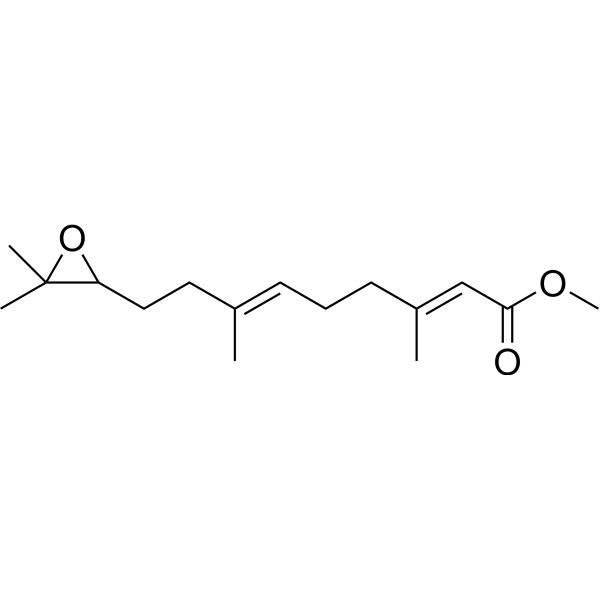
(Rac)-Juvenile hormone III

Based on 1 Customer Validation
(Rac)-Juvenile hormone III is a cecropia juvenile hormone and juvenile hormone agonist. (Rac)-Juvenile hormone III induces test insects to retain larval characteristics after the final molt to the adult stage. (Rac)-Juvenile hormone III exhibits juvenile hormone activity in Tenebrio molitor pupae and last-instar nymphs of Oncopeltus fasciatus. (Rac)-Juvenile hormone III possesses morphogenetic activity in insect assays.
For research use only. We do not sell to patients.
- Purity : 98.83%
- CAS No.: 24198-95-6
- Formula: C16H26O3
- Molecular Weight:266.38
-
Storage:
-20°C, protect from light, stored under nitrogen
* In solvent : -80°C, 6 months; -20°C, 1 month (protect from light, stored under nitrogen)

To place orders, for customer services and technical support, please contact: MedChemExpress USA
Tel: 609-228-6898 E-mail: [email protected] [email protected]


-
 Biological Activity
-
Chemical Information
- Purity & Documentation
- References
-
 Help & FAQs




Biological Activity
Description
In Vivo
(Rac)-Juvenile hormone III (IVa) (0.001-0.1 μg; topical; single application) induces a weak morphogenetic response (score 0-1) in last-instar Oncopeltus fasciatus nymphs at 0.1 μg, with no response at lower 0.001 μg and 0.01 μg doses[1].
MedChemExpress (MCE) has not independently confirmed the accuracy of these methods. They are for reference only.
-
Animal Model:Tenebrio molitor L. (newly molted pupae)[1]
-
Dosage:0.001 μg; 0.01 μg; 0.1 μg
-
Administration:topical; single application
-
Result:Showed no morphogenetic response (score 0) at 0.001 μg.
Showed no morphogenetic response (score 0) at 0.01 μg.
Induced a morphogenetic response score of 2 (corresponding to several well-developed gin traps or intermediate genitalia, or both) at 0.1 μg.
-
Animal Model:Oncopeltus fasciatus (Dallas) (last-instar nymphs)[1]
-
Dosage:0.001 μg; 0.01 μg; 0.1 μg
-
Administration:topical; single application
-
Result:Showed no morphogenetic response (score 0) at 0.001 μg.
Showed no morphogenetic response (score 0) at 0.01 μg.
Induced a weak morphogenetic response score of 0-1 (corresponding to essentially an adult with nymphal cuticle and coloration on the abdomen) at 0.1 μg.


Chemical Information
-
CAS No. 24198-95-6
-
Appearance Liquid (Density: 0.966±0.06 g/cm3)
-
Molecular Weight 266.38
-
Formula C16H26O3
-
Color Colorless to light yellow
-
SMILES
C/C(CCC1OC1(C)C)=C\CC/C(C)=C/C(OC)=O
-
Structure Classification
-
Initial Source
yellow mealworm
-
Shipping
Room temperature in continental US; may vary elsewhere.
-
Storage
-20°C, protect from light, stored under nitrogen
* In solvent : -80°C, 6 months; -20°C, 1 month (protect from light, stored under nitrogen)


Purity & Documentation
-
Data Sheet (268 KB)
-
SDS (393 KB)
- English - EN (393 KB)
- Français - FR (393 KB)
- Deutsch - DE (393 KB)
- Norwegian - NO (393 KB)
- Español - ES (393 KB)
- Swedish - SV (393 KB)
- Italian - IT (393 KB)
- Korean - KR (393 KB)
- Portuguese - PT (393 KB)
-
Handling Instructions (2659 KB)
References

Calculators
Concentration (start) × Volume (start) = Concentration (final) × Volume (final)


(Rac)-Juvenile hormone III Related Classifications
HY-N7240 Related Classifications
 Powered by Bioz