



15-PGDH/HPGD Protein, Mouse (His)

Based on 1 Customer Validation
The 15-PGDH/HPGD protein catalyzes the NAD-dependent dehydrogenation of various hydroxylated polyunsaturated fatty acids (mainly eicosanoids and behenic acid). 15-PGDH/HPGD Protein, Mouse (His) is the recombinant mouse-derived 15-PGDH/HPGD protein, expressed by E. coli , with C-His labeled tag.
- Species: Mouse
- Source: E. coli
-
Storage:Stored at -20°C for 2 years from date of receipt. After reconstitution, it is stable at 4°C for 1 week or -20°C for longer (with carrier protein). It is recommended to freeze aliquots at -20°C or -80°C for extended storage.


To place orders, for customer services and technical support, please contact: MedChemExpress USA
Tel: 609-228-6898 E-mail: [email protected] [email protected]


-
 Biological Activity
-
Technical Parameters
-
Product Properties
- Documentation
- Help & FAQs




Biological Activity
Description
The 15-PGDH/HPGD protein catalyzes the NAD-dependent dehydrogenation of various hydroxylated polyunsaturated fatty acids (mainly eicosanoids and behenic acid). 15-PGDH/HPGD Protein, Mouse (His) is the recombinant mouse-derived 15-PGDH/HPGD protein, expressed by E. coli , with C-His labeled tag.
Background
15-PGDH/HPGD protein plays a pivotal role in catalyzing the NAD-dependent dehydrogenation (oxidation) of a diverse range of hydroxylated polyunsaturated fatty acids, predominantly eicosanoids and docosanoids, including prostaglandins, lipoxins, and resolvins, resulting in the formation of their corresponding keto (oxo) metabolites. This enzymatic activity is crucial for modulating cellular responses, particularly by reducing the levels of pro-proliferative prostaglandins such as prostaglandin E2. By generating oxo-fatty acid products, 15-PGDH/HPGD can profoundly influence cell function and counteract the inflammatory effects of certain cytokines. Furthermore, the enzyme plays a role in inactivating resolvins, including resolvins E1, D1, and D2, which are involved in the resolution phase of acute inflammation and obesity-induced adipose inflammation.
Verified Bioactivity
Measure by the production of NADH during the oxidation of PGF2 alpha of 0.4 mM that incubate at room temperature in kinetic mode for 5 minutes. The specific activity is 1511.254 pmol/min/μg.
MCE Validation Data
-
Purity - SDS-PAGE
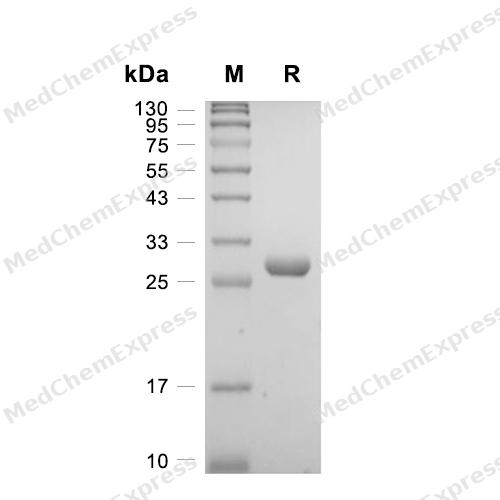
Purity - SDS-PAGE

Assay Procedure
Materials
Assay buffer: 50 mM Tris, 100 mM NaCl, 2 mM Dithiothreitol (DTT) , pH 9.0
15-PGDH/HPGD Protein, Mouse (His) (HY-P75555)
Substrates: beta-NAD, PGF2 alpha
Procedure
1. Prepare the substrate mixture:
a. Dilute beta-NAD to 1 mM in the assay buffer.
b. Dilute PGF2 alpha to 0.4 mM in the assay buffer.
c. Mix equal volumes of each solution to achieve a final concentration of 0.5 mM beta-NAD and 0.2 mM PGF2 alpha.
2. Dilute HPGD to 10 ng/μL in the assay buffer.
3. Add 50 μL of 1.0 ng/μL HPGD and 50 μL of the substrate mixture to each well to start the reaction. For the control group, add 50 μL of assay buffer and 50 μL of the substrate mixture.
4. Using a microplate reader, measure in kinetic mode at 339 nm for 5 minutes.
5. Calculate the specific activity:
Specific Activity (pmol/min/μg) = | Adjusted Vmax* (OD/min) x well volume (L) x 1012 nmol/mol |
| ext. coeff ** (M-1cm-1) x path corr. *** (cm) x amount of enzyme (μg) |
*Adjusted for substrate blank
**Extinction coefficient: 6220 M-1cm-1
***Path correction: 0.32 cm
Per Well:
Mouse HPGD: 0.5 μg
β-NAD: 0.25 mM
PGF2 α: 0.1 mM


Technical Parameters
-
Species Mouse
-
Source E. coli
-
Tag C-6*His
-
Accession
Q8VCC1 (M1-S269)
-
Molecular Construction
-
N-term
-
15-PGDH (M1-S269)
Accession # Q8VCC1 -
His
-
C-term
-
-
Protein Length
Full Length
-
Synonyms
HPGD; Hydroxyprostaglandin Dehydrogenase 15-(NAD); 15-Hydroxyprostaglandin Dehydrogenase; 15-PGDH; SDR36C1; PGDH1; 15-Hydroxyprostaglandin Dehydrogenase [NAD(+)]; Short Chain Dehydrogenase/Reductase Family 36C, Member 1; Prostaglandin Dehydrogenase 1; NAD
-
AA Sequence
MHVNGKVALVTGAAQGIGKAFAEALLLHGAKVALVDWNLEAGVKCKAALDEQFEPQKTLFVQCDVADQKQLRDTFRKVVDHFGRLDILVNNAGVNNEKNWEQTLQINLVSVISGTYLGLDYMSKQNGGEGGIIINMSSLAGLMPVAQQPVYCASKHGIIGFTRSAAMAANLMKSGVRLNVICPGFVDTPILESIEKEENMGQYIEYKDQIKAMMKFYGVLHPSTIANGLINLIEDDALNGAIMKITASKGIHFQDYDISPLLVKAPLTS
-
Molecular Weight
Approximately 30 kDa, based on SDS-PAGE under reducing conditions.
-
Purity
≥ 95%, as determined by reducing SDS-PAGE.


Product Properties
Lyophilized powder.
Lyophilized from a 0.22 μm filtered solution of PBS, pH 7.4, 8% trehalose, 8% mannitol and 0.02% Tween 80.
<1 EU/μg, determined by LAL method.
It is not recommended to reconstitute to a concentration less than 100 μg/mL in ddH2O.
Stored at -20°C for 2 years from date of receipt. After reconstitution, it is stable at 4°C for 1 week or -20°C for longer (with carrier protein). It is recommended to freeze aliquots at -20°C or -80°C for extended storage.
Room temperature in continental US; may vary elsewhere.


Documentation
-
Data Sheet (237 KB)
-
SDS (251 KB)
- English - EN (251 KB)
- Français - FR (251 KB)
- Deutsch - DE (251 KB)
- Norwegian - NO (251 KB)
- Español - ES (251 KB)
- Swedish - SV (251 KB)
- Italian - IT (251 KB)
- Korean - KR (251 KB)
- Portuguese - PT (251 KB)
-
Handling Instructions (2659 KB)

Calculators
Concentration (start) × Volume (start) = Concentration (final) × Volume (final)


 Powered by Bioz

