



ADAM9 Protein, Mouse (HEK293, His)
ADAM9 protein is a metalloprotease that plays an important role in tumorigenesis and angiogenesis. It cleaves TEK, KDR, EPHB4, CD40, VCAM1 and CDH5, regulating cancer-related signaling pathways and blood vessel formation. ADAM9 Protein, Mouse (HEK293, His) is the recombinant mouse-derived ADAM9 protein, expressed by HEK293 , with C-His labeled tag.
- Species: Mouse
- Source: HEK293
-
Storage:Stored at -20°C for 2 years from date of receipt. After reconstitution, it is stable at 4°C for 1 week or -20°C for longer (with carrier protein). It is recommended to freeze aliquots at -20°C or -80°C for extended storage.


To place orders, for customer services and technical support, please contact: MedChemExpress USA
Tel: 609-228-6898 E-mail: [email protected] [email protected]


-
 Biological Activity
-
Technical Parameters
-
Product Properties
- Documentation
- Help & FAQs




Biological Activity
Description
ADAM9 protein is a metalloprotease that plays an important role in tumorigenesis and angiogenesis. It cleaves TEK, KDR, EPHB4, CD40, VCAM1 and CDH5, regulating cancer-related signaling pathways and blood vessel formation. ADAM9 Protein, Mouse (HEK293, His) is the recombinant mouse-derived ADAM9 protein, expressed by HEK293 , with C-His labeled tag.
Background
ADAM9 Protein, a metalloprotease, is implicated in crucial cellular processes associated with tumorigenesis and angiogenesis. This multifaceted enzyme is known to cleave and release various molecules, including TEK, KDR, EPHB4, CD40, VCAM1, and CDH5, highlighting its involvement in modulating key signaling pathways relevant to cancer progression and blood vessel formation. Beyond its role in proteolytic events, ADAM9 is suggested to play a part in mediating cell-cell and cell-matrix interactions, thereby contributing to the regulation of cellular motility, potentially through interactions with integrins. This diverse range of molecular interactions underscores the significance of ADAM9 in influencing cellular behavior and its potential impact on pathological processes.
MCE Validation Data
-
Purity - SDS-PAGE
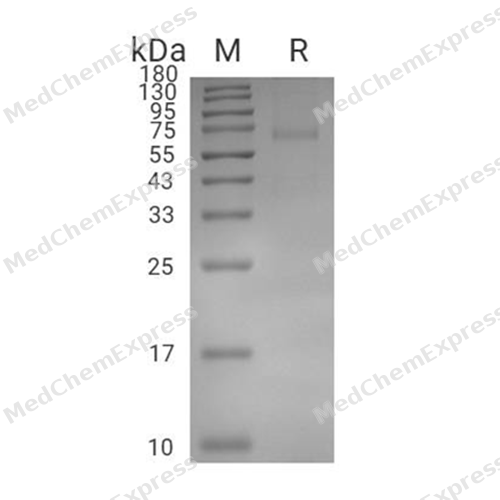
Purity - SDS-PAGE

Assay Procedure
Materials
检测缓冲液:25 mM Tris、2.5 μM ZnCl2、0.005%(W/V)的 Brij-35,pH 9.0
激活缓冲液: 50 mM Tris, 1 mM CaCl2, 2.5 μM ZnCl2,0.5% (w/v) Brij-35, pH 9.0
待测蛋白:ADAM9 Protein, Mouse (HEK293, His)(HY-P75531)
底物:Mca-PLAQAV-Dpa-RSSSR-NH2
标准品:MCA-Pro-Leu-OH
Procedure
1. 用检测缓冲液分别稀释 MCA-Pro-Leu-OH 至 50、25、12.5、6.25、3.125、1.5625、0.78125、0 μmol/L,各取 100 μL 加入孔内开始反应。激发和发射波长分别为 320 nm 和 405 nm,以动力学模式读取5分钟。以标准品浓度为横坐标,测得 RFU 为纵坐标,制作标准曲线,获得标准曲线公式。
2. Mouse ADAM9 先用无菌水复溶至 1000 μg/mL,随后在检测缓冲液中将 Mouse ADAM9 稀释至 40 μg/mL。
3. 在检测缓冲液中将底物稀释至 20 μM。
4. 将等体积 40 μg/mL Mouse ADAM9 和 20 μM 底物混合。包括含有分析缓冲液和不含任何 Mouse ADAM9 的 20 μM底物的对照。
5. 在 37°C 下培养反应物 30 mins。
6. 将每孔 100 μL 放入黑色平板中。
7. 在终点模式下,分别使用 320 nm 和 405 nm 的激发和发射波长进行读取。
8. 计算比活度:
| Specific Activity (pmol/min/μg) = |
Adjusted Fluorescence* (RFU) x Conversion Factor ** (pmol/RFU)
Incubation time (min) x Amount of enzyme (μg)
|
*Adjusted for Control
**Derived using calibration standard


Technical Parameters
-
Species Mouse
-
Source HEK293
-
Tag C-His
-
Accession
Q61072 (G30-D697)
-
Molecular Construction
-
N-term
-
ADAM9 (G30-D697)
Accession # Q61072 -
His
-
C-term
-
-
Protein Length
Extracellular Domain
-
Synonyms
ADAM9; Myeloma Cell Metalloproteinase; Prev. CORD9; A Disintegrin And Metalloproteinase Domain 9 (Meltrin Gamma); MDC9; ADAM Metallopeptidase Domain 9 (Meltrin Gamma); MCMP; Meltrin Gamma; KIAA0021; Meltrin-Gamma; Mltng; ADAM9 Protein; Disintegrin And Met
-
AA Sequence
GRPDLEQTVHLSSYEIITPWRLTRERREALGPSSQQISYVIQAQGKQHIIHLERNTDLLPNDFVVYTYDKEGSLLSDHPNVQSHCHYRGYVEGVQNSAVAVSACFGLRGLLHLENASFGIEPLHNSSHFEHIFYPMDGIHQEPLRCGVSNRDTEKEGTQGDEEEHPSVTQLLRRRRAVLPQTRYVELFIVVDKERYDMMGRNQTAVREEMIRLANYLDSMYIMLNIRIVLVGLEIWTDRNPINIIGGAGDVLGNFVQWREKFLITRWRHDSAQLVLKKGFGGTAGMAFVGTVCSRSHAGGINVFGQITVETFASIVAHELGHNLGMNHDDGRECFCGAKSCIMNSGASGSRNFSSCSAEDFEKLTLNKGGSCLLNIPKPDEAYSAPSCGNKLVDPGEECDCGTAKECEVDPCCEGSTCKLKSFAECAYGDCCKDCQFLPGGSMCRGKTSECDVPEYCNGSSQFCPPDVFIQNGYPCQNSKAYCYNGMCQYYDAQCQVIFGSKAKAAPRDCFIEVNSKGDRFGNCGFSGSEYKKCATGNALCGKLQCENVQDMPVFGIVPAIIQTPSRGTKCWGVDFQLGSDVPDPGMVNEGTKCDAGKICRNFQCVNASVLNYDCDIQGKCHGHGVCNSNKNCHCEDGWAPPHCDTKGYGGSVDSGPTYNAKSTALRD
-
Predicted Molecular Mass
54.4 kDa
-
Molecular Weight
Approximately 60-70 kDa, based on SDS-PAGE under reducing conditions, due to the glycosylation.
-
Glycosylation
Yes
-
Structure/Form
Monomer
-
Purity
≥ 90%, as determined by reducing SDS-PAGE.


Product Properties
Lyophilized powder
<1 EU/μg, determined by LAL method.
It is not recommended to reconstitute to a concentration less than 100 μg/mL in ddH2O.
Stored at -20°C for 2 years from date of receipt. After reconstitution, it is stable at 4°C for 1 week or -20°C for longer (with carrier protein). It is recommended to freeze aliquots at -20°C or -80°C for extended storage.
Room temperature in continental US; may vary elsewhere.


Documentation
-
Data Sheet (239 KB)
-
SDS (252 KB)
- English - EN (252 KB)
- Français - FR (252 KB)
- Deutsch - DE (252 KB)
- Norwegian - NO (252 KB)
- Español - ES (252 KB)
- Swedish - SV (252 KB)
- Italian - IT (252 KB)
- Korean - KR (252 KB)
- Portuguese - PT (252 KB)
-
Handling Instructions (2659 KB)

Calculators
Concentration (start) × Volume (start) = Concentration (final) × Volume (final)


 Powered by Bioz

