



Amphiregulin Protein, Mouse
Based on 1 Customer Validation
Amphiregulin Protein, an EGFR ligand, acts as an autocrine growth factor and mitogen for diverse cells, including astrocytes, Schwann cells, and fibroblasts. Engaging with CNIH in its immature stage, Amphiregulin's EGFR activation emphasizes its vital role in regulating cell growth and orchestrating various cellular functions across different cell types. Amphiregulin Protein, Mouse is the recombinant mouse-derived Amphiregulin protein, expressed by E. coli , with tag free.
- Species: Mouse
- Source: E. coli
-
Storage:Stored at -20°C for 2 years from date of receipt. After reconstitution, it is stable at 4°C for 1 week or -20°C for longer (with carrier protein). It is recommended to freeze aliquots at -20°C or -80°C for extended storage.


To place orders, for customer services and technical support, please contact: MedChemExpress USA
Tel: 609-228-6898 E-mail: [email protected] [email protected]


-
 Biological Activity
-
Technical Parameters
-
Product Properties
- Documentation
- Help & FAQs




Biological Activity
Description
Amphiregulin Protein, an EGFR ligand, acts as an autocrine growth factor and mitogen for diverse cells, including astrocytes, Schwann cells, and fibroblasts. Engaging with CNIH in its immature stage, Amphiregulin's EGFR activation emphasizes its vital role in regulating cell growth and orchestrating various cellular functions across different cell types. Amphiregulin Protein, Mouse is the recombinant mouse-derived Amphiregulin protein, expressed by E. coli , with tag free.
Background
Amphiregulin, a ligand for the EGF receptor (EGFR), functions as both an autocrine growth factor and a mitogen for a diverse array of target cells, such as astrocytes, Schwann cells, and fibroblasts. Its impact spans cellular proliferation, and during its immature precursor stage, Amphiregulin engages in interactions with CNIH. This versatile ligand's capacity to activate EGFR underscores its crucial role in regulating cell growth and underscores its significance in orchestrating various cellular functions across different cell types.
Verified Bioactivity
Measured in a cell proliferation assay using Balb/3T3 mouse embryonic fibroblast cells. The ED50 for this effect is <20 ng/mL.
MCE Validation Data
-
Purity - SDS-PAGE
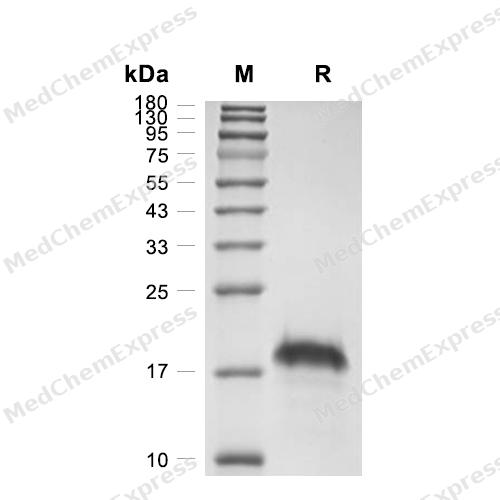
Purity - SDS-PAGE
-
Bioactivity - Cell-Based Assay
Bioactivity - Cell-Based Assay


Technical Parameters
-
Species Mouse
-
Source E. coli
-
Tag Tag Free
-
Accession
Q4FJT2 (S94-K191)
-
Gene ID11839
-
Molecular Construction
-
N-term
-
Amphiregulin (S94-K191)
Accession # Q4FJT2 -
C-term
-
-
Protein Length
Partial
-
Synonyms
AREG; AR; Prev. AREGB; Schwannoma-Derived Growth Factor; Prev. SDGF; Amphiregulin B; CRDGF; Amphiregulin; Colorectum Cell-Derived Growth Factor
-
AA Sequence
SVRVEQVIKPKKNKTEGEKSTEKPKRKKKGGKNGKGRRNKKKKNPCTAKFQNFCIHGECRYIENLEVVTCNCHQDYFGERCGEKSMKTHSEDDKDLSK
-
Molecular Weight
Approximately 18 kDa, based on SDS-PAGE under reducing conditions.
-
Purity
≥ 95%, as determined by reducing SDS-PAGE.


Product Properties
Lyophilized powder
Lyophilized from a 0.22 μm filtered solution of PBS, pH 7.4, 8% trehalose.
<1 EU/μg, determined by LAL method.
It is not recommended to reconstitute to a concentration less than 100 μg/mL in PBS.
Stored at -20°C for 2 years from date of receipt. After reconstitution, it is stable at 4°C for 1 week or -20°C for longer (with carrier protein). It is recommended to freeze aliquots at -20°C or -80°C for extended storage.
Room temperature in continental US; may vary elsewhere.


Documentation
-
Data Sheet (235 KB)
-
SDS (252 KB)
- English - EN (252 KB)
- Français - FR (252 KB)
- Deutsch - DE (252 KB)
- Norwegian - NO (252 KB)
- Español - ES (252 KB)
- Swedish - SV (252 KB)
- Italian - IT (252 KB)
- Korean - KR (252 KB)
- Portuguese - PT (252 KB)
-
Handling Instructions (2659 KB)

Calculators
Concentration (start) × Volume (start) = Concentration (final) × Volume (final)


 Powered by Bioz

