



B2M/Beta-2 microglobulin Protein, Rat (HEK293, His, solution)

Based on 1 Customer Validation
Beta-2 microglobulin protein (B2M) is crucial in presenting antigens, aiding immune surveillance.B2M forms a complex with an alpha chain, creating MHC class I molecules for antigen recognition.It also participates in a heterotrimer with MR1, expanding its role in antigen presentation and immune signaling pathways.B2M's intricate interactions underscore its significance in orchestrating immune responses.B2M/Beta-2 microglobulin Protein, Rat (HEK293, His, solution) is the recombinant rat-derived B2M/Beta-2 microglobulin protein, expressed by HEK293 , with C-His labeled tag.
- Species: Rat
- Source: HEK293
-
Storage:Stored at -80°C for 1 year from date of receipt. It is stable at -20°C for 3 months after opening. It is recommended to freeze aliquots at -80°C for extended storage. Avoid repeated freeze-thaw cycles.


To place orders, for customer services and technical support, please contact: MedChemExpress USA
Tel: 609-228-6898 E-mail: [email protected] [email protected]


-
 Biological Activity
-
Technical Parameters
-
Product Properties
- Documentation
- Help & FAQs




Biological Activity
Description
Beta-2 microglobulin protein (B2M) is crucial in presenting antigens, aiding immune surveillance.B2M forms a complex with an alpha chain, creating MHC class I molecules for antigen recognition.It also participates in a heterotrimer with MR1, expanding its role in antigen presentation and immune signaling pathways.B2M's intricate interactions underscore its significance in orchestrating immune responses.B2M/Beta-2 microglobulin Protein, Rat (HEK293, His, solution) is the recombinant rat-derived B2M/Beta-2 microglobulin protein, expressed by HEK293 , with C-His labeled tag.
Background
As a crucial component of the class I major histocompatibility complex (MHC), Beta-2 microglobulin (B2M) plays a pivotal role in presenting peptide antigens to the immune system, contributing to immune surveillance and response. Operating within a heterodimeric structure, B2M forms a complex with an alpha chain to create major histocompatibility complex class I molecules, facilitating the recognition of antigens by immune cells. Notably, B2M functions as the beta-chain in this molecular arrangement. Furthermore, it engages in the formation of a heterotrimer with MR1 and a metabolite antigen, expanding its involvement in antigen presentation and immune signaling pathways. The intricate interactions and molecular partnerships underscore the significance of B2M in the orchestration of immune responses through the recognition and presentation of antigens.
Verified Bioactivity
Measured by its ability to promote the proliferation of U251 human glioma cell. The ED50 for this effect is 58.88 ng/mL, corresponding to a specific activity is 1.7×10⁴ units/mg.
MCE Validation Data
-
Purity - SDS-PAGE
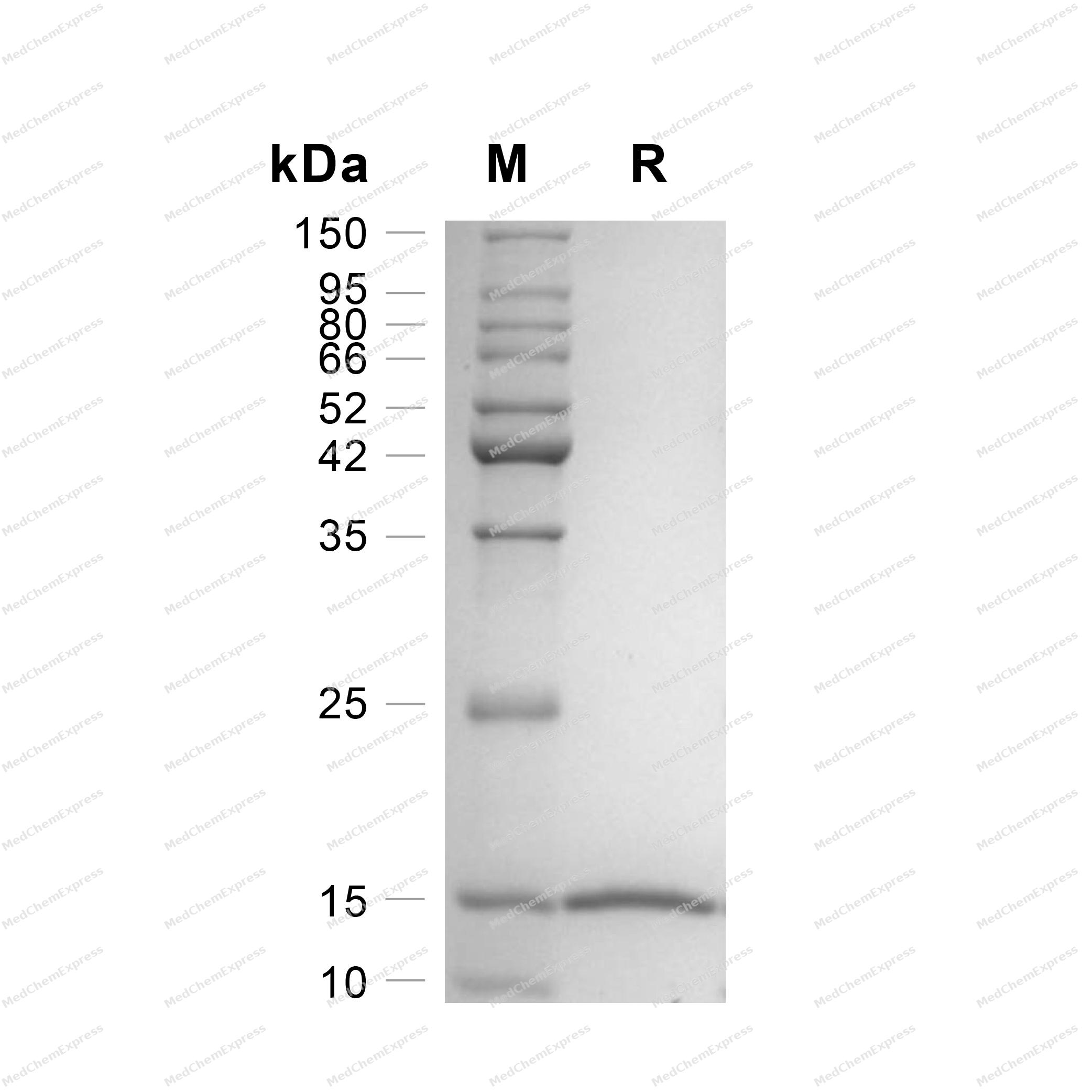
Purity - SDS-PAGE
-
Bioactivity - Cell-Based Assay
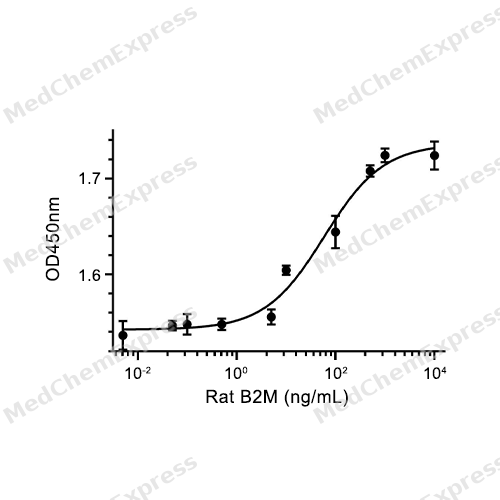
Bioactivity - Cell-Based Assay


Technical Parameters
-
Species Rat
-
Source HEK293
-
Tag C-His
-
Accession
P07151 (I21-M119)
-
Molecular Construction
-
N-term
-
B2M (M1-M119)
Accession # P07151 -
His
-
C-term
-
-
Protein Length
Full Length of Mature Protein
-
Synonyms
B2M; Beta 2-Microglobulin; Beta-2-Microglobulin; Beta-2-Microglobin; Beta Chain Of MHC Class I Molecules; AMYLD6; Beta 2-Microglobulin Protein; MHC1D4; Human Nkt Tcr Alpha Chain; IMD43; Human Nkt Tcr Beta Chain
-
AA Sequence
IQKTPQIQVYSRHPPENGKPNFLNCYVSQFHPPQIEIELLKNGKKIPNIEMSDLSFSKDWSFYILAHTEFTPTETDVYACRVKHVTLKEPKTVTWDRDM
-
Predicted Molecular Mass
13 kDa
-
Molecular Weight
Approximately 15 kDa, based on SDS-PAGE under reducing conditions.
-
Purity
≥ 95%, as determined by reducing SDS-PAGE.


Product Properties
Solution
Supplied as a 0.22 μm filtered solution of PBS, pH 7.4.
<1 EU/μg, determined by LAL method.
Stored at -80°C for 1 year from date of receipt. It is stable at -20°C for 3 months after opening. It is recommended to freeze aliquots at -80°C for extended storage. Avoid repeated freeze-thaw cycles.
Shipping with dry ice.


Documentation
-
Data Sheet (235 KB)
-
SDS (252 KB)
- English - EN (252 KB)
- Français - FR (252 KB)
- Deutsch - DE (252 KB)
- Norwegian - NO (252 KB)
- Español - ES (252 KB)
- Swedish - SV (252 KB)
- Italian - IT (252 KB)
- Korean - KR (252 KB)
- Portuguese - PT (252 KB)
-
Handling Instructions (2659 KB)

Calculators
Concentration (start) × Volume (start) = Concentration (final) × Volume (final)


 Powered by Bioz

