



BAI2 Protein, Human (HEK293, hFc)

Based on 1 Customer Validation
The BAI2 protein is an orphan G protein-coupled receptor involved in cell adhesion and possible cell-cell interactions. It activates the NFAT signaling pathway through the G protein GNAZ and contributes to transcriptional regulation. BAI2 Protein, Human (HEK293, hFc) is the recombinant human-derived BAI2 protein, expressed by HEK293 , with C-hFc labeled tag.
- Species: Human
- Source: HEK293
-
Storage:Stored at -20°C for 2 years from date of receipt. After reconstitution, it is stable at 4°C for 1 week or -20°C for longer (with carrier protein). It is recommended to freeze aliquots at -20°C or -80°C for extended storage.


To place orders, for customer services and technical support, please contact: MedChemExpress USA
Tel: 609-228-6898 E-mail: [email protected] [email protected]


-
 Biological Activity
-
Technical Parameters
-
Product Properties
- Documentation
- Help & FAQs




Biological Activity
Description
The BAI2 protein is an orphan G protein-coupled receptor involved in cell adhesion and possible cell-cell interactions. It activates the NFAT signaling pathway through the G protein GNAZ and contributes to transcriptional regulation. BAI2 Protein, Human (HEK293, hFc) is the recombinant human-derived BAI2 protein, expressed by HEK293 , with C-hFc labeled tag.
Background
The BAI2 Protein, an orphan G-protein coupled receptor, plays a significant role in cell adhesion and likely participates in cell-cell interactions. By activating the NFAT-signaling pathway through the G-protein GNAZ, BAI2 contributes to transcriptional regulation, highlighting its involvement in diverse cellular processes. Additionally, BAI2 is implicated in angiogenesis inhibition. Notably, the receptor activity of BAI2 is subject to regulation through proteolytic processing. The long N-terminal region exerts an inhibitory effect on constitutive signaling activity, and removal of this region induces an increase in receptor activity. These intricate regulatory mechanisms underscore the versatility of BAI2 in modulating cellular responses and provide insights into its potential as a key player in cellular communication and angiogenic processes.
Verified Bioactivity
Measured by its binding ability in a functional ELISA. When Recombinant Human C1qL3 is immobilized at 2 μg/mL can bind Biotinylated Recombinant Human BAI2. The ED50 for this effect is 82.33 ng/mL.
MCE Validation Data
-
Purity - SDS-PAGE
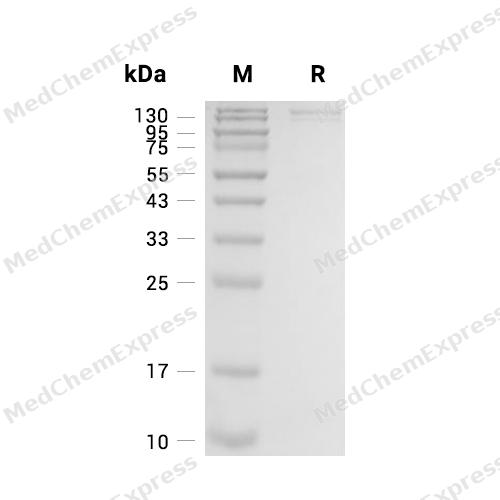
Purity - SDS-PAGE
-
Bioactivity - ELISA
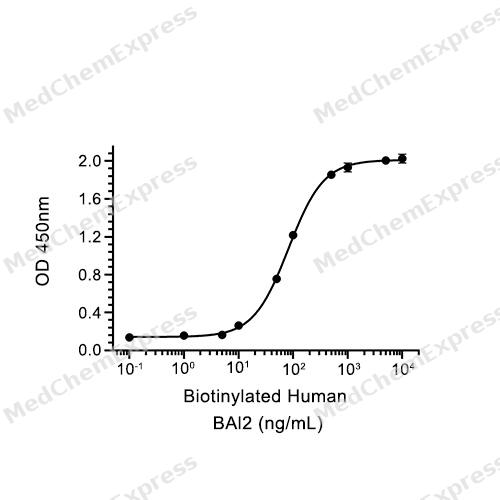
Bioactivity - ELISA


Technical Parameters
-
Species Human
-
Source HEK293
-
Tag C-hFc
-
Accession
O60241-3 (F21-D911)
-
Molecular Construction
-
N-term
-
BAI2 (F21-D911)
Accession # O60241-3 -
hFc
-
C-term
-
-
Protein Length
Partial
-
Synonyms
ADGRB2; Prev. BAI2; Adhesion G Protein-Coupled Receptor B2; Brain-Specific Angiogenesis Inhibitor 2
-
AA Sequence
FDPAPSACSALASGVLYGAFSLQDLFPTIASGCSWTLENPDPTKYSLYLRFNRQEQVCAHFAPRLLPLDHYLVNFTCLRPSPEEAVAQAESEVGRPEEEEAEAAAGLELCSGSGPFTFLHFDKNFVQLCLSAEPSEAPRLLAPAALAFRFVEVLLINNNNSSQFTCGVLCRWSEECGRAAGRACGFAQPGCSCPGEAGAGSTTTTSPGPPAAHTLSNALVPGGPAPPAEADLHSGSSNDLFTTEMRYGEEPEEEPKVKTQWPRSADEPGLYMAQTGDPAAEEWSPWSVCSLTCGQGLQVRTRSCVSSPYGTLCSGPLRETRPCNNSATCPVHGVWEEWGSWSLCSRSCGRGSRSRMRTCVPPQHGGKACEGPELQTKLCSMAACPVEGQWLEWGPWGPCSTSCANGTQQRSRKCSVAGPAWATCTGALTDTRECSNLECPATDSKWGPWNAWSLCSKTCDTGWQRRFRMCQATGTQGYPCEGTGEEVKPCSEKRCPAFHEMCRDEYVMLMTWKKAAAGEIIYNKCPPNASGSASRRCLLSAQGVAYWGLPSFARCISHEYRYLYLSLREHLAKGQRMLAGEGMSQVVRSLQELLARRTYYSGDLLFSVDILRNVTDTFKRATYVPSADDVQRFFQVVSFMVDAENKEKWDDAQQVSPGSVHLLRVVEDFIHLVGDALKAFQSSLIVTDNLVISIQREPVSAVSSDITFPMRGRRGMKDWVRHSEDRLFLPKEVLSLSSPGKPATSGAAGSPGRGRGPGTVPPGPGHSHQRLLPADPDESSYFVIGAVLYRTLGLILPPPRPPLAVTSRVMTVTVRPPTQPPAEPLITVELSYIINGTTDPHCASWDYSRADASSGDWDTENCQTLETQAAHTRCQCQHLSTFAVLAQPPKD
-
Predicted Molecular Mass
123.7 kDa
-
Molecular Weight
Approximately 128-150 kDa, based on SDS-PAGE under reducing conditions, due to the glycosylation.
-
Glycosylation
Yes
-
Purity
≥ 95%, as determined by reducing SDS-PAGE.


Product Properties
Lyophilized powder.
Lyophilized from a 0.22 μm filtered solution of PBS, pH 7.4, 8% trehalose.
<1 EU/μg, determined by LAL method.
It is not recommended to reconstitute to a concentration less than 100 μg/mL in ddH2O.
Stored at -20°C for 2 years from date of receipt. After reconstitution, it is stable at 4°C for 1 week or -20°C for longer (with carrier protein). It is recommended to freeze aliquots at -20°C or -80°C for extended storage.
Room temperature in continental US; may vary elsewhere.


Documentation
-
Data Sheet (241 KB)
-
SDS (252 KB)
- English - EN (252 KB)
- Français - FR (252 KB)
- Deutsch - DE (252 KB)
- Norwegian - NO (252 KB)
- Español - ES (252 KB)
- Swedish - SV (252 KB)
- Italian - IT (252 KB)
- Korean - KR (252 KB)
- Portuguese - PT (252 KB)
-
Handling Instructions (2659 KB)

Calculators
Concentration (start) × Volume (start) = Concentration (final) × Volume (final)


 Powered by Bioz

