



BPIFA2 Protein, Human (HEK293, His)

Based on 1 Customer Validation
The BPIFA2 protein, also known as bactericidal/permeability-increasing fold family A member 2, has significant antibacterial activity, particularly against Pseudomonas aeruginosa. The protein is effective against bacterial infections caused by Pseudomonas aeruginosa, a pathogen known to be resistant to many antibiotics. BPIFA2 Protein, Human (HEK293, His) is the recombinant human-derived BPIFA2 protein, expressed by HEK293 , with C-6*His labeled tag.
- Species: Human
- Source: HEK293
-
Storage:Stored at -20°C for 2 years from date of receipt. After reconstitution, it is stable at 4°C for 1 week or -20°C for longer (with carrier protein). It is recommended to freeze aliquots at -20°C or -80°C for extended storage.


To place orders, for customer services and technical support, please contact: MedChemExpress USA
Tel: 609-228-6898 E-mail: [email protected] [email protected]


-
 Biological Activity
-
Technical Parameters
-
Product Properties
- Documentation
- Help & FAQs




Biological Activity
Description
The BPIFA2 protein, also known as bactericidal/permeability-increasing fold family A member 2, has significant antibacterial activity, particularly against Pseudomonas aeruginosa. The protein is effective against bacterial infections caused by Pseudomonas aeruginosa, a pathogen known to be resistant to many antibiotics. BPIFA2 Protein, Human (HEK293, His) is the recombinant human-derived BPIFA2 protein, expressed by HEK293 , with C-6*His labeled tag.
Background
BPIFA2 protein, also known as bactericidal/permeability-increasing fold-containing family A member 2, exhibits remarkable antibacterial activity, specifically against Pseudomonas aeruginosa. This protein has the ability to effectively combat bacterial infections caused by Pseudomonas aeruginosa, a pathogenic bacterium known to be resistant to many antibiotics. The potent antibacterial activity of BPIFA2 protein suggests its potential as a therapeutic agent or as a target for the development of novel antibacterial strategies against Pseudomonas aeruginosa infections. Further exploration is required to fully understand the underlying mechanisms of action and the potential clinical applications of BPIFA2 protein.
MCE Validation Data
-
Purity - SDS-PAGE
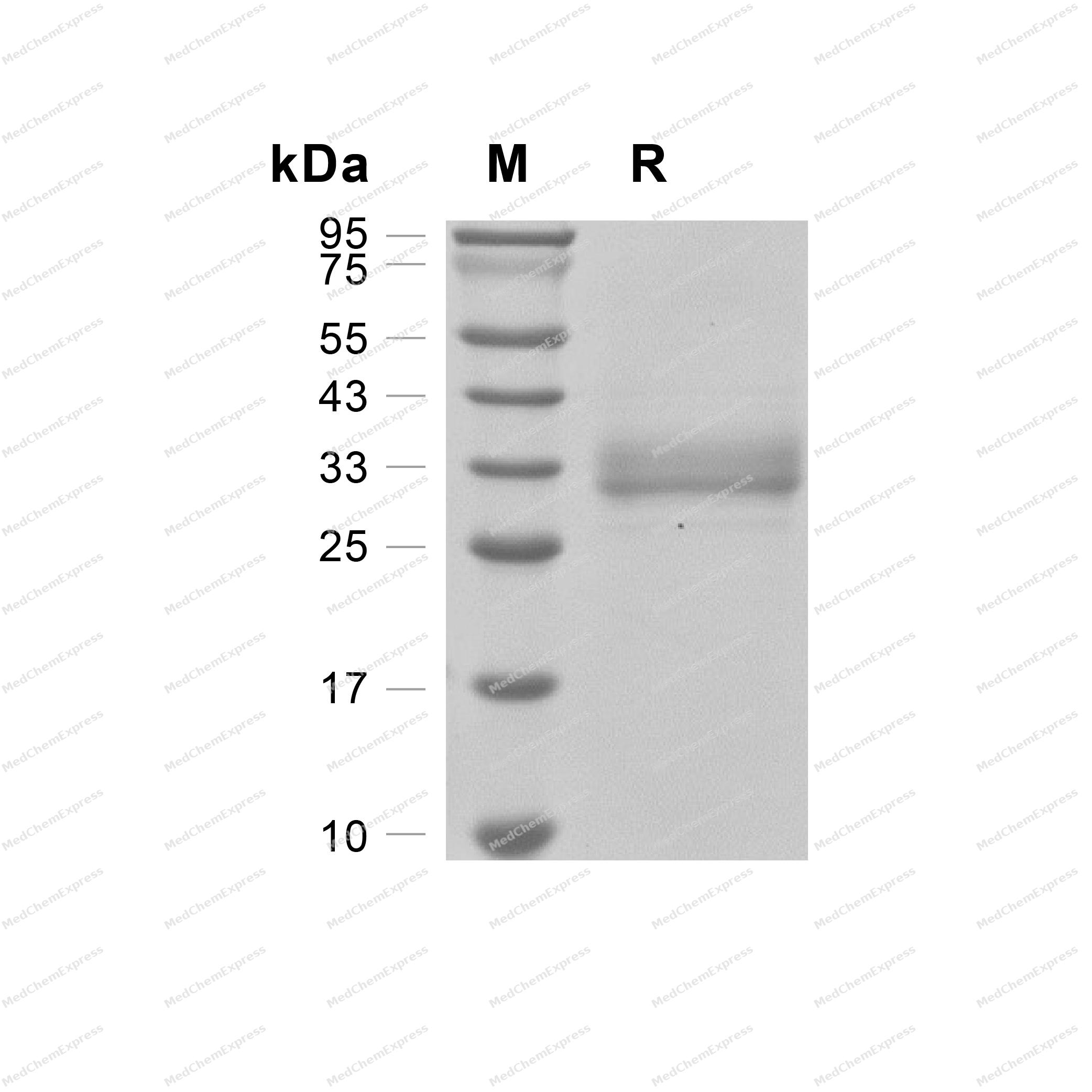
Purity - SDS-PAGE


Technical Parameters
-
Species Human
-
Source HEK293
-
Tag C-6*His
-
Accession
Q96DR5 (E19-I249)
-
Molecular Construction
-
N-term
-
BPIFA2 (E19-I249)
Accession # Q96DR5 -
6*His
-
C-term
-
-
Protein Length
Full Length of Mature Protein
-
Synonyms
BPIFA2; BA49G10.1; Prev. C20orf70; BPI Fold-Containing Family A Member 2; SPLUNC2; Parotid Secretory Protein; PSP; Chromosome 20 Open Reading Frame 70; BPI Fold Containing Family A Member 2; Short Palate, Lung And Nasal Epithelium Carcinoma-Associated Pro
-
AA Sequence
ESLLDNLGNDLSNVVDKLEPVLHEGLETVDNTLKGILEKLKVDLGVLQKSSAWQLAKQKAQEAEKLLNNVISKLLPTNTDIFGLKISNSLILDVKAEPIDDGKGLNLSFPVTANVTVAGPIIGQIINLKASLDLLTAVTIETDPQTHQPVAVLGECASDPTSISLSLLDKHSQIINKFVNSVINTLKSTVSSLLQKEICPLIRIFIHSLDVNVIQQVVDNPQHKTQLQTLI
-
Molecular Weight
Approximately 35 kDa, based on SDS-PAGE under reducing conditions.
-
Glycosylation
Yes
-
Purity
≥ 90%, as determined by reducing SDS-PAGE.


Product Properties
Lyophilized powder.
Lyophilized from a 0.22 μm filtered solution of PBS, pH 7.4.
<1 EU/μg, determined by LAL method.
It is not recommended to reconstitute to a concentration less than 100 μg/mL in ddH2O. For long term storage it is recommended to add a carrier protein (0.1% BSA, 5% HSA, 10% FBS or 5% Trehalose).
Stored at -20°C for 2 years from date of receipt. After reconstitution, it is stable at 4°C for 1 week or -20°C for longer (with carrier protein). It is recommended to freeze aliquots at -20°C or -80°C for extended storage.
Room temperature in continental US; may vary elsewhere.


Documentation
-
Data Sheet (236 KB)
-
SDS (251 KB)
- English - EN (251 KB)
- Français - FR (251 KB)
- Deutsch - DE (251 KB)
- Norwegian - NO (251 KB)
- Español - ES (251 KB)
- Swedish - SV (251 KB)
- Italian - IT (251 KB)
- Korean - KR (251 KB)
- Portuguese - PT (251 KB)
-
Handling Instructions (2659 KB)

Calculators
Concentration (start) × Volume (start) = Concentration (final) × Volume (final)


 Powered by Bioz

