



C1D Protein, Human (His)

Based on 1 Customer Validation
The C1D protein has multifunctionality in cellular processes, recruiting RNA exosome complexes for 5.8S rRNA processing, possibly in conjunction with MPHOSPH6. It activates PRKDC with linear and supercoiled DNA and induces apoptosis through the p53/TP53 pathway. C1D Protein, Human (His) is the recombinant human-derived C1D protein, expressed by E. coli , with N-6*His labeled tag.
- Species: Human
- Source: E. coli
-
Storage:Stored at -20°C for 2 years from date of receipt. After reconstitution, it is stable at 4°C for 1 week or -20°C for longer (with carrier protein). It is recommended to freeze aliquots at -20°C or -80°C for extended storage.


To place orders, for customer services and technical support, please contact: MedChemExpress USA
Tel: 609-228-6898 E-mail: [email protected] [email protected]


-
 Biological Activity
-
Technical Parameters
-
Product Properties
- Documentation
- Help & FAQs




Biological Activity
Description
The C1D protein has multifunctionality in cellular processes, recruiting RNA exosome complexes for 5.8S rRNA processing, possibly in conjunction with MPHOSPH6. It activates PRKDC with linear and supercoiled DNA and induces apoptosis through the p53/TP53 pathway. C1D Protein, Human (His) is the recombinant human-derived C1D protein, expressed by E. coli , with N-6*His labeled tag.
Background
C1D, a multifaceted protein, orchestrates various cellular processes with distinct functional implications. It plays a pivotal role in recruiting the RNA exosome complex to pre-rRNA, facilitating the intricate 3'-5' end processing of the 5.8S rRNA, possibly in collaboration with MPHOSPH6. Additionally, C1D exhibits a unique capability to activate PRKDC, not only in the presence of linear DNA but also in the presence of supercoiled DNA. Notably, it can induce apoptosis through a p53/TP53 dependent pathway, showcasing its regulatory role in programmed cell death. Furthermore, C1D may modulate the formation of the TRAX/TSN complex and enhances transcriptional repression by NR1D1 and THRB. As a molecular entity, C1D exists in monomeric and homodimeric forms, interacting with a spectrum of proteins including NR1D1, THRA, THRB, NCOR1, NCOR2, EXOSC10, TSNAX, and RAC3. This intricate network of interactions underscores the diverse functions and regulatory potential of C1D in cellular biology.
MCE Validation Data
-
Purity - SDS-PAGE
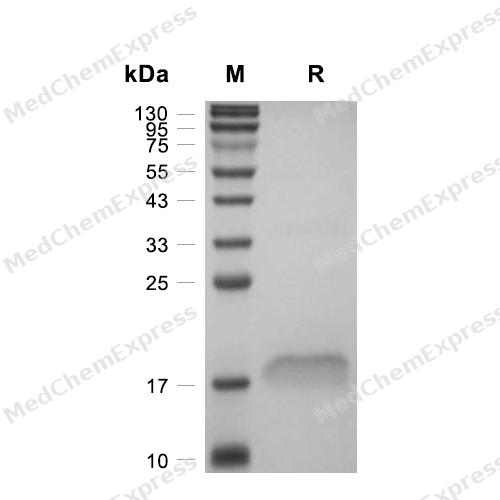
Purity - SDS-PAGE


Technical Parameters
-
Species Human
-
Source E. coli
-
Tag N-6*His
-
Accession
Q13901 (M1-S141)
-
Molecular Construction
-
N-term
-
GST
-
C1D (M1-S141)
Accession # Q13901 -
C-term
-
-
Protein Length
Full Length
-
Synonyms
C1D; Small Unique Nuclear Receptor Co-Repressor; C1D Nuclear Receptor Corepressor; C1D Nuclear Receptor Co-Repressor; Nuclear Nucleic Acid-Binding Protein C1D; HC1D; SUN-CoR; Small Unique Nuclear Receptor Corepressor; SUNCOR; Nuclear DNA-Binding Protein;
-
AA Sequence
MAGEEINEDYPVEIHEYLSAFENSIGAVDEMLKTMMSVSRNELLQKLDPLEQAKVDLVSAYTLNSMFWVYLATQGVNPKEHPVKQELERIRVYMNRVKEITDKKKAGKLDRGAASRFVKNALWEPKSKNASKVANKGKSKS
-
Molecular Weight
Approximately 43 kDa, based on SDS-PAGE under reducing conditions.
-
Purity
≥ 95%, as determined by reducing SDS-PAGE.


Product Properties
Lyophilized powder.
Lyophilized from a 0.22 μm filtered solution of PBS, pH 7.4.
<1 EU/μg, determined by LAL method.
It is not recommended to reconstitute to a concentration less than 100 μg/mL in ddH2O. For long term storage it is recommended to add a carrier protein (0.1% BSA, 5% HSA, 10% FBS or 5% Trehalose).
Stored at -20°C for 2 years from date of receipt. After reconstitution, it is stable at 4°C for 1 week or -20°C for longer (with carrier protein). It is recommended to freeze aliquots at -20°C or -80°C for extended storage.
Room temperature in continental US; may vary elsewhere.


Documentation
-
Data Sheet (236 KB)
-
SDS (251 KB)
- English - EN (251 KB)
- Français - FR (251 KB)
- Deutsch - DE (251 KB)
- Norwegian - NO (251 KB)
- Español - ES (251 KB)
- Swedish - SV (251 KB)
- Italian - IT (251 KB)
- Korean - KR (251 KB)
- Portuguese - PT (251 KB)
-
Handling Instructions (2659 KB)

Calculators
Concentration (start) × Volume (start) = Concentration (final) × Volume (final)


 Powered by Bioz

