



CADM1/IGSF4A Protein, Human (HEK293, His)
Based on 1 Customer Validation
The CADM1/IGSF4A protein is an important mediator of cell-cell adhesion.It forms homodimers and interacts with CADM3 and NECTIN3.CADM1/IGSF4A Protein, Human (HEK293, His) is the recombinant human-derived CADM1/IGSF4A protein, expressed by HEK293 , with C-His labeled tag.
- Species: Human
- Source: HEK293
-
Storage:Stored at -20°C for 2 years from date of receipt. After reconstitution, it is stable at 4°C for 1 week or -20°C for longer (with carrier protein). It is recommended to freeze aliquots at -20°C or -80°C for extended storage.


To place orders, for customer services and technical support, please contact: MedChemExpress USA
Tel: 609-228-6898 E-mail: [email protected] [email protected]


-
 Biological Activity
-
Technical Parameters
-
Product Properties
- Documentation
- Help & FAQs




Biological Activity
Description
The CADM1/IGSF4A protein is an important mediator of cell-cell adhesion.It forms homodimers and interacts with CADM3 and NECTIN3.CADM1/IGSF4A Protein, Human (HEK293, His) is the recombinant human-derived CADM1/IGSF4A protein, expressed by HEK293 , with C-His labeled tag.
Background
The CADM1/IGSF4A protein serves as a pivotal mediator of both homophilic and heterophilic cell-cell adhesion, operating in a Ca(2+)-independent manner. It forms homodimers and mediates homophilic adhesion, and also engages in heterophilic interactions with CADM3 and NECTIN3. The interaction between CADM1 and CRTAM promotes natural killer (NK) cell cytotoxicity, interferon-gamma (IFN-gamma) secretion by CD8+ cells, and NK cell-mediated rejection of tumors expressing CADM1. In mast cells, CADM1 plays a crucial role in attachment to and communication with nerves, being essential for mast cell development and survival in vivo. Furthermore, CADM1 is involved in the regulation of T-cell retention within the draining lymph node, required for the intestinal retention of specific T-cell subsets, and contributes to the adhesion of T-cells to gut-associated dendritic cells. Additionally, CADM1 functions as a synaptic cell adhesion molecule, playing roles in dendritic spine formation and synapse assembly. It is implicated in neuronal processes such as migration, axon growth, pathfinding, and fasciculation. Moreover, CADM1 is involved in spermatogenesis, contributing to the adhesion of spermatocytes and spermatids to Sertoli cells. In non-small-cell lung cancer (NSCLC) cells, CADM1 acts as a tumor suppressor, influencing invasive phenotypes. It forms homodimers via its Ig-like V-type domain and interacts with various proteins, including FARP1, CRTAM, EPB41L3/DAL1, MPP2, MPP3, and PALS2, facilitating diverse cellular functions and signaling pathways.
Verified Bioactivity
Measured by its binding ability in a functional ELISA. Immobilized Human CRTAM at 2 μg/mL (100 μL/well) can bind Biotinylated Human CADM1. The ED50 for this effect is 105.7 ng/mL.
MCE Validation Data
-
Purity - SDS-PAGE
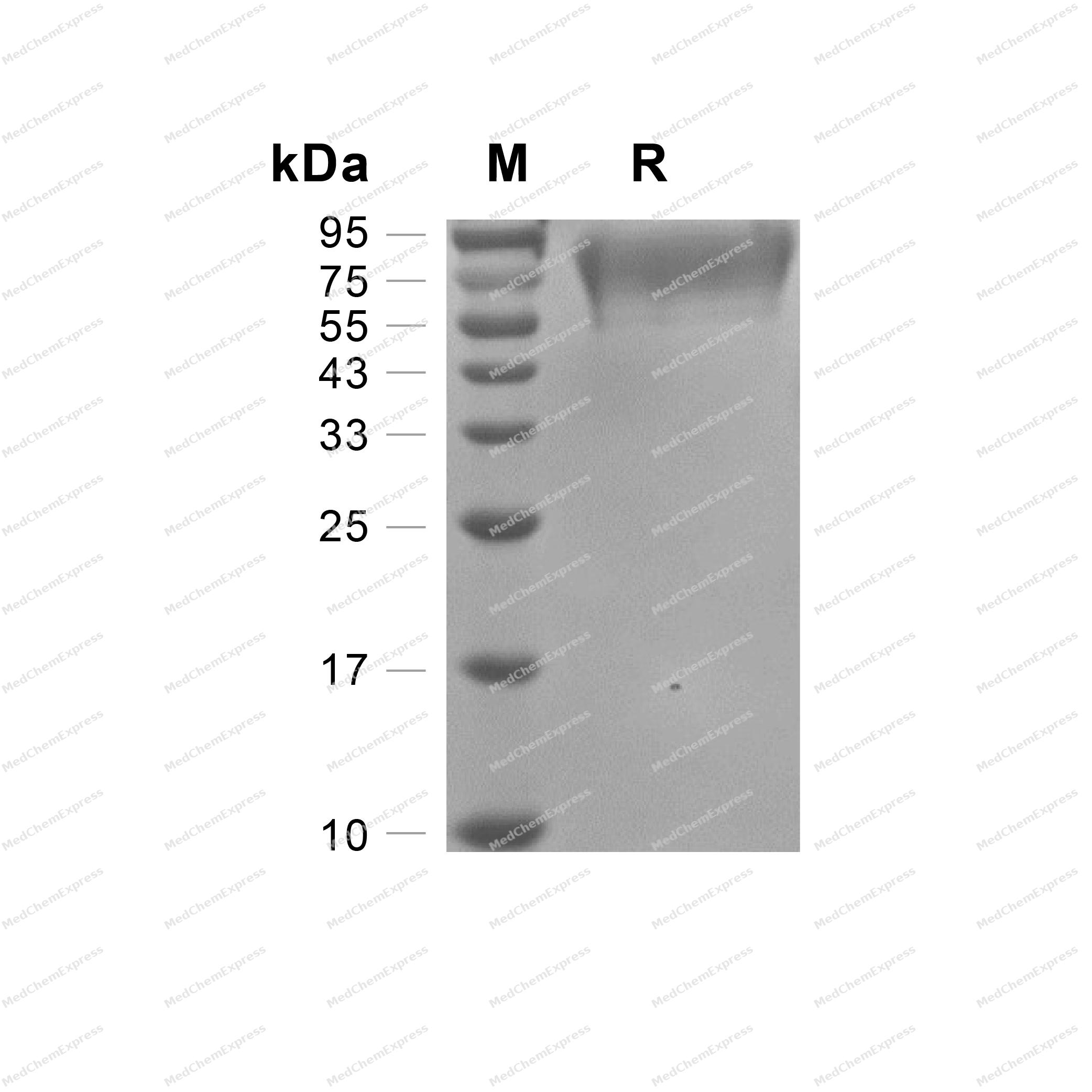
Purity - SDS-PAGE
-
Bioactivity - ELISA
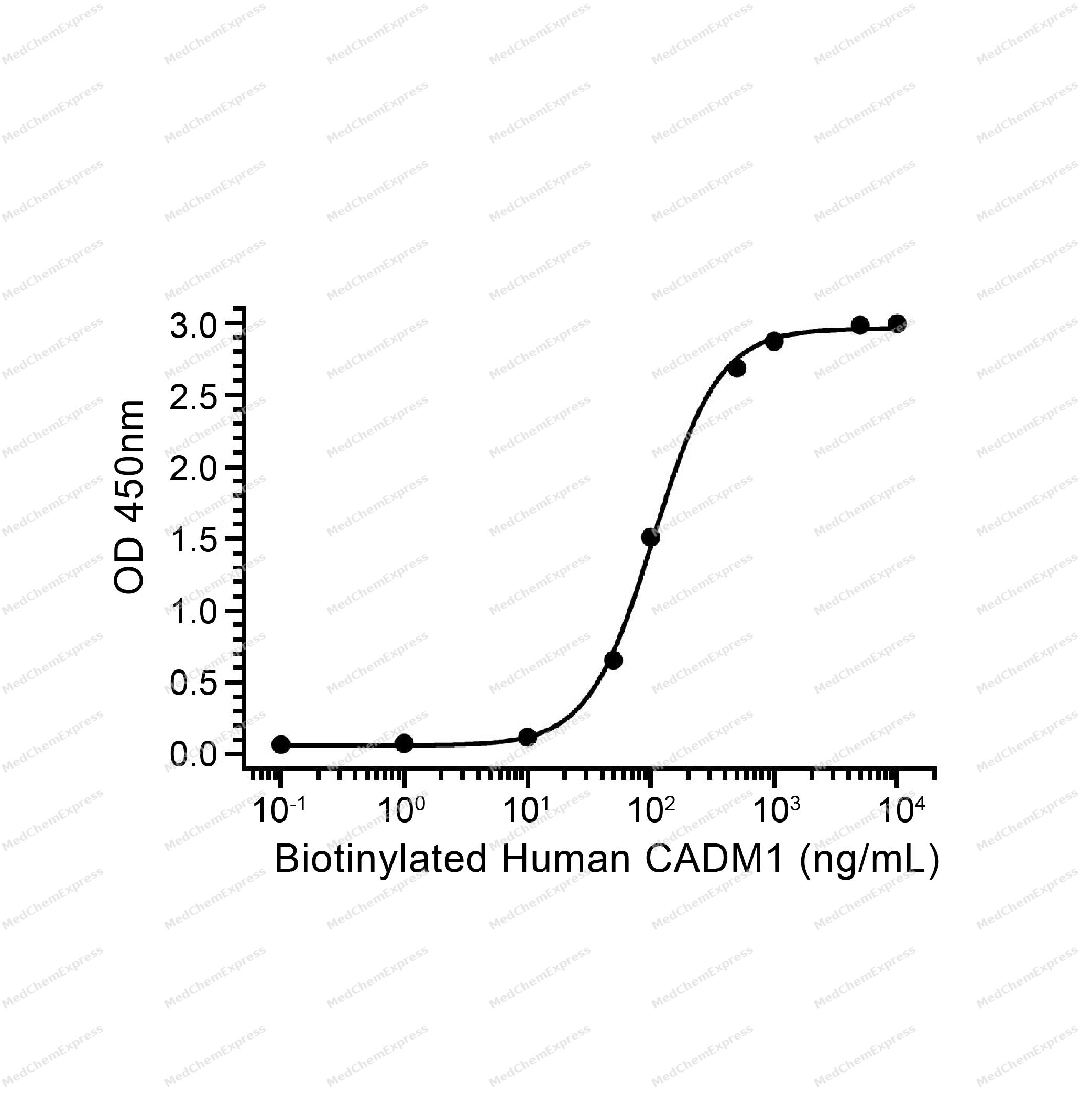
Bioactivity - ELISA


Technical Parameters
-
Species Human
-
Source HEK293
-
Tag C-His
-
Accession
Q9BY67 (Q45-H374)
-
Molecular Construction
-
N-term
-
CADM1 (Q45-H374)
Accession # Q9BY67 -
His
-
C-term
-
-
Protein Length
Extracellular Domain
-
Synonyms
CADM1; Immunoglobulin Superfamily Member 4; Prev. TSLC1; Nectin-Like 2; Prev. IGSF4; TSLC-1; IGSF4A; Immunoglobulin Superfamily, Member 4; SYNCAM; TSLC1/Nectin-Like 2/IGSF4; NECL2; Truncated CADM1 Protein; Tumor Suppressor In Lung Cancer 1; CADM1 Protein;
-
AA Sequence
QNLFTKDVTVIEGEVATISCQVNKSDDSVIQLLNPNRQTIYFRDFRPLKDSRFQLLNFSSSELKVSLTNVSISDEGRYFCQLYTDPPQESYTTITVLVPPRNLMIDIQKDTAVEGEEIEVNCTAMASKPATTIRWFKGNTELKGKSEVEEWSDMYTVTSQLMLKVHKEDDGVPVICQVEHPAVTGNLQTQRYLEVQYKPQVHIQMTYPLQGLTREGDALELTCEAIGKPQPVMVTWVRVDDEMPQHAVLSGPNLFINNLNKTDNGTYRCEASNIVGKAHSDYMLYVYDPPTTIPPPTTTTTTTTTTTTTILTIITDSRAGEEGSIRAVDH
-
Molecular Weight
Approximately 60-95 kDa, based on SDS-PAGE under reducing conditions, due to the glycosylation.
-
Glycosylation
Yes
-
Purity
≥ 95%, as determined by reducing SDS-PAGE.


Product Properties
Lyophilized powder
Lyophilized from a 0.22 μm filtered solution of PBS, pH 7.4.
<1 EU/μg, determined by LAL method.
It is not recommended to reconstitute to a concentration less than 100 μg/mL in ddH2O.
Stored at -20°C for 2 years from date of receipt. After reconstitution, it is stable at 4°C for 1 week or -20°C for longer (with carrier protein). It is recommended to freeze aliquots at -20°C or -80°C for extended storage.
Room temperature in continental US; may vary elsewhere.


Documentation
-
Data Sheet (238 KB)
-
SDS (251 KB)
- English - EN (251 KB)
- Français - FR (251 KB)
- Deutsch - DE (251 KB)
- Norwegian - NO (251 KB)
- Español - ES (251 KB)
- Swedish - SV (251 KB)
- Italian - IT (251 KB)
- Korean - KR (251 KB)
- Portuguese - PT (251 KB)
-
Handling Instructions (2659 KB)

Calculators
Concentration (start) × Volume (start) = Concentration (final) × Volume (final)


 Powered by Bioz

