



Calreticulin/CALR Protein, Mouse (GST)
Based on 1 publication(s) in Google Scholar
The calreticulin/CALR protein acts as a calcium-binding partner and promotes endoplasmic reticulum folding, assembly, and quality control. It interacts with monoglucosylated glycoproteins and mediates nuclear export of the NR3C1 DNA-binding domain. Calreticulin/CALR Protein, Mouse (GST) is the recombinant mouse-derived Calreticulin/CALR protein, expressed by E. coli , with N-GST labeled tag.
- Species: Mouse
- Source: E. coli
-
Storage:Stored at -20°C for 2 years from date of receipt. After reconstitution, it is stable at 4°C for 1 week or -20°C for longer (with carrier protein). It is recommended to freeze aliquots at -20°C or -80°C for extended storage.


To place orders, for customer services and technical support, please contact: MedChemExpress USA
Tel: 609-228-6898 E-mail: [email protected] [email protected]


-
 Biological Activity
-
Technical Parameters
-
Product Properties
- Documentation
- Help & FAQs




Biological Activity
Description
The calreticulin/CALR protein acts as a calcium-binding partner and promotes endoplasmic reticulum folding, assembly, and quality control. It interacts with monoglucosylated glycoproteins and mediates nuclear export of the NR3C1 DNA-binding domain. Calreticulin/CALR Protein, Mouse (GST) is the recombinant mouse-derived Calreticulin/CALR protein, expressed by E. coli , with N-GST labeled tag.
Background
Calreticulin/CALR protein, a calcium-binding chaperone, orchestrates crucial functions in the endoplasmic reticulum (ER) through the calreticulin/calnexin cycle, promoting the folding, oligomeric assembly, and quality control of glycoproteins. This lectin transiently interacts with nearly all monoglucosylated glycoproteins synthesized in the ER, contributing to their proper maturation and function. Beyond its role in glycoprotein processing, CALR is involved in diverse cellular processes. It interacts with the DNA-binding domain of NR3C1, mediating its nuclear export and influencing gene expression regulation. Furthermore, CALR may play a role in oocyte maturation by regulating calcium homeostasis and participating in the cortical reaction during oocyte activation, potentially contributing to the block against polyspermy. CALR forms complexes with various proteins, including GABARAP, PDIA3/ERp57, and TRIM21, highlighting its versatile interactions within cellular pathways. It also engages in intricate protein-protein interactions with PPIB, SPACA9, and CLCC1, underscoring its involvement in diverse cellular processes and protein complexes.
Verified Bioactivity
Measured by its binding ability in a functional ELISA. When Recombinant Mouse CALR is immobilized at 2.5 µg/mL(100 µL/well) can bind Anti-CALR Antibody. The ED50 for this effect is 20-50 ng/mL.
MCE Validation Data
-
Purity - SDS-PAGE
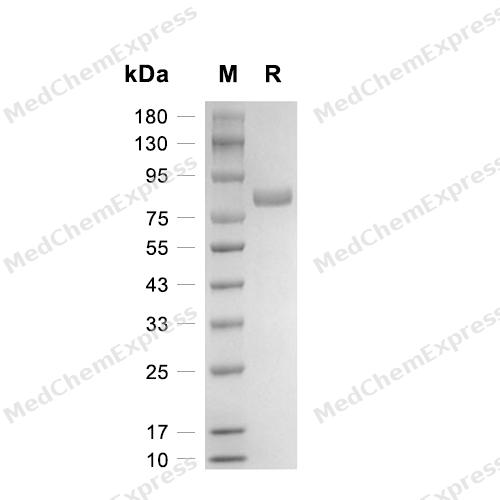
Purity - SDS-PAGE
-
Bioactivity - ELISA
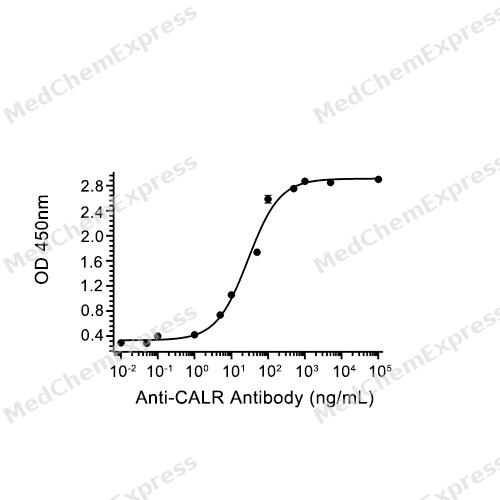
Bioactivity - ELISA


Publications (1)
-
Journal Impact Factor
-
Most Recent
-
Int Immunopharmacol
Calreticulin-driven immunogenic cell death promotes osteoclast differentiation and osteoarthritis progression via the LRP1/Rac1 signaling. [Abstract]2025 Oct 10:163:115277. PMID: 40714468


Technical Parameters
-
Species Mouse
-
Source E. coli
-
Tag N-GST
-
Accession
P14211 (D18-L416)
-
Molecular Construction
-
N-term
-
GST
-
CALR (D18-L416)
Accession # P14211 -
C-term
-
-
Protein Length
Full Length of Mature Protein
-
Synonyms
CALR; FLJ26680; Calreticulin; CRP55; Calregulin; ERp60; CC1qR; HACBP; CALR1; Grp60; SSA; Epididymis Secretory Sperm Binding Protein Li 99n; CRT; Autoantigen Ro; RO; HEL-S-99n; Sicca Syndrome Antigen A (Autoantigen Ro; Calreticulin); CRTC; Endoplasmic Reti
-
AA Sequence
DPAIYFKEQFLDGDAWTNRWVESKHKSDFGKFVLSSGKFYGDLEKDKGLQTSQDARFYALSAKFEPFSNKGQTLVVQFTVKHEQNIDCGGGYVKLFPSGLDQKDMHGDSEYNIMFGPDICGPGTKKVHVIFNYKGKNVLINKDIRCKDDEFTHLYTLIVRPDNTYEVKIDNSQVESGSLEDDWDFLPPKKIKDPDAAKPEDWDERAKIDDPTDSKPEDWDKPEHIPDPDAKKPEDWDEEMDGEWEPPVIQNPEYKGEWKPRQIDNPDYKGTWIHPEIDNPEYSPDANIYAYDSFAVLGLDLWQVKSGTIFDNFLITNDEAYAEEFGNETWGVTKAAEKQMKDKQDEEQRLKEEEEDKKRKEEEEAEDKEDDDDRDEDEDEEDEKEEDEEESPGQAKDEL
-
Molecular Weight
Approximately 76 kDa, based on SDS-PAGE under reducing conditions.
-
Purity
≥ 95%, as determined by reducing SDS-PAGE.


Product Properties
Lyophilized powder
Lyophilized from a 0.22 μm filtered solution of 50 mM Tris-HCl, pH 7.4, 8% trehalose.
Note: For SPR assay, please replace the buffer. Primary amine components (e.g., Tris, imidazole) can affect protein-coupled chips.
<1 EU/μg, determined by LAL method.
It is not recommended to reconstitute to a concentration less than 100 μg/mL in ddH2O.
Stored at -20°C for 2 years from date of receipt. After reconstitution, it is stable at 4°C for 1 week or -20°C for longer (with carrier protein). It is recommended to freeze aliquots at -20°C or -80°C for extended storage.
Room temperature in continental US; may vary elsewhere.


Documentation
-
Data Sheet (238 KB)
-
SDS (252 KB)
- English - EN (252 KB)
- Français - FR (252 KB)
- Deutsch - DE (252 KB)
- Norwegian - NO (252 KB)
- Español - ES (252 KB)
- Swedish - SV (252 KB)
- Italian - IT (252 KB)
- Korean - KR (252 KB)
- Portuguese - PT (252 KB)
-
Handling Instructions (2659 KB)

Calculators
Concentration (start) × Volume (start) = Concentration (final) × Volume (final)


 Powered by Bioz

