



Catalase Protein, Human (His)
- Species: Human
- Source: E. coli
-
Storage:Stored at -20°C for 2 years from date of receipt. After reconstitution, it is stable at 4°C for 1 week or -20°C for longer (with carrier protein). It is recommended to freeze aliquots at -20°C or -80°C for extended storage.


To place orders, for customer services and technical support, please contact: MedChemExpress USA
Tel: 609-228-6898 E-mail: [email protected] [email protected]


-
 Biological Activity
-
Technical Parameters
-
Product Properties
- Documentation
- Help & FAQs




Biological Activity
Background
Catalase is an enzyme that plays a crucial role in cellular defense by catalyzing the degradation of hydrogen peroxide (H2O2) to water and oxygen. This enzymatic activity is particularly important for neutralizing the toxic effects of hydrogen peroxide, a reactive oxygen species generated by peroxisomal oxidases. By efficiently converting hydrogen peroxide into non-toxic byproducts, catalase serves as a key component of the antioxidant defense system, protecting cells from oxidative stress. Serval researches indicatethat catalase's protective role extends to various cell types, promoting the growth of T-cells, B-cells, myeloid leukemia cells, melanoma cells, mastocytoma cells, and both normal and transformed fibroblast cells. This highlights catalase's significance in maintaining cellular homeostasis and supporting the growth of diverse cell populations.
MCE Validation Data
-
Purity - SDS-PAGE
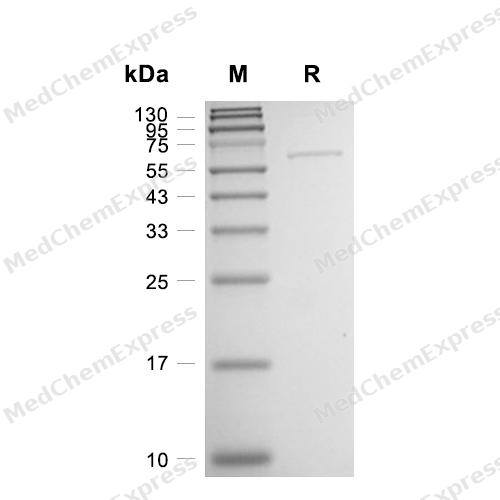
Purity - SDS-PAGE


Technical Parameters
-
Species Human
-
Source E. coli
-
Tag N-6*His
-
Accession
P04040 (A2-L527)
-
Molecular Construction
-
N-term
-
6*His
-
Catalase (A2-L527)
Accession # P04040 -
C-term
-
-
Protein Length
Full Length
-
Synonyms
CAT; Epididymis Secretory Sperm Binding Protein; Catalase
-
AA Sequence
ADSRDPASDQMQHWKEQRAAQKADVLTTGAGNPVGDKLNVITVGPRGPLLVQDVVFTDEMAHFDRERIPERVVHAKGAGAFGYFEVTHDITKYSKAKVFEHIGKKTPIAVRFSTVAGESGSADTVRDPRGFAVKFYTEDGNWDLVGNNTPIFFIRDPILFPSFIHSQKRNPQTHLKDPDMVWDFWSLRPESLHQVSFLFSDRGIPDGHRHMNGYGSHTFKLVNANGEAVYCKFHYKTDQGIKNLSVEDAARLSQEDPDYGIRDLFNAIATGKYPSWTFYIQVMTFNQAETFPFNPFDLTKVWPHKDYPLIPVGKLVLNRNPVNYFAEVEQIAFDPSNMPPGIEASPDKMLQGRLFAYPDTHRHRLGPNYLHIPVNCPYRARVANYQRDGPMCMQDNQGGAPNYYPNSFGAPEQQPSALEHSIQYSGEVRRFNTANDDNVTQVRAFYVNVLNEEQRKRLCENIAGHLKDAQIFIQKKAVKNFTEVHPDYGSHIQALLDKYNAEKPKNAIHTFVQSGSHLAAREKANL
-
Predicted Molecular Mass
59.6 kDa
-
Molecular Weight
Approximately 61 kDa, based on SDS-PAGE under reducing conditions.
-
Purity
≥ 95%, as determined by reducing SDS-PAGE.


Product Properties
Lyophilized powder.
<1 EU/μg, determined by LAL method.
It is not recommended to reconstitute to a concentration less than 100 μg/mL in ddH2O.
Stored at -20°C for 2 years from date of receipt. After reconstitution, it is stable at 4°C for 1 week or -20°C for longer (with carrier protein). It is recommended to freeze aliquots at -20°C or -80°C for extended storage.
Room temperature in continental US; may vary elsewhere.


Documentation
-
Data Sheet (238 KB)
-
SDS (251 KB)
- English - EN (251 KB)
- Français - FR (251 KB)
- Deutsch - DE (251 KB)
- Norwegian - NO (251 KB)
- Español - ES (251 KB)
- Swedish - SV (251 KB)
- Italian - IT (251 KB)
- Korean - KR (251 KB)
- Portuguese - PT (251 KB)
-
Handling Instructions (2659 KB)

Calculators
Concentration (start) × Volume (start) = Concentration (final) × Volume (final)


 Powered by Bioz

